
This article may contain affiliate links. We may earn a commission at no additional cost to you; this does not determine our editorial conclusions.
You spend hours researching a topic, write a comprehensive article, add useful examples, optimize the page, and publish something you genuinely believe is better than what already ranks.
Then Google puts a shorter, older, seemingly less useful competitor article above yours.
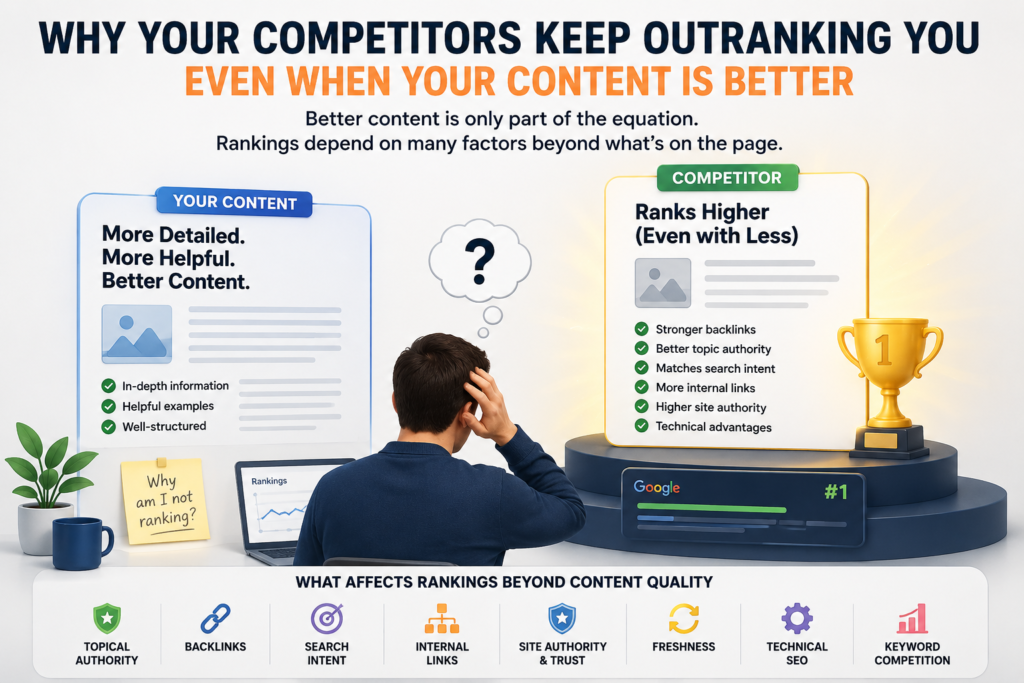
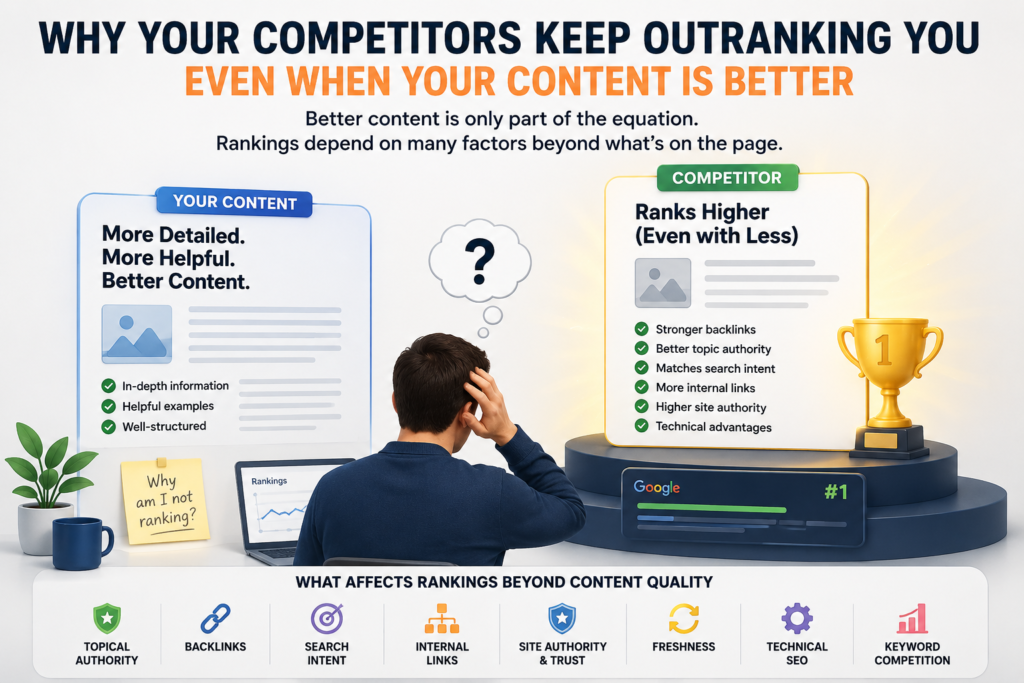
It’s one of the most frustrating situations in SEO, but it doesn’t necessarily mean Google thinks your competitor’s writing is better. Content quality is only one part of why a page ranks. Search engines consider many signals when deciding which pages are most likely to satisfy a particular search.
Your competitor may have stronger authority around the topic, more relevant backlinks, better internal links, or a page that matches search intent more precisely. Your own article could also be targeting a keyword that’s simply too competitive for your website right now.
That’s why adding another 1,000 words or rewriting the introduction isn’t always the answer.
If your competitors consistently outrank content you believe is better, you need to look beyond the words on the page. Here are the factors that may actually be holding you back—and what you can do about them.
Quick Takeaways
• Better writing alone doesn’t guarantee better rankings.
• Search intent can matter more than article length or depth.
• Backlinks, topical authority, internal links, and site-level signals can give competitors an advantage.
• Longer content isn’t automatically more helpful.
• Technical problems can prevent excellent content from reaching its ranking potential.
• Sometimes the keyword is simply too competitive for your website right now.
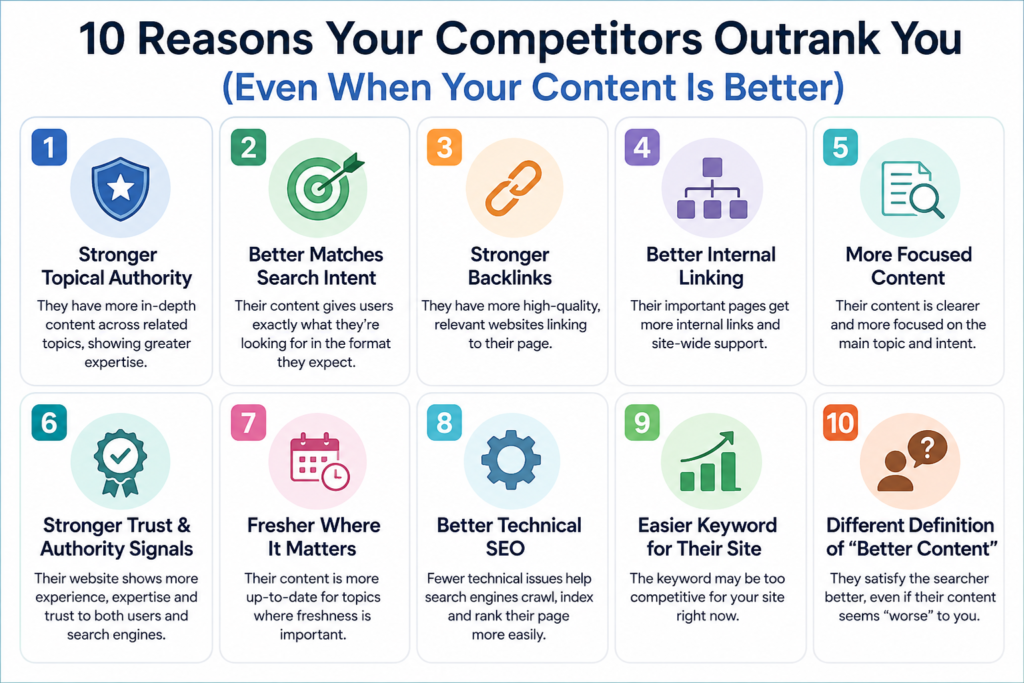
1. Your Competitor Has Stronger Topical Authority
You may have written an excellent article about a subject, but Google doesn’t evaluate that page completely in isolation.
Imagine you’ve published a detailed guide to email deliverability. Your competitor has a similar guide, but it also has dozens of established articles covering sender reputation, authentication, bounce rates, spam complaints, email verification, SPF, DKIM, DMARC, and related subjects.
Even if your individual article appears stronger, the competitor has built a much deeper body of content around the broader topic.
That context can matter.
Google’s systems look for signals that help determine whether content demonstrates expertise and whether a source is trustworthy for a particular subject. Google’s own explanation of how Search works notes that its systems consider factors including the relevance and usability of pages as well as the expertise of sources.
This is why publishing isolated articles around unrelated high-volume keywords can make SEO harder. A website with consistent depth around a subject may be better positioned than one with a single exceptional article surrounded by unrelated content.
The solution isn’t to publish dozens of thin articles just to make your site look comprehensive. Instead, identify the subjects that genuinely matter to your audience and build meaningful coverage around them.
Related articles should answer different questions, satisfy different search intents, and connect naturally through internal links. Over time, this creates a much clearer picture of what your website actually specializes in.
This is the same principle behind building topical authority with content marketing: depth comes from useful coverage of connected subjects, not simply publishing more pages.
2. Their Content Matches Search Intent More Precisely
One of the easiest traps to fall into is assuming that the most comprehensive article deserves the highest position.
It doesn’t always.
Suppose someone searches for “best email marketing software for small business.”
You create a 4,000-word guide explaining how email marketing works, how automation functions, how to build a subscriber list, and what businesses should look for in a platform. It’s detailed, accurate, and genuinely useful.
Your competitor publishes a much shorter article that immediately compares five platforms, explains pricing, highlights strengths and weaknesses, and recommends which businesses should choose each one.
For that particular search, the competitor may have created the better result.
The searcher wasn’t asking for everything there is to know about email marketing. They wanted help choosing software.
This distinction is at the heart of search intent versus keywords. Targeting the right phrase isn’t enough if the page doesn’t provide the type of answer users expect.
Before deciding that a competitor’s content is objectively worse, search the target keyword yourself and examine the pages currently performing well.
Look for patterns:
• Are most results guides, comparisons, product pages, or listicles?
• How quickly do they answer the main question?
• Are the results aimed at beginners or experienced readers?
• Do users appear to want a quick answer or an in-depth explanation?
• Are videos, images, tables, or other formats prominent?
You don’t need to reproduce the competing pages. You need to understand why that format is satisfying the search.
Sometimes improving your ranking isn’t about adding more information. It’s about removing distractions and making the answer users actually want easier to find.
3. Your Competitor Has Better Backlinks
This is where the difference between better content and stronger SEO signals becomes particularly noticeable.
You could publish the clearest article in your industry, but a competitor may have hundreds of relevant websites linking to its page while yours has very few.
Links remain part of Google’s ranking systems. Google describes PageRank as one of its core ranking systems and explains that it uses links to understand what pages are about and which pages may be helpful in response to a query.
Not all backlinks are equal, however.
Ten relevant links from respected industry websites may be far more meaningful than hundreds of low-quality links created purely for SEO. The context of the link, the source website, and how naturally the reference was earned all matter.
Competitors often develop backlink advantages because their pages have existed longer. A guide published five years ago may have accumulated links from articles, newsletters, industry resources, and other websites over time.
Your newer article could be more accurate and useful today but hasn’t had the same opportunity to build those signals.
Instead of immediately rewriting the content, investigate the backlink difference.
Look at which competitor pages attract links and ask why people reference them. Often, the most linkable content isn’t simply another long blog post. It may contain original research, statistics, templates, calculators, charts, definitions, or genuinely useful resources that other writers want to cite.
The lesson isn’t to copy those assets. It’s to create something worth referencing in your own right.
4. Their Internal Linking Is Giving the Page More Support
Backlinks get most of the attention in SEO discussions, but links from your own website can also influence how easily search engines discover and understand important pages.
Consider two otherwise similar articles.
The first is linked naturally from several established pages across the website. It’s part of a clear topic cluster and can be reached through logical navigation.
The second was published six months ago and has almost no internal links pointing toward it.
Even if the second article contains better information, you’ve made it harder for both users and search engines to understand how important that page is within your site.
Internal links provide context. They connect related subjects, help visitors discover additional information, and give search engines clearer pathways through your content.
This doesn’t mean adding twenty keyword-rich links to every page.
Instead, when publishing or updating an article, look for established pages where mentioning the new resource genuinely helps the reader. Likewise, link outward from the new article to supporting pages that provide additional depth.
A strong content library should feel connected rather than like hundreds of individual articles that happen to live on the same domain.
And when an important article continues to struggle despite being genuinely useful, reviewing its internal links should be part of the wider process of finding underperforming content and improving it without starting over.
Sometimes the page doesn’t need another rewrite. It simply needs stronger support from the rest of your website.
5. Your Content Is More Comprehensive, but Less Focused
There’s a common assumption in SEO that more information automatically creates better content.
If the top-ranking competitor has 1,500 words, you write 2,500. If they answer five questions, you answer ten. If they explain three strategies, you explain eight.
Eventually, the article becomes enormous.
The problem is that comprehensive and helpful aren’t always the same thing.
Someone searching for a relatively simple answer may not want to navigate through thousands of words before finding it. Additional sections can also dilute the main purpose of the page if they drift into subjects that would be better addressed elsewhere.
Consider someone searching for “how to write a meta description.” They probably need a concise explanation, recommended length, practical guidance, and a few examples. Adding extensive sections about keyword research, technical SEO, backlinks, site architecture, and content marketing doesn’t necessarily make that page more useful.
Sometimes your competitor is outranking you because its article is simply more focused.
Review your struggling page and ask whether every major section genuinely helps satisfy the primary search intent. If removing a section would make the answer clearer without leaving an important question unanswered, that section may belong somewhere else.
The objective shouldn’t be to create the longest article in the search results. It should be to create the page that most efficiently gives the reader what they came for.
6. Your Competitor Has Stronger Trust and Authority Signals
Sometimes two pages are both excellent, but they’re published by websites with very different histories.
A well-established industry publication may have years of relevant content, mentions from reputable websites, recognized authors, and an established reputation within its niche. A newer website publishing its first few articles on the same subject doesn’t yet have those advantages.
That doesn’t mean newer or smaller websites can’t outrank established competitors. It means page-level quality isn’t the only signal available to search engines.
Google’s guidance around E-E-A-T—experience, expertise, authoritativeness, and trustworthiness—is useful here. Google describes trust as the most important element of the framework, while also explaining that E-E-A-T itself isn’t a single ranking factor. Google’s guidance on creating helpful, reliable, people-first content
For publishers, the practical lesson is to make it easy for readers to understand why they should trust what they’re reading.
That can include clearly identifying authors, demonstrating relevant experience where appropriate, citing reliable sources for factual claims, keeping information current, maintaining accurate About and contact information, and avoiding unsupported claims simply to make an article sound more authoritative.
Originality matters too.
If your article simply summarizes what the ten highest-ranking competitors already say, technically polished writing may not provide much reason for your page to replace them.
Original examples, firsthand observations, proprietary research, useful comparisons, screenshots, data, and genuinely different insights can give the content a reason to exist beyond being another version of what’s already available.
7. Their Content Is Fresher Where Freshness Actually Matters
Seeing an older competitor outrank your newly published article can make freshness seem irrelevant. In other searches, however, recently updated information can be essential.
The difference is the query.
Someone searching “what is content marketing?” doesn’t necessarily need an article updated yesterday. The fundamental concept hasn’t suddenly changed.
Someone searching “best email marketing platforms in 2026,” “Instagram image sizes,” or “Google algorithm updates” has a much stronger reason to expect current information.
This is why simply changing the publication date every few months isn’t a meaningful content-refresh strategy.
A genuinely useful update should address something that has actually changed. That might mean replacing outdated statistics, removing discontinued products, updating screenshots, checking broken links, revising recommendations, adding new developments, or rewriting sections that no longer reflect how the topic works.
Your competitor may be outranking you because its page is more current in the places where currency affects usefulness.
But the opposite can also happen. Constantly rewriting a stable evergreen article simply to make it look fresh can introduce unnecessary changes without making the page any better.
Focus on meaningful freshness, not cosmetic freshness.
8. Technical SEO May Be Holding Your Content Back
Sometimes the content isn’t the problem at all.
You can have strong writing, good search-intent alignment, relevant internal links, and useful information while technical issues quietly limit the page’s ability to perform.
For example, a page might have:
• Accidentally been set to noindex
• Been canonicalized to another URL
• Become difficult for search engines to discover
• Developed redirect problems
• Been duplicated across several URLs
• Loaded important content in a way search engines struggle to process
• Been affected by wider crawling or indexing problems
If a page performs significantly worse than expected, particularly when it receives little or no search visibility, checking the technical basics should happen before rewriting the entire article.
Google Search Console is particularly useful here. Its URL Inspection tool can show information about Google’s indexed version of a page and help identify indexing or crawling problems. Google’s URL Inspection documentation
Search Console can also help distinguish between two very different problems.
If the page receives impressions but consistently sits around positions 15–30, Google already knows about it. Your challenge is more likely competitiveness, relevance, authority, or content quality.
If the page receives virtually no impressions and isn’t properly indexed, rewriting paragraphs isn’t likely to solve the underlying issue.
Diagnose first. Optimize second.
9. You’re Targeting a Keyword Your Website Isn’t Ready to Win
Not every keyword is realistically attainable for every website at the same moment.
Imagine launching a relatively new marketing blog and immediately targeting a broad phrase such as “SEO,” “CRM software,” or “email marketing.”
You could create an exceptional article, but you’re competing against established companies and publications with enormous content libraries, strong backlink profiles, years of search visibility, and substantial brand recognition.
The article isn’t necessarily failing because it’s bad.
You may simply have chosen a battlefield where your competitors currently have much stronger advantages.
This is where keyword research should go beyond search volume.
A keyword with 20,000 monthly searches may look exciting, but a more specific phrase with substantially lower volume could produce better results if your website has a realistic opportunity to rank for it.
For example, instead of immediately targeting:
“CRM software”
a smaller site might begin with something more specific:
“CRM software for independent consultants”
or:
“simple CRM for small sales teams.”
These searches may have smaller audiences, but they also allow you to create content tailored much more precisely to the searcher’s needs.
As your website earns links, develops topical depth, and establishes stronger visibility, you can gradually pursue more competitive terms.
SEO isn’t only about finding the biggest keywords. It’s about identifying the best opportunities for your website at its current stage.
10. Your Definition of “Better Content” May Be the Problem
This may be the most important point in the entire article.
When marketers say their content is better than a competitor’s, they’re often judging it using metrics that are easy to see:
Our article is longer.
Our design looks better.
We have more screenshots.
We included more statistics.
We used more headings.
Those things can improve an article, but none automatically makes it the better search result.
A 3,000-word article isn’t better than a 1,200-word article if the shorter page answers the question more clearly. Twenty screenshots aren’t useful if readers only need two. More statistics don’t help if they’re unrelated to the decision the searcher is trying to make.
A better question is:
Which page does the best job of helping this particular searcher accomplish what they came to do?
That shifts the evaluation away from word counts and SEO checklists and toward usefulness.
Compare your page against the ranking competitors again, but this time look at it from the searcher’s perspective. Examine how quickly each page answers the main question, how easy the information is to navigate, whether examples actually clarify difficult concepts, and whether anything important is missing.
You may discover that your competitor isn’t outranking you despite having worse content.
It may be outranking you because, for that particular search, its content is doing one important thing better.
What to Do When a Competitor Outranks Your Content
That’s not always the best move.
Before changing anything, identify why the competing page may have an advantage. Otherwise, you could spend hours improving something that wasn’t causing the problem in the first place.
Start with the search results themselves. Search your primary keyword and compare the dominant page types with your own. If Google predominantly shows comparison pages and you’ve published an educational guide, search intent may be the issue.
Next, compare the broader SEO signals surrounding the pages. Look at backlinks, internal links, topical coverage, freshness, and the overall strength of the competing websites.
Then check Google Search Console.
If your page receives plenty of impressions but sits just outside the first page, you may have a realistic optimization opportunity. If impressions are growing but clicks remain low, your title, search position, or alignment with the query may deserve closer attention.
Technical problems should also be ruled out before making major content changes.
Only after you’ve identified the likely weakness should you decide whether the article needs to be expanded, shortened, restructured, updated, better linked internally, supported by additional content, or left alone while you work on building authority elsewhere.
The goal isn’t to change everything.
It’s to identify the one or two factors most likely preventing the page from competing effectively.
Frequently Asked Questions
Why does worse content sometimes rank higher on Google?
A page can outrank seemingly better content because rankings aren’t based on writing quality alone. Search intent, backlinks, topical authority, internal linking, relevance, website authority, technical accessibility, and other signals can all influence which results appear.
Can a new article outrank an older competitor?
Yes. Older pages may have advantages such as established backlinks and a longer history in search results, but newer content can still compete when it better satisfies search intent, provides genuinely useful information, and has sufficient supporting authority.
Should I make my article longer than the competitor’s?
Not simply for SEO. Article length should reflect what is required to answer the searcher’s question properly. Adding unnecessary sections to exceed a competitor’s word count can make an article less focused rather than more useful.
How do I know if backlinks are why a competitor outranks me?
Compare the backlink profiles of the individual pages as well as the broader domains. A substantial difference in relevant, authoritative referring domains may help explain the ranking gap, particularly for competitive searches. However, backlinks should be considered alongside intent, content quality, internal linking, and other factors.
How long should I wait before deciding an article isn’t ranking?
There isn’t a universal waiting period. New pages can take time to be discovered, indexed, and establish visibility, particularly on newer websites. Instead of judging performance solely by age, use Search Console to see whether the page is indexed, receiving impressions, and beginning to appear for relevant queries.
Should I update content every time a competitor outranks me?
No. Rankings naturally fluctuate, and constantly rewriting content can create unnecessary work. Update a page when you identify a meaningful weakness, outdated information, changing search intent, missing information, or another clear opportunity to improve usefulness.
Can internal links really help a page rank?
Internal links help search engines discover pages, understand relationships between content, and recognize how pages fit within the broader structure of a website. They also help readers move naturally between related resources. Important pages shouldn’t be left isolated from the rest of your content.
What should I improve first if my content isn’t ranking?
Start with diagnosis rather than rewriting. Confirm that the page is indexed, examine search intent, review its current queries and positions in Search Console, and compare the page with ranking competitors. Once you understand the likely cause, you can prioritize the change most likely to matter.
Final Thoughts
Seeing a competitor outrank an article you’ve spent hours creating can make it tempting to conclude that Google simply prefers bigger websites or that your content isn’t good enough.
Usually, the explanation is more complicated.
Your article may genuinely be more detailed or better written while the competing page has stronger backlinks, clearer topical support, better internal linking, greater authority, or a closer match to what people searching that particular query want.
That’s why improving SEO shouldn’t become an endless cycle of making articles longer.
Look at the entire picture.
Understand the search intent. Examine the competing pages. Review backlinks and internal links. Check whether your website has enough supporting coverage around the subject. Rule out technical problems. And be realistic about the competitiveness of the keyword you’re pursuing.
Most importantly, evaluate your content from the reader’s perspective rather than your own.
The objective isn’t to create an article that’s better than your competitor’s on paper. It’s to create the most useful result for the person performing the search.
When you approach rankings that way, competitor analysis becomes much more productive. Instead of asking “Why is Google choosing them over me?”, you can start identifying the specific advantages they have—and decide which ones are actually worth improving.

We research and organize marketing software around practical use cases. Product claims are included only when supported by available sources.
Read our editorial policy →Related guides

Black Friday Tracking Blind Spots: How Cookie Consent Affects Marketing Data and Attribution
Black Friday tracking blind spots can make campaign performance harder to interpret at exactly the time marketers need reliable data most. Ecommerce brands may see orders and leads increasing while analytics, advertising platforms, and other marketing systems provide an incomplete picture of which campaigns actually influenced those conversions. That doesn’t necessarily mean something is broken. […]
Meta Box vs ACF: Which WordPress Custom Fields Plugin Is Better in 2026?
Meta Box vs ACF is a common comparison when a WordPress website starts needing more flexibility than the standard post and page editor provides. Both plugins let you create custom fields, organize structured information, and build more dynamic WordPress websites without forcing everything into the main content editor. The differences become more important as the […]
Kinsta vs WP Engine: Which Managed WordPress Hosting Is Better in 2026?
Kinsta vs WP Engine is a comparison you’re likely to come across when looking for managed WordPress hosting. Both take care of much of the technical work that comes with running WordPress, including performance optimization, security, backups, updates and staging environments. The difference is less about whether either platform can host a WordPress site and […]