
This article may contain affiliate links. We may earn a commission at no additional cost to you; this does not determine our editorial conclusions.
Many websites invest significant time researching keywords, optimizing headings, and publishing new content, yet they still struggle to achieve consistent rankings. It’s easy to assume the problem is choosing the wrong keyword, but that’s often only part of the story.
Today, search engines do much more than match words on a page. They try to understand why someone performed a search and whether the content genuinely satisfies that need. This is where many SEO strategies fall short. A page may target the perfect keyword but fail to answer the question the searcher actually wants answered.
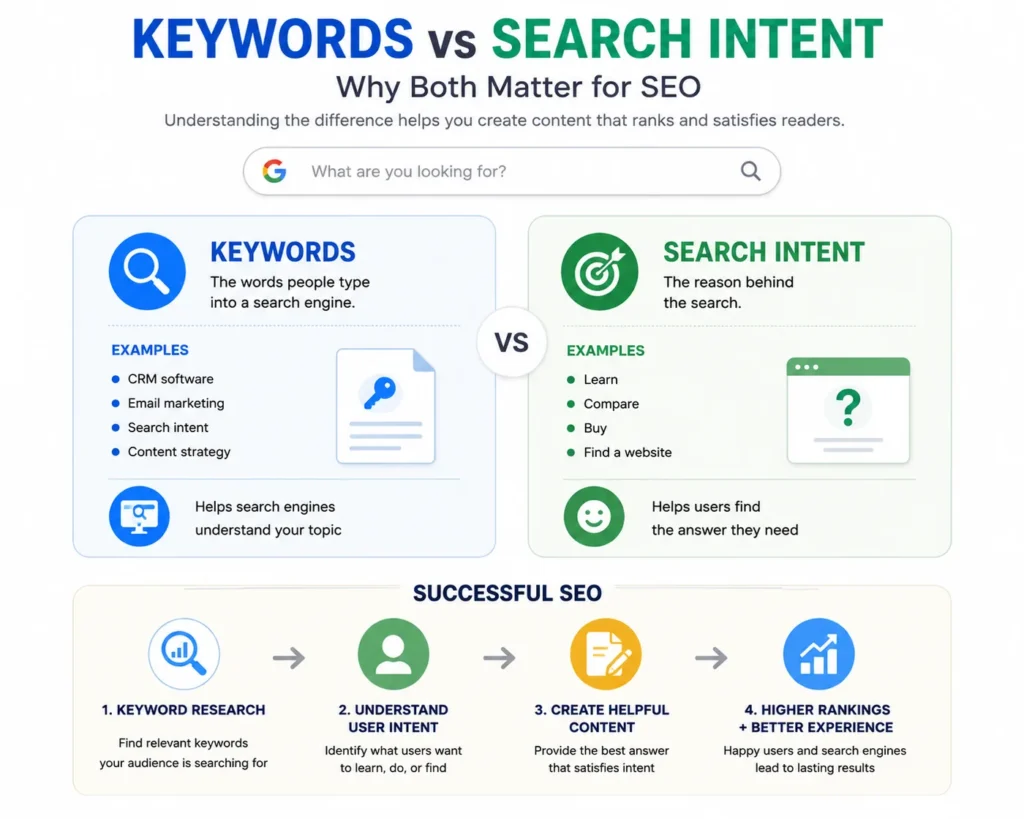
This is the difference between keywords and search intent. Keywords tell search engines what your content is about, while search intent helps determine whether your content is the right result for a particular search.
Understanding how these two concepts work together allows you to create content that attracts the right audience, ranks more consistently, and provides a better experience for readers. In this guide, we’ll explain the difference between keywords and search intent, why both matter, and how to use them together to create content that performs better in search.
Quick Takeaways
• Keywords identify the topic people are searching for.
• Search intent explains what users expect to find.
• High search volume doesn’t guarantee high rankings.
• Matching search intent often improves both rankings and conversions.
• Successful SEO combines keyword research with understanding user intent.
Search Intent vs Keywords: What’s the Difference?
Although they’re closely related, keywords and search intent are not the same thing.
A keyword is the word or phrase someone types into a search engine. For example, “CRM software,” “email marketing tips,” or “content strategy” are all keywords.
Search intent, on the other hand, explains the reason behind that search. Someone searching for “CRM software” might want a list of the best platforms, pricing information, customer reviews, or a free CRM to try. While the keyword remains the same, the information they’re hoping to find can vary depending on where they are in their decision-making process.
Google has become increasingly effective at recognising these differences. Rather than simply matching keywords, it analyses user behaviour and consistently promotes pages that satisfy the intent behind a search.
Google’s guidance on creating helpful, reliable, people-first content reflects this approach by encouraging publishers to focus on solving users’ problems rather than creating pages designed primarily for search engines.
1. Stop Choosing Keywords Before Understanding Intent
Many businesses begin their content planning by exporting a list of keywords from an SEO tool and sorting them by search volume. While this can uncover valuable opportunities, search volume alone doesn’t explain why people are performing those searches.
Consider these two keywords:
• Best project management software
• What is project management software?
At first glance, they appear closely related, but the people searching for them have very different goals. Someone searching for the first keyword is usually comparing solutions before making a purchase, while someone searching for the second is looking for a beginner-friendly explanation.
Treating both keywords the same often leads to disappointing results. Even if your article is well written and properly optimized, it may struggle to rank because it doesn’t match what readers expect to find.
A better approach is to understand the purpose behind the search before planning your content. Search your target keyword, review the pages already ranking, and look for patterns. Are users looking for educational content, comparisons, reviews, pricing, or something else entirely? Once you understand that goal, you can create content that answers the right question instead of simply targeting the right keyword.
2. A Keyword Doesn’t Always Mean One Thing
It’s easy to assume every keyword has one clear meaning, but many search terms can represent several different needs depending on who’s searching.
Take the keyword “CRM” as an example. One person may want a definition, another may be researching software, while someone else may be looking for pricing, implementation advice, or product comparisons. Although they’re using the same keyword, they’re expecting very different answers.
Trying to satisfy every possible interpretation in a single article often creates content that’s too broad to be genuinely useful. Readers leave without finding exactly what they need, and search engines may struggle to determine which audience your page is intended for.
Instead of guessing, search the keyword yourself and study the first page of results. Pay attention to:
• The types of pages ranking.
• The questions being answered.
• Whether the content targets beginners or experienced users.
• How much detail successful articles provide.
These patterns reveal how Google currently interprets the keyword and what users are most likely expecting to find. Rather than forcing your own assumptions, let the search results help shape your content.
3. Search Intent Influences the Best Content Format
Choosing the right topic is only part of the process. You also need to present the information in the format readers expect.
Someone searching for “best email marketing software” is usually looking for a comparison article or buyer’s guide. Publishing a beginner’s guide explaining what email marketing is probably won’t satisfy that audience. Likewise, someone searching for “how to improve SEO” is far more likely to expect a practical tutorial than a sales page.
This is why two articles targeting similar keywords can perform very differently. One matches the user’s expectations, while the other doesn’t.
Before outlining your content, spend a few minutes reviewing Google’s first page. Look for patterns such as:
• Are how-to guides dominating the results?
• Do comparison articles appear most often?
• Are review sites ranking well?
• Are videos featured prominently?
• Are product or service pages being prioritised?
The goal isn’t to copy what’s already ranking. It’s to understand what readers expect, then create something even more useful by providing clearer explanations, practical examples, and deeper insights. This approach gives your content a much stronger chance of satisfying both users and search engines.
4. Keywords Help Search Engines Find Your Content, Intent Helps It Rank
Many people think keywords are the most important part of SEO because they’re the words users type into Google. While keywords are still essential, they only help search engines understand the topic of your content. They don’t automatically make your page the best answer.
Imagine two websites targeting the keyword “content marketing strategy.” Both include the keyword in the title, headings, and body copy. One article explains the concept in general terms, while the other provides a step-by-step framework, practical examples, common mistakes to avoid, and answers to related questions.
Although both pages target the same keyword, the second article is much more likely to satisfy search intent. Search engines increasingly reward content that solves the reader’s problem rather than simply matching the search phrase.
When planning your content, think beyond where to place your keywords. Ask yourself whether someone who lands on your page will leave feeling that their question has been completely answered. That’s ultimately what search engines are trying to measure.
5. Matching Search Intent Improves More Than Rankings
It’s easy to measure rankings because they’re visible, but rankings alone don’t determine whether your content is successful.
Imagine someone searching for “best CRM for small businesses.” If they click on your article and immediately find a detailed comparison with pricing, features, and recommendations, they’re more likely to continue reading and eventually take action. If they land on a general article explaining what CRM software is, they’ll probably return to the search results within seconds.
Creating content that consistently meets user expectations starts with a well-defined content strategy. Rather than publishing isolated articles, successful businesses plan content around related topics that support one another and guide readers through their journey.
Creating content that matches search intent often leads to:
• Higher click-through rates.
• Longer engagement.
• Lower bounce rates.
• Better conversion opportunities.
Rather than focusing only on attracting visitors, focus on satisfying the reason they searched in the first place. When readers quickly find what they’re looking for, positive engagement often follows naturally.
6. Why Keyword Stuffing Doesn’t Work Anymore
There was a time when repeating the same keyword throughout a page was considered an effective SEO strategy. Some articles included the target phrase in nearly every heading and paragraph, hoping search engines would view them as more relevant.
Modern search engines have become far more sophisticated.
Instead of counting how often a keyword appears, they evaluate the overall quality of the content, how well it answers the user’s question, and whether readers appear satisfied with the result. Repeating the same phrase unnecessarily can actually make content harder to read without providing any additional SEO benefit.
A better approach is to write naturally while covering the topic thoroughly. Use your primary keyword where it makes sense, include related terms where appropriate, and focus on explaining concepts clearly rather than trying to reach a specific keyword density.
When your content genuinely addresses the topic in depth, relevant keywords usually appear naturally without forcing them into every paragraph.
7. Use Keywords Naturally Within Helpful Content
Some writers become so focused on avoiding keyword stuffing that they hardly use their target keyword at all. Others go to the opposite extreme, repeating it so frequently that the content feels unnatural.
Neither approach creates the best experience for readers.
Think of keywords as signposts that help search engines understand your topic. They should appear naturally in places such as the page title, headings, introduction, and body copy, but only where they genuinely fit the flow of the article.
The strongest content is written for people first. It explains concepts clearly, answers related questions, and uses natural language that readers would expect. Search engines have become increasingly effective at understanding context, synonyms, and related concepts, making it unnecessary to repeat the exact same phrase over and over.
When you focus on helping readers rather than trying to satisfy an algorithm, keyword usage usually takes care of itself.
8. Don’t Ignore the Search Results Before You Write
One of the simplest ways to understand search intent is to study the pages already ranking for your target keyword.
Some writers avoid doing this because they’re concerned about copying competitors. Others only look at article titles before creating their own outline. Both approaches miss valuable information.
The first page of Google reveals what searchers are consistently responding to. It shows the types of content users prefer, the level of detail they’re expecting, and the questions that successful pages are answering.
Before you begin writing, spend a few minutes reviewing the search results and look for patterns.
Pay attention to things such as:
• The type of content ranking on the first page.
• The depth of information being provided.
• The questions successful articles answer.
• Whether comparison tables, examples, videos, or FAQs appear frequently.
• The overall structure of the highest-ranking pages.
This doesn’t mean you should copy competing articles. Instead, use them to understand what readers expect, then look for opportunities to provide clearer explanations, more practical examples, or additional insights that improve the overall experience. Once you’ve identified what users are looking for, the next step is presenting that information in a way that’s easy to read and genuinely helpful. Applying proven blog writing best practices can make your content more engaging while improving its chances of ranking.
9. Search Intent Can Change Over Time
One of the biggest SEO mistakes is assuming that search intent stays the same forever.
As industries evolve, new products launch, and user behaviour changes, Google often adjusts the types of pages it ranks for the same keyword. An article that performed well a year ago may gradually lose visibility because it no longer matches what users expect today.
For example, a keyword that once returned educational blog posts may now be dominated by comparison articles, videos, or product pages. If your content never changes, it can slowly become less relevant even if the information is still accurate.
This is why successful websites regularly review their most important content instead of treating published articles as finished projects.
Refreshing older articles, improving examples, updating statistics, and adjusting the structure to match current search intent can often produce better results than creating a brand-new article targeting the same keyword. Regularly reviewing existing pages also helps you identify underperforming content that may only need updates instead of being rewritten from scratch.
10. The Best SEO Strategy Combines Keywords and Search Intent
It’s sometimes presented as an either-or decision: should you focus on keywords or search intent?
In reality, the most successful content strategies use both together.
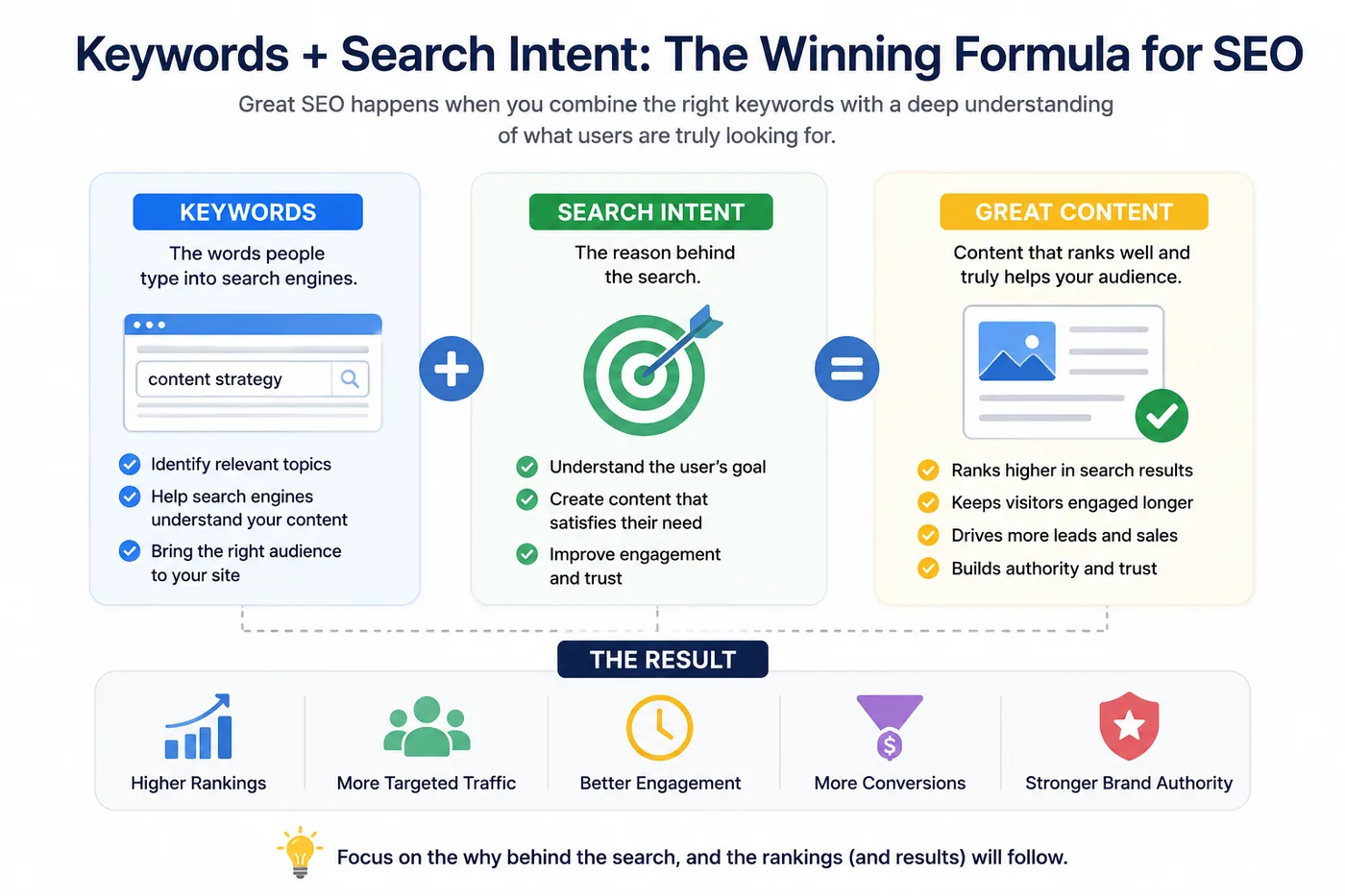
Keywords help search engines understand the topic of your content, while search intent helps determine whether your page is the best answer for the reader. Focusing on only one usually limits your results.
Imagine writing an excellent article that perfectly matches search intent but never mentions the topic people are searching for. Search engines may struggle to understand what the page is about. On the other hand, a page that repeats the target keyword dozens of times but fails to answer the reader’s question is unlikely to perform well either.
The strongest content combines thoughtful keyword research with a genuine understanding of what readers hope to achieve. Instead of asking, “How many times should I use this keyword?” ask, “Will someone finish this article feeling that they’ve found exactly what they were looking for?”
That simple shift in thinking often makes the biggest difference between content that attracts visitors and content that genuinely earns their trust.
Frequently Asked Questions
What’s the difference between keywords and search intent?
Keywords are the words or phrases people type into a search engine. Search intent explains why they’re searching. Two people can use similar keywords but expect completely different answers depending on where they are in their journey.
Which is more important: keywords or search intent?
Both are important, but they serve different purposes. Keywords help search engines understand the topic of your content, while search intent determines whether your page satisfies what users are actually looking for. The best-performing content combines both.
Can one keyword have multiple search intents?
Yes. Broad keywords often have several possible meanings. For example, someone searching for “CRM” could be looking for a definition, software recommendations, pricing information, or implementation advice. Reviewing the current search results helps identify the dominant intent before you start writing.
How do I identify search intent?
The easiest way is to search your target keyword and study the first page of Google. Look at the type of content ranking, the questions being answered, the depth of information provided, and whether the results are educational, commercial, or transactional.
Does search intent change over time?
Yes. As user behaviour changes and industries evolve, Google may begin ranking different types of content for the same keyword. Reviewing and updating important articles regularly helps ensure they continue matching current search intent.
Does matching search intent improve conversions?
Often, yes. When visitors immediately find the information they’re looking for, they’re more likely to stay on your website, explore additional pages, subscribe, or become customers. Matching search intent improves the overall user experience, which frequently leads to better business results.
Final Thoughts
Keywords remain an important part of SEO, but they no longer guarantee strong rankings on their own. Search engines have become increasingly effective at understanding the purpose behind a search and rewarding content that genuinely satisfies user expectations.
Instead of treating keyword research as the starting and ending point of your content strategy, think about what your audience is trying to accomplish. The more accurately your content answers that need, the more likely it is to earn visibility, build trust, and keep readers engaged.
The strongest SEO strategies don’t choose between keywords and search intent—they use both together. Keywords help people discover your content, while search intent ensures they find the answers they were searching for. When those two elements work together, your content is far more likely to perform well in both traditional search results and AI-powered search experiences.

We research and organize marketing software around practical use cases. Product claims are included only when supported by available sources.
Read our editorial policy →Related guides

5 Best Competitor Analysis Tools for Content Marketers in 2026
Compare 5 competitor analysis tools for content marketers to uncover keyword gaps, backlinks, top pages, and new content opportunities.
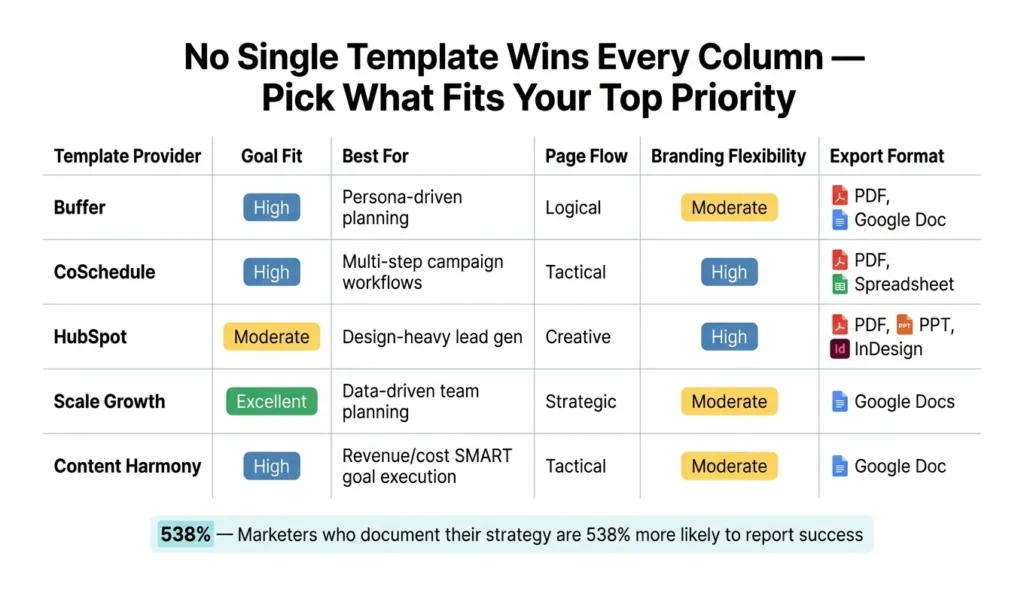
Content Marketing Strategy eBook Template Guide
The short answer: pick the eBook template based on the job it needs to do. If your goal is leads, use a short layout with clear CTA blocks. If your goal is planning, use…

Best Shopify Apps for Content Marketers in 2026 (Top Picks Compared)
Creating content for a Shopify store is easier than turning that content into traffic and sales. The best Shopify apps for content marketers help optimize blog posts for search engines, automate email marketing, showcase…