
This article may contain affiliate links. We may earn a commission at no additional cost to you; this does not determine our editorial conclusions.
Shopify vs Squarespace is a common decision for entrepreneurs and small businesses planning to sell products online. Both platforms allow you to create a professional website, manage products, accept payments, and operate an online store without building everything from scratch. However, they approach ecommerce differently, and those differences can become more important as your business grows.
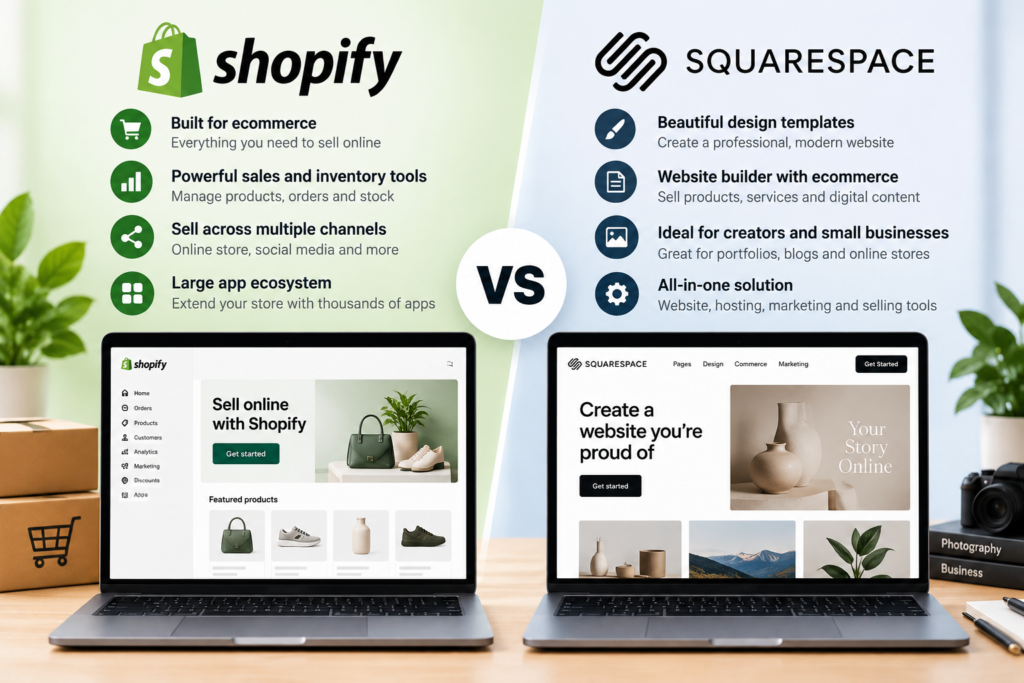
Shopify is primarily designed for selling. Its tools focus on product management, checkout, inventory, sales channels, and the day-to-day operations of an ecommerce business. Squarespace began as a website builder and places greater emphasis on design, content presentation, and creating an attractive online presence with ecommerce functionality built in.
For a small business selling a handful of products, either platform may provide everything needed. But a growing retailer managing hundreds of products, multiple sales channels, and more complicated inventory requirements will have different priorities from a photographer selling prints or a consultant offering digital products.
This Shopify vs Squarespace comparison examines pricing, ease of use, website design, ecommerce features, marketing tools, and scalability to help you decide which platform better fits your business.
Shopify vs Squarespace at a Glance
Both Shopify and Squarespace provide hosted website-building solutions, which means businesses do not need to arrange separate web hosting or maintain their own ecommerce infrastructure.
The main difference is where each platform places its emphasis. Shopify is built around managing an online retail operation, while Squarespace combines website creation, content publishing, and online selling within a design-focused environment.
| Feature | Shopify | Squarespace |
|---|---|---|
| Primary focus | Dedicated ecommerce platform | Website builder with ecommerce capabilities |
| Best suited for | Online retailers and growing ecommerce businesses | Creators, service businesses, and smaller stores |
| Free trial | Available | Available |
| Website templates | Ecommerce-focused themes | Design-focused templates |
| Physical products | Yes | Yes |
| Digital products | Yes, with suitable apps or tools | Yes |
| Inventory management | Extensive built-in ecommerce tools | Suitable for many smaller stores |
| In-person selling | Shopify POS | Available through supported payment and POS integrations |
| Multichannel selling | Broad range of sales channel integrations | More limited options |
| App ecosystem | Extensive Shopify App Store | Extensions and third-party integrations |
| Blogging and content | Available | Strong emphasis on website content and presentation |
| Scalability | Particularly suited to growing retail operations | Well suited to content-led and simpler ecommerce businesses |
The comparison is not simply about which platform has more features. A business selling handmade products through a visually appealing website may have little need for advanced retail operations. Meanwhile, a retailer handling large inventories and frequent orders may benefit from tools designed specifically for ecommerce.
For businesses planning their first online store, the better starting point is understanding how customers will discover products, place orders, and receive support. Those practical requirements should guide the platform decision rather than the appearance of a template alone.
Shopify vs Squarespace: Ease of Use and Website Design
A website builder should make it easier to launch and maintain an online store, not create additional work every time you need to update a product or change a page. Shopify and Squarespace both provide visual editing tools, but their workflows reflect their different priorities.
For business owners without technical experience, the difference is most noticeable during setup and everyday website management.
Building a Store With Shopify
Shopify guides users through the process of setting up an online store, including adding products, organizing collections, configuring payments, and managing shipping settings.
Its dashboard is organized around ecommerce operations. Product listings, orders, customers, inventory, and sales information are accessible from a central location, making it easier to manage the business as orders begin coming in.
For example, imagine a small clothing business preparing to launch its first online store. The owner needs to upload product photographs, create size and color variants, organize items into collections, and configure delivery options.
Shopify provides a structured workflow for handling these tasks. The owner can choose a theme, customize the storefront, and manage products without needing to build a separate system for inventory or checkout.
Shopify also offers a collection of free and paid themes designed specifically for ecommerce. These themes generally prioritize product discovery, shopping navigation, and the purchasing experience.
The trade-off is that more extensive visual customization may require additional apps, theme modifications, or developer assistance, depending on the design.
Building a Website With Squarespace
Squarespace approaches website creation from a design-first perspective.
Its visual editor allows users to arrange sections, customize layouts, add images, and create polished pages without writing code. This makes it particularly appealing to photographers, designers, consultants, and small businesses that want their websites to showcase their work as well as sell products.
Consider a photographer who wants to display a portfolio, publish articles about recent projects, and sell prints or digital downloads.
Squarespace can bring those activities together in a visually consistent website. The photographer can create galleries, develop service pages, publish content, and offer products without managing several separate systems.
For businesses where visual presentation is central to attracting customers, this can be a significant advantage.
However, businesses with more complex product catalogs, multiple sales channels, or specialized inventory requirements may eventually need capabilities that Shopify is more specifically designed to provide.
Which Platform Is Easier to Use?
Squarespace may feel more intuitive when the main objective is creating an attractive business website with a relatively small online store.
Shopify generally provides a more focused experience for businesses where selling products is the primary activity.
Neither approach is inherently easier for everyone. The better experience depends on whether you spend more time managing website content or handling products, orders, and customers.
Website design should also support the information customers need before purchasing. Clear product descriptions, helpful images, and well-organized pages matter just as much as the overall appearance. Businesses that develop a content marketing strategy around customer needs can make their websites more useful without adding unnecessary design elements.
Shopify vs Squarespace for Ecommerce Features and Store Management
The biggest differences between Shopify and Squarespace become clearer once a store starts receiving regular orders. Creating an attractive storefront is important, but running an ecommerce business also involves managing inventory, processing payments, organizing products, and making sure customers can complete purchases without unnecessary complications.
Both platforms handle the fundamentals of online selling. However, Shopify provides a more extensive set of ecommerce tools, while Squarespace offers a simpler approach that can work particularly well for smaller product catalogs and businesses where selling is only one part of the website.
Product Management and Inventory
Shopify is designed to manage product catalogs that can grow alongside a business. Store owners can organize products into collections, create variants such as sizes and colors, track inventory, and manage stock across supported sales channels and locations.
For example, imagine a skincare business that begins by selling five products. Within a year, it expands to thirty products, each with different sizes, bundles, and inventory requirements. The business also starts selling through social media and occasional physical events.
As operations become more complicated, Shopify’s inventory and product management tools can help the owner maintain a clearer view of stock availability and incoming orders.
Squarespace also supports physical products, variants, inventory tracking, and product organization. For a small boutique, artist, or independent brand with a manageable catalog, these capabilities may be entirely sufficient.
The difference becomes more noticeable when inventory management involves multiple locations, complex product relationships, or several connected sales channels.
Businesses should therefore consider not only how many products they currently sell but also how their product catalog and fulfillment requirements might change.
Checkout and Payment Processing
Checkout is one of the most important parts of an ecommerce website. A customer may enjoy browsing a store, but complicated payment steps, unexpected charges, or limited payment options can still prevent a purchase.
Shopify provides a checkout experience designed specifically for ecommerce transactions. Its payment and checkout tools support different payment methods, customer information collection, shipping options, and order processing workflows, depending on the store’s location and configuration.
Squarespace also provides integrated checkout and payment capabilities, allowing businesses to accept online payments and manage orders without building their own payment system.
For a business selling a small number of products, the differences may be relatively minor. Both platforms can provide a professional purchasing experience.
However, Shopify offers a broader ecosystem of checkout-related tools and integrations that may become useful when a business needs more specialized selling workflows.
Payment availability and transaction fees vary by country, provider, and subscription plan. Before choosing either platform, businesses should confirm which payment methods are supported in their operating location.
Selling Across Multiple Channels
Many ecommerce businesses no longer depend entirely on customers visiting their websites.
Products may also be promoted or sold through social media, marketplaces, physical stores, and other channels. Managing these activities separately can create additional administrative work, especially when inventory needs to remain accurate.
Shopify places considerable emphasis on multichannel commerce. Its ecosystem supports connections with various selling platforms, helping businesses manage products and orders across supported channels.
Squarespace also offers integrations and tools for selling beyond a traditional website, but its overall ecosystem is more focused on website-based commerce.
For a small business that receives most orders directly through its website, this distinction may not be especially important.
For a retailer planning to expand across multiple platforms, Shopify’s broader commerce infrastructure may provide more room to grow.
Selling Services and Digital Products
Not every business sells physical products.
Consultants, educators, designers, and other professionals may need to sell appointments, digital downloads, memberships, or online services.
Squarespace can be particularly appealing for these businesses because its website-building tools make it relatively easy to combine service information, portfolios, content, and selling features within one website. Some capabilities, such as scheduling or specialized digital products, may require separate subscriptions or additional tools.
Shopify can also support digital products, subscriptions, and service-based selling, although some workflows depend on apps or integrations.
A consultant who primarily wants a professional website with booking options may find Squarespace more closely aligned with their needs. A business selling a large catalog of digital products alongside physical merchandise may prefer Shopify’s ecommerce-focused environment.
The better choice depends on what customers are purchasing and how those purchases need to be delivered.
Shopify vs Squarespace: Marketing Tools and Business Growth
Launching an online store is only the beginning. Businesses also need ways to attract visitors, explain their products, encourage purchases, and maintain relationships with customers.
Both Shopify and Squarespace provide tools that support marketing activities, but they approach customer acquisition and growth from different directions.
Search Engine Optimization and Content Marketing
Both platforms allow businesses to manage important SEO elements such as page titles, meta descriptions, URLs, and image information.
Shopify provides SEO functionality for product pages, collections, blog posts, and other store content. Its structure is particularly useful for businesses organizing products into categories and building pages around different types of merchandise.
Squarespace also includes SEO settings and blogging capabilities, with a strong emphasis on presenting written and visual content within a consistent website design.
For a business that relies heavily on articles, portfolios, educational resources, or editorial content, Squarespace may offer an appealing publishing experience.
However, neither platform automatically guarantees strong search rankings. Product pages and articles still need to address what potential customers are actually searching for.
For example, a store selling ergonomic office chairs may attract more qualified visitors by explaining differences in lumbar support, seat adjustments, and materials rather than publishing generic descriptions filled with keywords. Understanding the difference between search intent and keywords helps businesses create pages that answer real buying questions.
Email Marketing and Customer Relationships
Email marketing can help ecommerce businesses stay connected with customers after their first visit or purchase.
Shopify offers email marketing capabilities and integrations that can support activities such as promotional campaigns, customer segmentation, and automated messages. Additional functionality may depend on the apps or services a business chooses.
Squarespace also provides email marketing tools that allow businesses to create branded campaigns and communicate with subscribers. Its approach can be attractive for smaller businesses that want their website and marketing materials to maintain a consistent visual identity.
Consider a handmade jewelry business preparing to launch a seasonal collection.
With either platform, the owner can promote new products through email and direct customers back to the online store. As the business grows, however, more advanced customer segmentation, automated campaigns, and integrations may become important.
Shopify’s larger app ecosystem can be advantageous when a business needs to connect ecommerce activity with specialized marketing software.
Squarespace may be sufficient for businesses with simpler email marketing requirements that prefer managing their website and communications through a smaller set of tools.
Discounts, Promotions, and Customer Retention
Promotions can help businesses introduce new products, encourage repeat purchases, or increase average order values.
Both Shopify and Squarespace support common promotional activities, including discount codes and sales campaigns.
Shopify provides a broader ecosystem for businesses that want more sophisticated promotions, loyalty programs, subscriptions, and customer retention workflows. Some of these capabilities require additional apps or paid services.
Squarespace supports discounts and promotional tools that can work well for smaller stores without complicated sales strategies.
For example, a bakery selling gift boxes online may only need seasonal discounts and occasional promotional emails. A growing beauty retailer might eventually want customer loyalty rewards, product bundles, subscription purchases, and personalized offers.
The second business is more likely to benefit from Shopify’s wider range of ecommerce integrations.
However, adding more marketing tools does not necessarily lead to better results. Businesses should focus on the activities that genuinely help customers discover, evaluate, and purchase products.
Scalability and Long-Term Flexibility
A platform that works well for a business today should ideally continue supporting it as its requirements change.
Shopify is particularly suited to businesses planning to expand their ecommerce operations. Its app ecosystem, sales channel integrations, inventory tools, and business-oriented plans provide options for stores that become more operationally complex.
Squarespace can also support growing businesses, especially those with straightforward ecommerce requirements. A professional services company, creative studio, or independent brand may continue using Squarespace successfully even as its audience and revenue increase.
The difference is less about how large a business becomes and more about how complicated its operations become.
A business generating substantial revenue from a small collection of digital products may not need advanced inventory systems. Meanwhile, a smaller retailer managing hundreds of product variations and multiple fulfillment locations may require specialized ecommerce capabilities much earlier.
Before committing to a platform, consider whether future growth is likely to involve more products, additional selling channels, complicated fulfillment requirements, or simply more visitors and customers.
The right platform should support those changes without forcing the business to rebuild its entire website unnecessarily.
Shopify vs Squarespace: Pricing and Overall Value
Pricing is an important part of the Shopify vs Squarespace comparison, particularly for small businesses trying to keep their operating costs manageable. Both platforms offer subscription plans, but the total cost of running a store depends on more than the monthly fee.
Payment processing, transaction fees, premium templates, third-party apps, and additional services can all affect how much a business spends over time.
Shopify Pricing
Shopify offers several plans designed for businesses at different stages of growth.
| Plan | Typical starting price (USD, annual billing) | Best suited for |
|---|---|---|
| Basic | $29/month | Individuals and new online stores |
| Grow | $79/month | Growing businesses with small teams |
| Advanced | $299/month | Businesses needing more advanced commerce tools |
| Plus | From $2,300/month on a multi-year term | Larger businesses with complex requirements |
These are reference prices rather than a confirmed October 2026 quote. Shopify’s prices, promotions, and available features may differ by country and billing arrangement.
For many small businesses, the Basic plan provides the essential tools needed to operate an online store. As the business expands, higher-tier plans offer additional staff, reporting, and operational capabilities.
However, subscription fees are only one part of the cost. Shopify stores may also use paid apps for subscriptions, product reviews, marketing automation, or specialized functionality.
A store that begins with a relatively inexpensive plan can therefore become more costly as additional tools are introduced.
Squarespace Pricing
Squarespace has historically offered website and ecommerce plans at different price points. Its newer Basic, Core, Plus, and Advanced plan structure is intended to accommodate businesses with varying website and selling requirements.
The exact prices and features should be confirmed for the business’s location before subscribing, particularly because Squarespace has changed its plan structure over time.
For a business that mainly needs a professional website with a small store, Squarespace may offer good value by combining website design, content publishing, and ecommerce features.
However, certain capabilities, such as appointment scheduling, email campaigns, or specialized digital-product functionality, may require additional subscriptions or services.
Understanding the Total Cost
Consider two small businesses with different requirements.
The first is a photographer selling prints, offering occasional workshops, and maintaining a portfolio. The business needs an attractive website, a manageable product catalog, and straightforward payment processing.
Squarespace may provide a cost-effective solution because the website’s primary purpose is presenting creative work, with ecommerce as an additional function.
The second business sells clothing online, regularly introduces new products, and plans to expand into marketplaces and physical retail.
Shopify may provide better long-term value because its ecommerce tools can support inventory management, order processing, and additional sales channels as the business grows.
Neither platform is automatically cheaper in every situation. The better value depends on which features are included, which additional services are necessary, and how much time the business spends managing its store.
Shopify vs Squarespace: Which Should You Choose?
The right platform depends on whether your business is primarily focused on selling products or building a broader online presence that includes ecommerce.
Both Shopify and Squarespace can support professional websites and online stores. The differences become more important when you consider the complexity of your products, the number of sales channels you use, and the experience you want to provide for customers.
Choose Shopify If Ecommerce Is Your Main Business
Shopify is generally the stronger choice for businesses that expect online selling to become a significant part of their operations.
Its tools are designed around managing products, processing orders, tracking inventory, and connecting with different sales channels. This makes it particularly appealing to retailers planning to expand beyond a simple storefront.
A clothing retailer, for example, may begin with a small online catalog but eventually need to manage hundreds of product variations, multiple stock locations, and orders from different channels.
Shopify’s ecommerce-focused structure can make that expansion easier to manage.
It is also worth considering if your business expects to rely on specialized ecommerce apps for subscriptions, loyalty programs, product bundles, or more advanced marketing activities.
However, these capabilities should be evaluated against the additional costs and complexity they may introduce.
Choose Squarespace If Design and Content Are Your Priorities
Squarespace is a strong option for businesses that want a visually appealing website with ecommerce functionality.
It can be particularly suitable for photographers, designers, consultants, creative studios, and independent brands that use their websites to showcase work, explain services, and sell a relatively manageable selection of products.
For example, an interior designer may need a portfolio, service descriptions, testimonials, a blog, and a small collection of downloadable design resources.
Squarespace can bring these elements together in a consistent website without requiring a complicated ecommerce setup.
Its design-oriented approach may also appeal to business owners who want greater control over the visual presentation of their pages without depending heavily on developers.
Consider Your Long-Term Business Needs
Before choosing either platform, think about what your website needs to accomplish over the next few years.
If you expect to manage a large product catalog, expand across sales channels, or develop more complicated fulfillment processes, Shopify is likely to provide greater flexibility.
If your website will primarily support a service business, portfolio, or content-driven brand with a smaller ecommerce component, Squarespace may be more than sufficient.
It is also important to consider how customers will discover your business. Publishing helpful product information and related resources can strengthen a store’s visibility over time, particularly when those resources contribute to building topical authority around a specific subject.
Ultimately, Shopify vs Squarespace is less about choosing the platform with the longest feature list and more about selecting the one that supports your actual business model.
For businesses that need a dedicated ecommerce platform, Shopify’s official plan comparison provides an overview of the available options and their included features.
Frequently Asked Questions
Is Shopify better than Squarespace for ecommerce?
Shopify is generally better suited to businesses where ecommerce is the primary activity, particularly those managing larger catalogs, multiple sales channels, or more complex retail operations.
Squarespace can be a better fit for businesses that prioritize website design, content, and a simpler online store.
Is Squarespace cheaper than Shopify?
It depends on the subscription plan, payment processing fees, and additional services required.
Squarespace may be cost-effective for smaller stores and content-focused websites, while Shopify may offer better value for businesses that need more extensive ecommerce functionality.
Comparing the total cost of ownership is more useful than comparing subscription prices alone.
Can I sell physical and digital products on both platforms?
Yes. Both platforms support selling physical and digital products, although the available features and setup requirements differ.
Shopify may require additional apps for certain digital-product workflows, while some specialized Squarespace selling features may depend on the subscription plan or additional services.
Which platform is easier for beginners?
Squarespace may be easier for beginners who want to create an attractive website with a small online store.
Shopify provides a more ecommerce-focused setup experience, which can be easier for users whose main objective is managing products and orders.
Is Shopify better for dropshipping?
Shopify is generally more suitable for businesses planning to use dropshipping because of its extensive ecosystem of supplier and fulfillment integrations.
However, businesses should evaluate suppliers carefully and consider shipping reliability, product quality, and customer service before adopting a dropshipping model.
Can I move my website from Squarespace to Shopify?
Yes, but migration may require additional work.
Product information, customer records, images, website content, and URLs may need to be transferred or recreated. The complexity depends on the size of the website and the features currently in use.
Businesses should also plan redirects where necessary to reduce disruption to existing links and search traffic.
Does Shopify or Squarespace have better SEO?
Both provide essential SEO capabilities, including editable page titles, descriptions, and URLs.
Shopify is particularly suited to ecommerce-focused website structures, while Squarespace offers a strong environment for content-led websites.
Search performance depends more on content quality, technical implementation, website structure, and user experience than on the platform alone.
Final Thoughts
The Shopify vs Squarespace comparison ultimately comes down to what role ecommerce plays in your business.
Shopify is built around selling products and managing retail operations. Its inventory tools, checkout capabilities, integrations, and broader ecommerce ecosystem make it particularly attractive to businesses that expect their online stores to become more complex over time.
Squarespace offers a different advantage. Its design-focused website builder allows businesses to combine attractive pages, portfolios, content, and online selling within a relatively straightforward environment. For creators, service providers, and smaller stores, that approach may be more practical than adopting a platform with extensive retail features they rarely use.
Neither platform is the right choice for every business. A small store with a limited product range may operate comfortably on Squarespace for years, while a retailer managing multiple sales channels may benefit from Shopify much earlier.
The best decision is to start with the products you sell, how customers purchase them, and the operational requirements you expect to face as your business grows. A good ecommerce platform should make those activities easier to manage rather than adding unnecessary complexity.

We research and organize marketing software around practical use cases. Product claims are included only when supported by available sources.
Read our editorial policy →Related guides
Parallels Desktop vs VMware Fusion: Which Is Better for Running Windows on Mac in 2026?
Parallels Desktop is best for Mac users who want seamless Windows integration and easy setup. VMware Fusion is better for those seeking free virtualization, especially developers and occasional Windows users.

Black Friday Tracking Blind Spots: How Cookie Consent Affects Marketing Data and Attribution
Black Friday tracking blind spots can make campaign performance harder to interpret at exactly the time marketers need reliable data most. Ecommerce brands may see orders and leads increasing while analytics, advertising platforms, and other marketing systems provide an incomplete picture of which campaigns actually influenced those conversions. That doesn’t necessarily mean something is broken. […]

AI Marketing Video QA: A Pre-Publish Checklist for Small Teams
Check claims, product accuracy, permissions, captions and mobile readability before publishing an AI-assisted marketing video.