
This article may contain affiliate links. We may earn a commission at no additional cost to you; this does not determine our editorial conclusions.
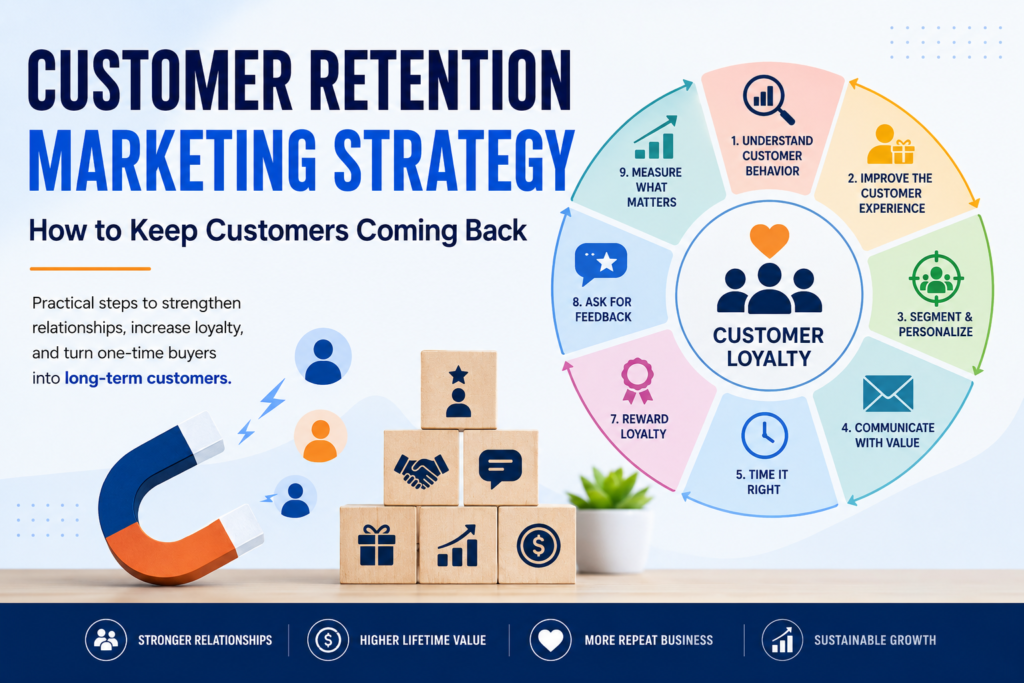
Winning a new customer is important, but the relationship shouldn’t end as soon as the first purchase is complete. If customers buy once and then disappear, the business has to keep replacing them with new customers just to maintain the same level of sales.
A customer retention marketing strategy focuses on what happens after that first conversion. The goal is to give customers good reasons to return, stay engaged with the business, and choose you again when they need the same product or service.
That doesn’t mean bombarding customers with promotional emails or offering a discount every time you want another sale. Effective retention marketing is usually much broader. It includes the customer experience, useful communication, personalization, timing, feedback, loyalty, and understanding when a previously active customer may be starting to lose interest.
This guide looks at how to put those pieces together into a practical retention strategy—without turning every customer interaction into another sales pitch.
Quick Takeaways
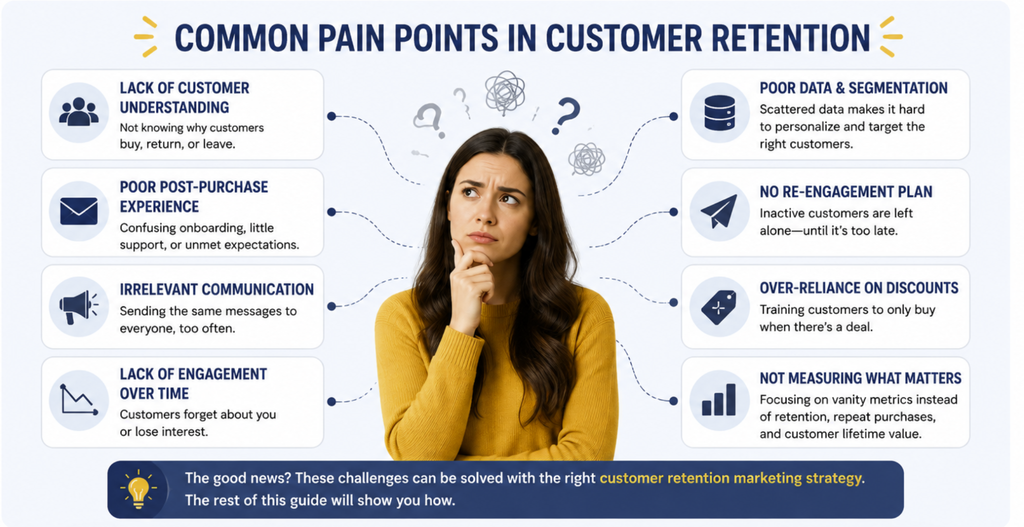
• Customer retention begins with understanding why customers return and why they leave.
• The experience immediately after a purchase can influence whether there is a second one.
• Customer segmentation makes follow-up more relevant than sending everyone the same message.
• Post-purchase emails should be useful before they become promotional.
• Staying visible doesn’t mean constantly sending offers.
• Customer behavior can help determine when follow-up is actually appropriate.
• Re-engagement works better when it starts before customers completely lose interest.
• Loyalty programs can help, but discounts aren’t the only way to reward customers.
• Customer feedback can reveal retention problems that analytics alone won’t explain.
• Repeat purchase rate, retention, and customer value matter more than simply growing a contact list.
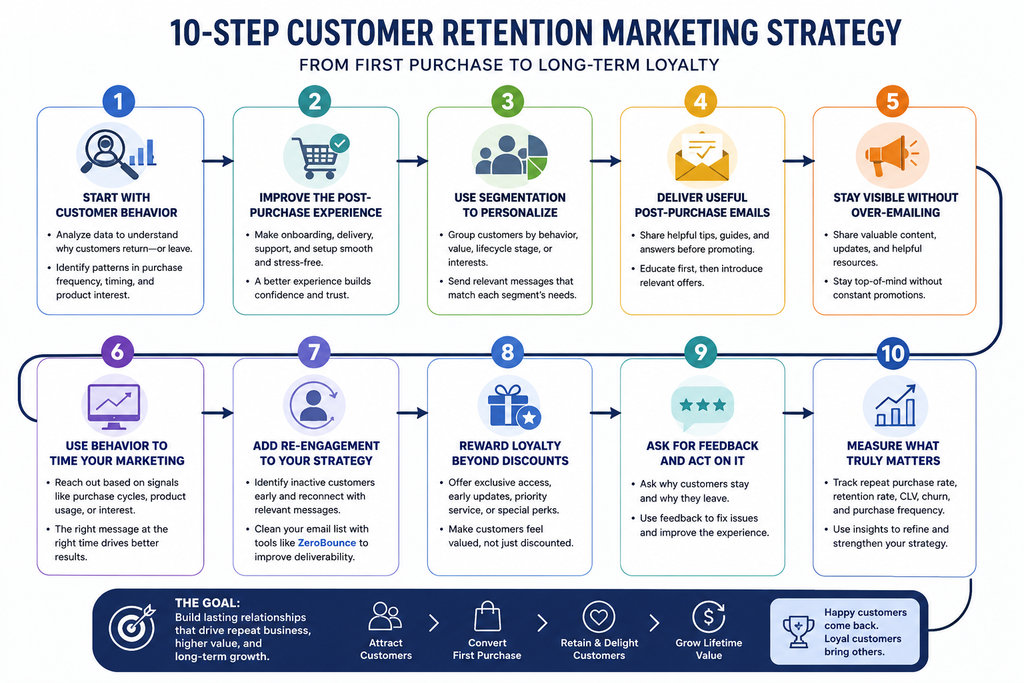
1. Start Your Customer Retention Marketing Strategy With Customer Behavior
Before creating a loyalty program or writing a series of retention emails, find out what your existing customers are already doing.
Start with a few straightforward questions. How many customers make a second purchase? How long does that normally take? Which products or services tend to lead to repeat business? Are there customers who used to buy regularly but haven’t returned recently?
The answers will differ considerably between businesses.
A coffee subscription could reasonably expect frequent repeat purchases. A company selling mattresses won’t. A software company might look at renewals and product usage, while a professional service business could be more interested in repeat projects, contract renewals, referrals, or additional services.
That context matters because retention shouldn’t be measured against an arbitrary idea of how often customers should buy.
Look for patterns in your own customer data instead. If customers who buy Product A frequently return for Product B within three months, that’s useful information. If customers regularly disappear after a particular stage of the relationship, that’s worth investigating too.
This is where having customer information organized in one place becomes useful. A CRM such as HubSpot, for example, can help businesses maintain records of customer interactions and activity rather than relying on scattered spreadsheets, inboxes, and individual employees’ memories.
The software isn’t the strategy, though. The important part is using what you know about customers to decide what happens next.
2. Improve the Experience Before Trying to Market Again
Sometimes a retention problem isn’t really a marketing problem.
A customer may have received the wrong product. Delivery may have taken too long. Getting help may have been frustrating. Instructions might have been confusing. Perhaps the product was fine, but the experience after the purchase gave them no particular reason to choose the business again.
No amount of clever email automation can fully compensate for a disappointing customer experience. Before building elaborate retention campaigns, look at what happens between the initial purchase and the point where you hope someone will return. This works best when retention is treated as part of the broader content marketing strategy, rather than as a separate campaign that only begins after a sale.
Is the confirmation clear? Does the customer know what happens next? Can they easily get help? Are there common questions that could be answered proactively? If the product requires setup or onboarding, are customers given enough information to get value from it?
Even small improvements can become part of retention marketing.
A company selling a complicated product might send a useful setup guide after purchase. A service business could check in after completing a project rather than disappearing until it wants another sale. An ecommerce store might provide useful care instructions for something the customer just bought.
These interactions aren’t particularly aggressive marketing tactics. That’s exactly why they can work.
They give the business another opportunity to be useful after it has already been paid.
3. Use Segmentation to Improve Your Customer Retention Marketing Strategy
Treating every existing customer as one audience is one of the quickest ways to make retention marketing feel irrelevant.
Someone who purchased yesterday shouldn’t necessarily receive the same message as someone who hasn’t bought anything for eighteen months. A frequent customer may deserve different communication from someone who made one small purchase several years ago.
Segmentation doesn’t need to become overly complicated.
Depending on the business, useful groups might include:
• First-time customers
• Repeat customers
• High-value or frequent customers
• Customers interested in a particular product category
• Recently active customers
• Customers approaching a renewal
• Previously active customers who haven’t purchased recently
Once those differences are visible, marketing can respond to them.
A first-time customer might benefit from help getting started. Someone approaching a renewal may need a reminder and information about their options. A customer who regularly purchases a particular category might appreciate hearing about something genuinely related to that interest.
This is also where CRM data becomes more useful than simply storing names and email addresses. Purchase history, previous conversations, interests, and customer stage can provide context for deciding which communication actually makes sense.
The goal isn’t to create dozens of tiny segments and maintain a separate campaign for each one. It’s simply to stop pretending that every customer has the same relationship with your business.
4. Make Post-Purchase Emails Useful Before Making Them Promotional
The period immediately after a purchase is an opportunity to strengthen the customer’s decision—not just an opportunity to sell something else.
Unfortunately, many post-purchase sequences quickly become:
Thanks for your order. Here’s another thing to buy.
There are better ways to stay in contact.
Think about what someone may need after buying. They might need setup instructions, usage tips, answers to common questions, information about getting support, or advice that helps them get better results from what they’ve purchased.
Only after those needs have been addressed does another offer necessarily make sense.
For example, someone buying a camera might initially benefit more from a simple setup guide than an immediate promotion for another camera. Later, accessories related to the product they already own could be genuinely relevant.
A software customer might benefit from onboarding guidance before being encouraged to upgrade.
This type of communication helps retention because it extends the value of the original purchase rather than immediately asking the customer to spend again.
It also gives you a reason to remain in the inbox without every message looking like a promotion.
That matters because email remains one of the most practical ways to maintain a direct relationship with existing customers. But that relationship only has value if people continue to want the messages you’re sending. Businesses using email for retention also need to follow applicable marketing rules, including requirements around opt-outs and unsubscribe requests covered in the FTC’s CAN-SPAM compliance guidance.
5. Stay Visible Without Constantly Asking Customers to Buy
Customer retention depends partly on staying familiar. If someone buys from you once and doesn’t hear from the business for the next year, there’s a good chance they’ll start their next purchase with another Google search rather than automatically coming back.
But staying visible doesn’t mean sending another promotion every few days.
There are plenty of reasons to contact existing customers that don’t involve a sale. The same principle behind matching content to search intent applies here: useful communication starts with what the customer needs at that particular moment rather than what the business happens to want to promote.
The right balance depends on the business. A fashion retailer may have legitimate reasons to contact customers frequently because products and collections change quickly. A professional services company may communicate far less often.
Pay attention to how customers respond. Declining engagement, increasing unsubscribes, or consistently ignored campaigns can be signs that you’re communicating too often, sending the wrong material, or simply not giving customers enough reason to pay attention.
The objective isn’t maximum contact. It’s maintaining enough of a relationship that your business isn’t starting from zero every time the customer needs something again.
6. Use Customer Behavior to Improve the Timing of Your Marketing
Timing can make the difference between a helpful message and an annoying one.
Instead of sending every customer the same campaign on the same schedule, look for behaviors that suggest when communication would actually be useful.
Imagine an online store where customers typically reorder a particular product every 60 to 90 days. A reminder around that period makes more sense than sending the same promotion two weeks after the original purchase.
The same principle applies outside ecommerce.
A software company might pay attention to renewal dates or declining product usage. A service business could follow up when a recurring service is likely to be needed again. A company selling replacement parts or consumable products might estimate when customers are likely to run out.
Behavior can also reveal interest before a purchase. An existing customer who repeatedly visits pages about another service, for example, may be more receptive to information about it than someone who has shown no interest at all.
You don’t need to track every action a customer takes. Focus on behavior that helps answer a practical question:
Is there a reason this customer might benefit from hearing from us now?
That produces much more useful retention marketing than sending messages simply because the marketing calendar says it’s Tuesday.
7. Add Re-Engagement to Your Customer Retention Marketing Strategy
Not every customer who goes quiet is gone permanently.
People stop buying for all sorts of reasons. Their priorities change. They forget about the business. They find an alternative. They no longer need the product. Or they may still be interested but simply haven’t had a reason to return.
A re-engagement campaign gives you an opportunity to find out which situation you’re dealing with.
The first message doesn’t necessarily need to contain a discount. You might remind customers about something useful, highlight what’s changed since their last purchase, recommend something based on their previous interest, or simply ask whether they still want to hear from you.
The timing matters. Waiting several years before recognizing that a previously active customer has disappeared makes re-engagement considerably harder. Define what “inactive” means based on your normal customer lifecycle and act when someone’s behavior starts to deviate from it.
Email list quality matters here as well.
Over time, email lists naturally accumulate addresses that are invalid, abandoned, mistyped, or no longer useful. Continuing to send campaigns to addresses that cannot receive them doesn’t help retention and can create deliverability problems.
An email verification service such as ZeroBounce can be useful for identifying problematic addresses when you’re cleaning an older customer list or preparing a re-engagement campaign. It shouldn’t be treated as a substitute for good permission practices or sensible list management, but verification can be one part of keeping customer data cleaner.
Re-engagement also needs an endpoint. If someone repeatedly ignores your messages for a long period, sending them indefinitely isn’t necessarily helping either side.
Sometimes good retention marketing includes knowing when to stop.
8. Reward Loyalty Without Making Everything About Discounts
Discounts can encourage repeat purchases, but they can also train customers to wait for the next promotion.
A strong customer retention marketing strategy gives people other reasons to value an ongoing relationship with the business.
That might include early access to new products, priority booking, useful members-only resources, faster support, complimentary upgrades, exclusive events, or simply recognition of customers who have been with the business for a long time.
The reward should make sense for the type of relationship you have with customers.
A restaurant might use a straightforward points program. A professional service business probably doesn’t need to give clients a digital badge for completing ten projects. It might provide priority scheduling or additional support instead.
Even simple recognition can matter. A customer who has purchased regularly for three years shouldn’t necessarily receive exactly the same communication as someone who joined yesterday.
The important question is:
What would make a good customer feel that continuing the relationship has some additional value?
Sometimes the answer is a discount. It just shouldn’t automatically be the only answer.
9. Ask Customers Why They Stay—and Why They Leave
Analytics can tell you that a customer hasn’t returned. They can’t always tell you why.
That’s where direct feedback becomes valuable.
You don’t need to send a lengthy survey after every interaction. A short question at the right moment can reveal issues that aren’t obvious from purchase data.
Ask new customers what nearly stopped them from buying. Ask repeat customers why they continue choosing you. Ask customers who cancel a subscription or service what influenced their decision.
Support conversations and reviews are useful sources of information too. If the same complaint keeps appearing, it may point to a retention problem that needs fixing rather than another marketing campaign.
Feedback becomes particularly valuable when you look for patterns instead of reacting to every individual comment. It’s similar to the way you would improve underperforming content: identify where people are struggling, understand why, and improve the weak point rather than replacing everything.
If several customers mention confusing onboarding, improve onboarding. If people consistently praise one part of the service, consider whether that strength should receive more attention in your customer communication.
Most importantly, close the loop when appropriate. If customers repeatedly ask for an improvement and you make it, tell them.
That demonstrates that asking for feedback wasn’t simply another marketing exercise.
10. Measure Whether Customers Are Actually Coming Back
A retention strategy needs a better measure of success than the size of your email list.
Depending on the business, useful metrics might include repeat purchase rate, renewal rate, churn, purchase frequency, average order value among returning customers, and customer lifetime value.
You don’t need to track every possible retention metric. Choose the ones that reflect how customers normally interact with your business. Website analytics can provide additional context as well. For example, Google Analytics distinguishes between new and returning users, which can help you understand whether people are coming back to your site over time.
For an ecommerce store, repeat purchase rate may be particularly useful. A subscription company will probably care much more about churn and renewals. A service business might track repeat projects or the percentage of existing clients purchasing additional services.
Look at these numbers over time rather than treating one month’s result as definitive.
You should also connect retention activity with actual customer behavior where possible. A re-engagement campaign with a high open rate may look successful, but the more important question is whether inactive customers returned. A loyalty program with thousands of members isn’t necessarily effective if those members don’t purchase more frequently or remain customers longer.
The purpose of measurement is ultimately straightforward: determine whether your customer retention marketing strategy is creating stronger customer relationships that translate into meaningful business results.
Acquiring customers matters. But once you’ve done the difficult work of earning someone’s business, it’s worth knowing whether you’re giving them a good reason to choose you again.
How to Put Your Customer Retention Marketing Strategy Into Practice
A retention strategy doesn’t need to begin with a complicated loyalty program or a large collection of automated campaigns. Start by looking at what happens to a customer after the first purchase.
Choose a recent group of customers and follow their journey. What communication did they receive after buying? Did they get useful information or only promotional messages? How long did it take returning customers to make another purchase? At what point did inactive customers typically disappear?
Then look for the most obvious gap.
If customers struggle after purchasing, improve the post-purchase experience first. If customers have a good experience but rarely hear from you again, work on follow-up. If you’re already communicating regularly but engagement is declining, examine your messaging, frequency, segmentation, and email list quality.
You don’t need to fix everything simultaneously. Improving one weak part of the customer experience can be more valuable than launching several new retention campaigns at once.
A simple way to approach it is:
Understand → Improve → Segment → Follow Up → Re-engage → Measure
Then repeat the process as you learn more about why customers stay, return, or leave.
Frequently Asked Questions
What is a customer retention marketing strategy?
A customer retention marketing strategy is a plan for encouraging existing customers to remain engaged with a business and continue buying over time.
It can include post-purchase communication, customer segmentation, email marketing, loyalty programs, personalized recommendations, re-engagement campaigns, customer support, and improvements to the overall customer experience.
What’s the difference between customer acquisition and customer retention?
Customer acquisition focuses on gaining new customers. Customer retention focuses on maintaining and developing relationships with people who have already purchased.
Most businesses need both. Acquisition brings new customers into the business, while retention determines how many of those relationships continue beyond the first transaction.
What are some examples of customer retention marketing?
Examples include useful post-purchase emails, renewal reminders, personalized recommendations based on previous purchases, loyalty benefits, customer education, re-engagement campaigns, and follow-ups based on when a product or service is likely to be needed again.
The best approach depends on the customer’s normal buying cycle rather than applying the same tactics to every business.
How can email marketing improve customer retention?
Email provides a direct way to stay in contact after a purchase. It can be used for onboarding, helpful product information, reminders, relevant recommendations, company updates, re-engagement, and loyalty offers.
The important part is relevance. Sending more emails doesn’t automatically improve retention. Customers need a reason to continue opening them.
Do loyalty programs improve customer retention?
They can, but a loyalty program isn’t automatically a retention strategy.
A program works best when the rewards are genuinely useful and complement an experience customers already value. If customers are leaving because of poor service, confusing processes, or an unsatisfactory product, points and discounts are unlikely to solve the underlying problem.
How do you re-engage inactive customers?
First define inactivity based on your normal customer lifecycle. Someone who hasn’t purchased for three months could be inactive for one business and completely normal for another.
Once you’ve identified customers whose behavior has genuinely changed, use a relevant reason to reconnect. That could be useful information, something new since their last purchase, a reminder based on previous interests, or an incentive where appropriate.
What metrics should you use to measure customer retention?
The most useful metrics depend on the business model, but common examples include repeat purchase rate, customer retention rate, churn rate, renewal rate, purchase frequency, and customer lifetime value.
Rather than tracking every available metric, choose the few that best show whether customers are continuing their relationship with the business.
Final Thoughts
A good customer retention marketing strategy isn’t built around finding more ways to sell to people who have already bought from you.
It starts with giving them a reason to want to come back.
That may mean making the post-purchase experience better, sending more relevant communication, recognizing loyal customers, reaching out at the right moment, or simply paying closer attention when customers tell you something isn’t working.
Tools such as CRM platforms and email verification services can make parts of the process easier, but they can’t create customer loyalty on their own. The underlying experience still matters most.
Start with what your customers are already telling you through their behavior. Improve the weakest part of the relationship, measure what changes, and build from there.
Keeping more of the customers you’ve already earned can become one of the most valuable parts of your marketing—not because you’re contacting them more often, but because you’re giving them better reasons to stay.

We research and organize marketing software around practical use cases. Product claims are included only when supported by available sources.
Read our editorial policy →Related guides

Parallels Desktop vs VMware Fusion: Which Is Better for Running Windows on Mac in 2026?
Parallels Desktop is best for Mac users who want seamless Windows integration and easy setup. VMware Fusion is better for those seeking free virtualization, especially developers and occasional Windows users.
Black Friday Tracking Blind Spots: How Cookie Consent Affects Marketing Data and Attribution
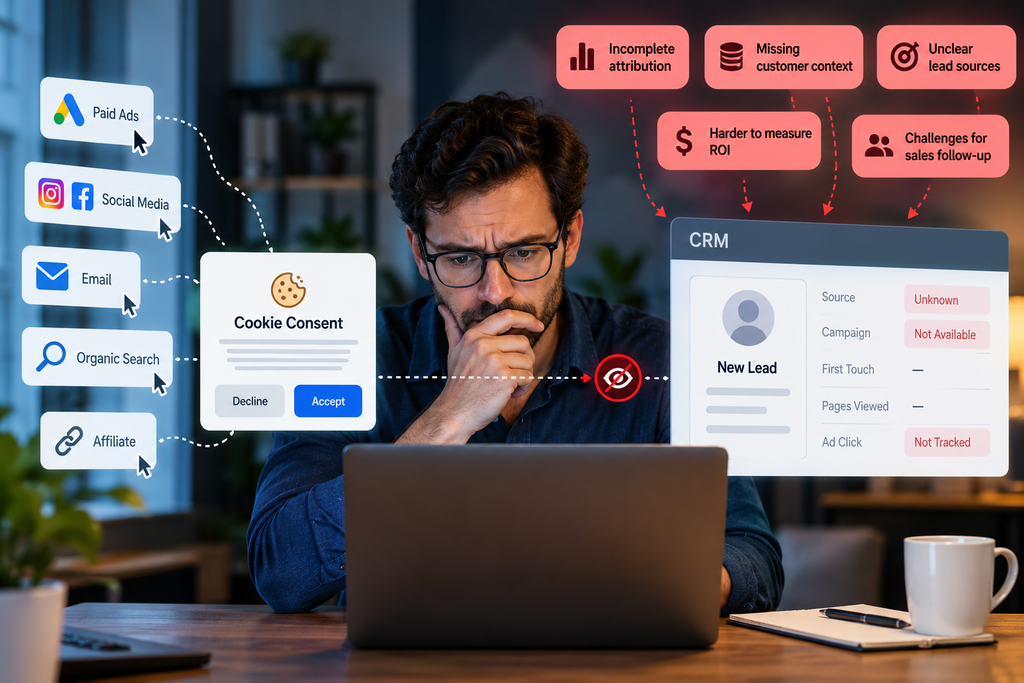
Black Friday tracking blind spots can make campaign performance harder to interpret at exactly the time marketers need reliable data most. Ecommerce brands may see orders and leads increasing while analytics, advertising platforms, and other marketing systems provide an incomplete picture of which campaigns actually influenced those conversions. That doesn’t necessarily mean something is broken. […]
AI Marketing Video QA: A Pre-Publish Checklist for Small Teams
Check claims, product accuracy, permissions, captions and mobile readability before publishing an AI-assisted marketing video.