

This article may contain affiliate links. We may earn a commission at no additional cost to you; this does not determine our editorial conclusions.
Creating content without knowing what your competitors are doing can leave valuable opportunities unnoticed. You might spend weeks targeting a topic only to discover that established competitors already dominate it, while easier keywords and unanswered questions were sitting elsewhere.
Competitor analysis tools make that research much easier. Instead of manually searching hundreds of keywords and opening dozens of competing articles, these platforms can reveal which pages bring competitors organic visibility, which keywords they rank for, where they earn backlinks, and—most importantly—where gaps exist that your own content could fill.
For content marketers, the goal isn’t to copy successful competitors. It’s to understand the landscape before deciding what deserves your time. A competitor may rank for a valuable topic but cover it poorly, ignore an important question, or target an audience different from yours. Those gaps can become opportunities for genuinely better content.
This guide compares five of the best competitor analysis tools for content marketers in 2026, with an emphasis on content research, keyword gaps, successful pages, backlinks, and finding topics worth pursuing.
Quick Rundown
• Semrush — Best overall for competitor keyword and content research
• Ahrefs — Best for competitor backlinks and organic content analysis
• Similarweb — Best for understanding competitor traffic and broader market performance
• SpyFu — Best for straightforward SEO and PPC competitor research
• SE Ranking — Best for affordable all-in-one competitor analysis
What Should Content Marketers Look for in a Competitor Analysis Tool?
The best competitor analysis tool isn’t necessarily the platform with the largest number of reports. For content marketers, what matters is whether the data helps answer practical questions about what to create next.
A useful platform should help you identify the topics competitors are gaining visibility from, the keywords you’re missing, and the pages that appear to be performing particularly well. Backlink information is also valuable because it can reveal which types of competitor content attract references from other websites.
This shouldn’t become a process of blindly reproducing whatever already ranks. Google’s guidance continues to emphasize creating helpful, people-first content rather than material primarily designed to manipulate search visibility.
Competitor research is therefore most valuable when you use it to find opportunities competitors haven’t fully addressed.
That’s also where keyword research becomes more useful. Rather than choosing a phrase simply because it has attractive search volume, competitor data provides context around who’s already ranking, how difficult the opportunity may be, and whether there’s room to approach the subject differently. Our existing keyword research tools article explores the broader research process and tools available for discovering those opportunities.
1. Semrush — Best Overall Competitor Analysis Tool for Content Marketers
Semrush is one of the strongest options when competitor research needs to influence an entire content strategy rather than answer a single question.
Enter a competitor’s domain and you can investigate its organic rankings, identify keywords bringing it search visibility, examine competing domains, explore backlinks, and compare keyword profiles. Semrush’s Keyword Gap tool can compare your site against multiple competitors and identify keywords they rank for that you don’t.
That last capability is particularly useful for content marketers.
Suppose three competing websites consistently rank for a group of questions around a subject your blog barely covers. Rather than treating every missing keyword as a reason to create another article, you can group related opportunities, examine their intent, and decide whether they warrant a new article, an expansion of an existing page, or a broader topic cluster.
Semrush can also help uncover search competitors you didn’t know you had. Your direct business competitors aren’t necessarily the websites competing with you in Google. Semrush’s organic competitor reporting identifies domains that frequently compete for the same search terms, which can expose publishers, niche sites, or other businesses taking visibility from your content.
Why Semrush Stands Out for Content Marketing
Its biggest advantage is the amount of competitive information available in one environment. A content team can move from discovering competitors to analyzing keyword gaps and investigating backlinks without stitching together several separate tools.
Semrush has also expanded competitor research beyond conventional Google rankings. Its current competitor research capabilities include AI visibility comparisons that can reveal topics and prompts where competing brands appear in AI platforms while yours does not.
That makes it increasingly relevant as content teams think about visibility across both traditional search and AI-powered discovery.
What to Consider Before Choosing Semrush
The breadth of the platform can also be its drawback. If you only want to check a handful of competitor keywords occasionally, Semrush may provide far more functionality than you need.
It’s better suited to marketers who will actually use competitor insights as part of ongoing SEO and content planning rather than someone looking for a simple one-purpose research tool.
Best for: Content marketers who want one platform for competitor keywords, content opportunities, backlinks and broader search visibility.
2. Ahrefs — Best for Competitor Backlink and Organic Content Analysis
Ahrefs is particularly useful when you want to understand why certain competitor pages perform well, rather than simply seeing which keywords a competing website ranks for.
Its Site Explorer makes it possible to enter a competitor’s domain and investigate its strongest organic pages, ranking keywords, backlinks, and referring domains. For content marketers, the Top Pages report is especially valuable because it shows which pages are estimated to generate the most organic search traffic and the keywords contributing to that visibility.
This can reveal patterns that aren’t immediately obvious from looking at a competitor’s blog.
You might discover, for example, that a competitor publishes frequently but receives most of its organic traffic from only a relatively small group of comprehensive guides. Another competitor may consistently perform well with comparison articles, templates, or beginner-focused content.
Those insights can help you decide which formats and subjects deserve further investigation without simply copying what’s already successful.
Ahrefs also has a strong Content Gap feature. You can compare your website with multiple competitors to identify keywords they rank for but you don’t. Filters can narrow the results to terms where several competitors already rank, making it easier to identify gaps that may represent genuine opportunities rather than isolated keywords.
For content marketers, this is most useful when the results are treated as research rather than a ready-made publishing list. If several competitors rank for closely related queries your website barely addresses, that could indicate a missing article, an underdeveloped section of an existing page, or even an entire topic cluster worth building.
Where Ahrefs Really Stands Out
Backlink analysis remains one of the strongest reasons to consider Ahrefs.
Looking at which competitor pages attract links can tell you something keyword research alone cannot: which content other websites consider worth referencing.
A competitor’s high-traffic article might attract few links, while an original study, statistics page, calculator, template, or detailed reference guide could earn links consistently. That information can influence the type of content you create rather than simply the keywords you target.
Ahrefs also lets you compare domains and examine factors such as referring domains, backlinks, organic competitors and content gaps from its competitive-analysis tools.
This becomes particularly useful when you’re trying to build topical authority. Instead of publishing disconnected articles based on individual keywords, competitor research can expose entire areas where established websites have stronger coverage than yours.
A broader topical approach matters because building authority usually requires covering related questions comprehensively rather than relying on one article to rank for everything.
What to Consider Before Choosing Ahrefs
Ahrefs provides a significant amount of SEO data, so it can be more than a small content team needs if competitor research is only an occasional task.
It also remains primarily an SEO-focused platform. If your main goal is understanding competitors’ overall website traffic, audience behaviour, referral channels, social traffic, or broader digital market position, Similarweb may provide a more suitable perspective.
Best for: Content marketers who want to investigate competitor organic pages, content gaps and backlinks in depth.
3. Similarweb — Best for Understanding Competitor Traffic and Content Performance
Semrush and Ahrefs primarily help answer questions about search visibility. Similarweb approaches competitor analysis from a broader perspective.
It can help content marketers understand where a competitor’s audience is actually coming from.
Similarweb’s website analysis provides estimates and insights across traffic and engagement, search terms, referring domains and marketing channels. Its competitive-analysis capabilities can also compare competitors across SEO, paid search, social, referrals, direct traffic and other channels.
That distinction matters.
Imagine discovering that a competitor receives substantial traffic but organic search accounts for only a relatively small portion of it. Perhaps referrals, social media, email or paid campaigns play a much larger role.
If you looked only at competitor keywords, you could miss an important part of how that business attracts its audience.
Where Similarweb Really Stands Out
For content marketers, one particularly useful area is Similarweb’s Website Content reporting. It can surface popular pages, folders, subdomains and other areas of a competitor’s website, helping you understand which parts of its content operation receive the most attention.
That can reveal broader patterns.
Perhaps a competitor’s educational resources attract substantially more interest than its product content. Maybe a particular topic category is growing quickly, or a collection of comparison pages receives a disproportionate share of traffic.
Similarweb can also identify competitors based on overlapping search terms rather than relying only on the businesses you already consider rivals.
This is useful because your biggest content competitor isn’t always your biggest business competitor. A publisher, review website, industry blog or niche resource may compete for far more of your target searches than a company selling a similar product.
Understanding those distinctions gives you a more realistic picture of the websites you’re actually competing against for audience attention.
What to Consider Before Choosing Similarweb
Similarweb is strongest when you want the bigger picture.
If your primary objective is detailed backlink research or finding hundreds of individual keyword gaps for an SEO campaign, Ahrefs or Semrush may be a better starting point.
Traffic figures for competing websites should also be treated as estimates rather than as if you were looking directly at a competitor’s private analytics account. The value lies in comparing patterns, channels and relative performance rather than treating every estimated visit as an exact measurement.
Best for: Content marketers who want to understand competitor traffic, audience acquisition channels, popular website areas and overall digital performance.
4. SpyFu — Best for Straightforward SEO and PPC Competitor Research
SpyFu takes a more focused approach to competitor analysis than platforms such as Semrush or Similarweb. Its core strength is showing you which keywords competitors rank for organically, which terms they advertise on, and how those strategies have changed over time.
For content marketers, the organic research is particularly useful. Enter a competitor’s domain and SpyFu can reveal the keywords it ranks for, estimated clicks from those rankings, competing domains, and the URLs generating visibility. You can also compare overlapping keywords to uncover terms competitors rank for that your website doesn’t currently target.
That makes SpyFu useful when you want to move quickly from “Who competes with us?” to “What are they ranking for that we’re missing?”
For example, suppose a competitor consistently attracts traffic from articles answering beginner-level questions that your website has overlooked. You might discover that those topics belong within your own content strategy—not because you want to recreate the competitor’s articles, but because the data has revealed an audience need you aren’t currently addressing.
SpyFu can also uncover competitors you may not immediately recognize. Its competitor reporting identifies domains with overlapping organic rankings or paid keywords and lets you compare changes over time.
Where SpyFu Really Stands Out
SpyFu becomes particularly interesting when your content and paid-search teams work together.
Alongside organic competitor keywords, you can investigate competitors’ Google Ads keywords, estimated spending, advertising history and ads they’ve tested.
That information can provide another layer of context for content planning.
If several competitors repeatedly spend money targeting a particular commercial search term, for example, that doesn’t automatically mean you should create content for it. But it may indicate that the keyword has meaningful business value and deserves further investigation.
The historical element is useful as well. Instead of seeing only a snapshot of current rankings, content marketers can examine how competitors’ search visibility has changed and identify emerging competitors that are gaining ground.
What to Consider Before Choosing SpyFu
SpyFu is more specialized than some of the larger platforms in this comparison. If you need extensive market intelligence, audience analysis, or a broad collection of content marketing features, another platform may be a better fit.
Its advantage is simplicity of purpose: competitor SEO and PPC intelligence is at the heart of the product.
That can make it appealing to smaller teams that don’t necessarily need every feature offered by a larger enterprise SEO suite.
Best for: Content marketers who want accessible competitor keyword research with particularly strong visibility into both organic SEO and paid search.
5. SE Ranking — Best Value for Small Content Marketing Teams
SE Ranking is a good fit for teams that want competitor research alongside everyday SEO functionality without necessarily moving straight into one of the more expensive platforms.
Its competitive research capabilities are designed to help users investigate competitors’ organic and paid keywords, traffic estimates, ranking pages and changes in search performance. For content marketers, this means competitor research can sit alongside keyword research, rank tracking and broader SEO monitoring rather than becoming a completely separate workflow.
This can be especially useful for a small marketing team.
Instead of paying for one platform to monitor rankings, another for keyword research and another purely for competitor analysis, an all-in-one platform can make the workflow easier to manage.
The real value, however, still comes down to how you use the information.
A long export containing thousands of competitor keywords isn’t automatically a content strategy. The useful part is identifying patterns: subjects competitors consistently perform well for, valuable queries you’ve overlooked, pages gaining visibility, and areas where your existing content may need strengthening.
Where SE Ranking Really Stands Out
SE Ranking makes sense when ongoing monitoring matters as much as one-time research.
Content marketing isn’t static. A competitor can publish a new content cluster, improve an important article, begin ranking for a new group of keywords, or lose visibility after search results change.
Tracking those movements over time gives you a better picture than conducting competitor research once and forgetting about it.
This also connects naturally with maintaining your own content. When competitors begin overtaking an article that previously performed well, the answer isn’t always to publish another page targeting the same keyword. Sometimes the better move is to identify why your existing content is underperforming and improve it without starting over.
What to Consider Before Choosing SE Ranking
SE Ranking is attractive because it brings several SEO functions together, but teams conducting very deep backlink research may still prefer Ahrefs, while those requiring broader market and traffic intelligence may find Similarweb more suitable.
That’s an important distinction throughout this comparison: there isn’t one competitor analysis tool that’s automatically best at everything.
A smaller content team may get considerably more value from an affordable platform it uses every week than from a more advanced system whose additional capabilities rarely leave the dashboard.
Best for: Small content marketing teams that want competitor research, keyword analysis and rank monitoring within one SEO platform.
Comprehensive Comparison: Best Competitor Analysis Tools for Content Marketers
| Feature | Semrush | Ahrefs | Similarweb | SpyFu | SE Ranking |
|---|---|---|---|---|---|
| Best for | Overall competitor research | SEO content & backlinks | Traffic & market intelligence | SEO & PPC competitors | Small teams & value |
| Competitor keyword research | Excellent | Excellent | Good | Excellent | Very good |
| Content gap research | Excellent | Excellent | Good | Very good | Very good |
| Competitor top-page analysis | Excellent | Excellent | Excellent | Very good | Very good |
| Backlink analysis | Excellent | Excellent | More limited for SEO-focused research | Good | Very good |
| Traffic/channel analysis | Very good | SEO focused | Excellent | SEO/PPC focused | Good |
| PPC competitor research | Excellent | More SEO focused | Very good | Excellent | Very good |
| Historical competitor research | Excellent | Excellent | Excellent | Excellent | Very good |
| Rank monitoring | Yes | Yes | Not its primary strength | Yes | Yes |
| Ease of use | Intermediate | Intermediate | Intermediate | Beginner-friendly | Beginner-friendly |
| Starting price* | From about $139/month | Starter access from about $29/month | Plan-dependent / custom options | From about $39/month | Plan-dependent |
| Best suited to | Growing marketing teams | SEO-focused teams | Larger brands & market research | SEO/PPC marketers | Small-to-midsize teams |
| Main advantage | Broad competitive intelligence | Deep SEO and backlink data | Bigger picture of competitor traffic | Focused competitor research | Strong all-in-one value |
| Main limitation | Can be more than small teams need | Primarily SEO focused | Less focused on granular SEO work | Less comprehensive overall | Less depth in some specialist areas |
*Pricing is approximate and may change. Check each provider’s website for current plans and features before subscribing.
How to Choose the Right Competitor Analysis Tool
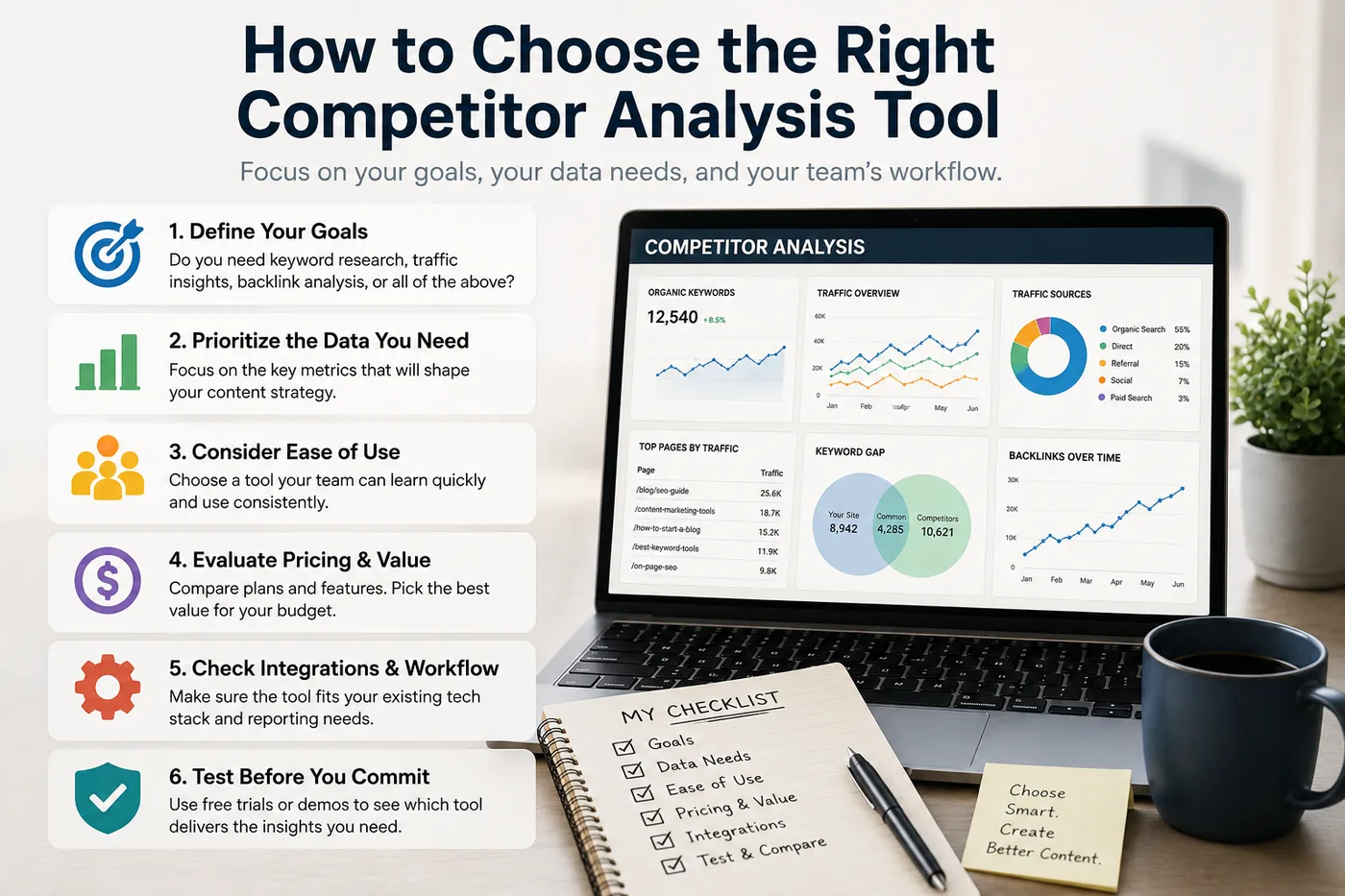
The best competitor analysis tool depends on what you actually want to learn from your competitors. A platform with hundreds of reports isn’t automatically the best choice if your team only uses a handful of them.
For content marketers, start by identifying the questions you need competitor data to answer.
If your main goal is discovering competitor keywords, content gaps, and new topics, Semrush provides one of the broadest sets of research capabilities. Ahrefs is particularly strong when you want to understand which competitor pages perform organically and, importantly, which pieces of content attract backlinks.
Similarweb makes more sense when you want to look beyond SEO. Its broader traffic intelligence can help reveal whether competitors rely heavily on search, referrals, social media, paid campaigns, or other acquisition channels.
SpyFu is worth considering when SEO and paid search overlap in your strategy, while SE Ranking can be a practical choice for smaller teams that want competitor research alongside rank tracking and other everyday SEO functions.
Price matters, but it shouldn’t be the only consideration. A less expensive platform isn’t necessarily better value if it doesn’t provide the information your team regularly needs. Likewise, paying for an advanced platform makes little sense if most of its capabilities remain unused.
Before subscribing, consider:
• Which competitor insights will you actually use each month?
• Do you primarily need SEO data or broader traffic intelligence?
• Is backlink research important to your content strategy?
• Do you need to monitor competitors continuously or conduct occasional research?
• How many websites, keywords, or competitors will you need to track?
Ultimately, the best tool is the one that turns competitor data into better content decisions, rather than simply giving you more reports to look at.
How to Turn Competitor Research Into Better Content
Finding a keyword your competitor ranks for doesn’t automatically mean you should create an article targeting it.
This is where competitor analysis often goes wrong.
It’s easy to export hundreds of missing keywords, hand them to a writer, and assume filling every gap will improve organic visibility. But some of those searches may be irrelevant to your audience, too competitive for your website, or already adequately addressed by content you have published.
Instead, use competitor research as a starting point.
Look for recurring patterns across several competitors. If multiple successful websites cover a subject that your site barely mentions, there may be a genuine gap in your topical coverage. If only one competitor ranks for an obscure keyword that has little relevance to your customers, it may not deserve your attention at all.
Search intent should also influence the decision. A competitor might rank for a valuable keyword with a comparison page while you’re considering publishing an educational guide. Even if you target the same phrase, the difference in intent could prevent your article from competing effectively.
This is why creating content that matches search intent should remain part of competitor research rather than becoming a separate SEO exercise. Understanding what users expect helps you decide not only which opportunities to pursue, but also what type of content you should create.
Don’t Copy Your Competitors — Find What They’re Missing
Competitor analysis becomes far more useful when you stop asking, “What are they doing?” and start asking, “What could we do better?”
Suppose a competing article ranks well but hasn’t been updated in several years. Another may cover the right topic but provide very few practical examples. A comparison article might overlook an important product category, while an educational guide may leave several common reader questions unanswered.
Those weaknesses create opportunities.
You might improve on existing search results by providing:
• More current information
• Original examples or firsthand insights
• Clearer explanations
• Better organization and readability
• Useful data or research
• Answers to questions competitors overlook
• A perspective designed for a more specific audience
The objective isn’t to make your article longer simply because a competitor published 2,000 words. More content isn’t automatically better content.
Instead, determine what someone searching for the topic still needs after reviewing the pages already available. That’s where competitor analysis moves beyond imitation and becomes useful content strategy.
Frequently Asked Questions
What is a competitor analysis tool?
A competitor analysis tool is software that helps businesses research the online performance of competing websites. Depending on the platform, it may reveal competitor keywords, rankings, backlinks, popular pages, traffic sources, paid advertising activity, and other digital marketing information.
Which competitor analysis tool is best for content marketing?
Semrush is one of the strongest overall choices for content marketers because it combines keyword gaps, organic competitor research, backlinks, and other competitive insights. Ahrefs is particularly strong for SEO and backlink analysis, while Similarweb is better suited to broader traffic and market intelligence.
Can competitor analysis tools show exactly how much traffic another website receives?
Not usually. Unless you have access to a competitor’s private analytics account, third-party traffic figures are generally estimates. They are more useful for identifying relative performance, trends, and traffic patterns than determining an exact visitor count.
How often should you analyze competitors?
Competitor research doesn’t need to happen every day. For many content teams, reviewing major competitors during quarterly content planning and checking important search competitors when researching new topics is sufficient. More competitive industries may benefit from more frequent monitoring.
Is it okay to use competitors’ keywords?
Yes. Keywords aren’t owned by individual websites. However, discovering that a competitor ranks for a keyword doesn’t mean you should copy its article. Use the keyword to understand the opportunity, then create original content that provides genuine value to your audience.
How many competitors should you analyze?
Three to five relevant competitors is often enough to identify useful patterns without creating an overwhelming amount of data. Remember to include search competitors, not just businesses selling similar products or services. The websites competing with you for Google visibility may be very different from your direct commercial competitors.
Can competitor analysis improve topical authority?
It can help identify subjects and related questions your website hasn’t adequately covered. When those gaps are genuinely relevant to your audience, filling them with useful, interconnected content can strengthen your overall coverage of a topic. The goal is not to cover every keyword a competitor ranks for, but to build meaningful depth around subjects that matter to your readers.
Final Thoughts
Competitor analysis tools can reveal an enormous amount of information, but having more data doesn’t automatically produce a better content strategy.
The real value comes from knowing what to do with it.
Semrush offers the strongest all-around package for many content marketers, while Ahrefs excels at organic and backlink research. Similarweb provides a broader view of competitor traffic, SpyFu makes SEO and PPC competitor research relatively straightforward, and SE Ranking offers an appealing combination of functionality and value for smaller teams.
Whichever platform you choose, use competitor data as evidence rather than instructions. Look for patterns, identify genuine gaps, understand search intent, and then decide where your own experience or perspective can produce something more useful.
Your competitors can show you where opportunities exist. What you create from those opportunities is what ultimately differentiates your content.

We research and organize marketing software around practical use cases. Product claims are included only when supported by available sources.
Read our editorial policy →Related guides
Meta Box vs ACF: Which WordPress Custom Fields Plugin Is Better in 2026?
Meta Box vs ACF is a common comparison when a WordPress website starts needing more flexibility than the standard post and page editor provides. Both plugins let you create custom fields, organize structured information, and build more dynamic WordPress websites without forcing everything into the main content editor. The differences become more important as the […]
Kinsta vs WP Engine: Which Managed WordPress Hosting Is Better in 2026?
Kinsta vs WP Engine is a comparison you’re likely to come across when looking for managed WordPress hosting. Both take care of much of the technical work that comes with running WordPress, including performance optimization, security, backups, updates and staging environments. The difference is less about whether either platform can host a WordPress site and […]
Online Store Launch Checklist: From Product Idea to First Order
Prepare your first online store with a practical checklist for products, checkout, delivery, order testing and a focused customer-acquisition plan.