
This article may contain affiliate links. We may earn a commission at no additional cost to you; this does not determine our editorial conclusions.
Creating content for a Shopify store is easier than turning that content into traffic and sales. The best Shopify apps for content marketers help optimize blog posts for search engines, automate email marketing, showcase social proof, improve site performance, and convert readers into loyal customers.
Many merchants struggle with disconnected tools, time-consuming manual tasks, and content that attracts visitors but fails to generate meaningful engagement or revenue. Without the right apps, even well-written buying guides, tutorials, and product comparisons can fall short of their potential.
If you’re still building your editorial plan, our guide on how to create a winning content strategy from scratch explains how to align your content with long-term business goals before choosing the right tools.
Whether you’re building an ecommerce blog, investing in SEO, or growing an audience through email and social media, the apps in this guide can streamline your workflow and help you get more value from every piece of content you publish.
Quick Rundown: Best Shopify Apps for Content Marketers
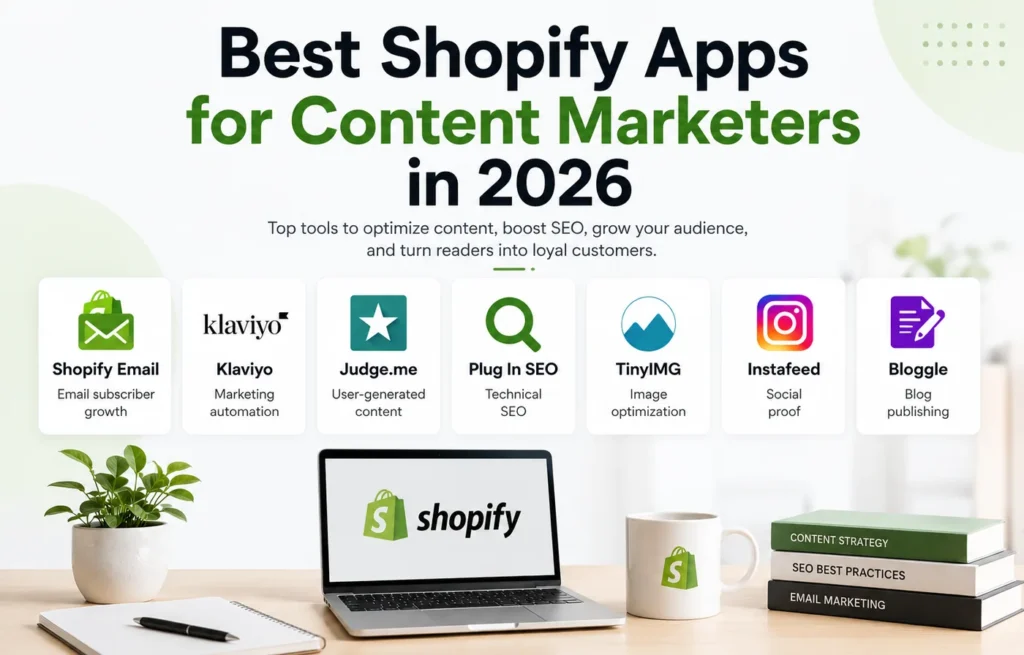
• Shopify Email – Best for turning blog readers into subscribers and customers.
• Klaviyo – Best for advanced email marketing automation and audience segmentation.
• Judge.me – Best for adding user-generated content and social proof.
• Plug In SEO – Best for identifying on-site SEO issues.
• TinyIMG SEO & Image Optimizer – Best for improving page speed and image optimization.
• Instafeed – Best for incorporating social media content into your store.
• Bloggle – Best for creating visually appealing Shopify blog posts.
Why Content Marketing Matters for Shopify Stores
Many shoppers don’t make a purchase the first time they visit an online store. Instead, they research products, compare options, read reviews, and look for answers to their questions before deciding to buy. Content marketing helps Shopify merchants reach these potential customers early in the buying journey by providing useful blog posts, buying guides, tutorials, FAQs, and product comparisons.
Shopify’s own guide to content marketing explains how educational content can attract qualified visitors and nurture them into customers over time.
A well-executed content strategy can do more than attract traffic. It can build trust, establish your brand as an authority in your niche, improve visibility in search engines, and encourage visitors to join your email list or follow your brand on social media. Over time, this creates multiple opportunities to re-engage potential customers and guide them toward a purchase.
However, consistently producing and promoting high-quality content can be challenging without the right tools. Shopify apps designed for SEO, email marketing, blogging, review collection, and social media integration help automate repetitive tasks and enhance the overall effectiveness of your content marketing efforts. By choosing the right apps, merchants can spend less time managing workflows and more time creating content that drives meaningful business results.
Publishing consistently is only part of the equation. Understanding why SEO and content marketing deliver long-term results can help merchants prioritize sustainable traffic growth instead of relying solely on paid advertising.
1. Shopify Email — Best for Converting Readers into Customers
Publishing helpful content is only the first step in content marketing. To maximize its value, you need a way to stay connected with readers after they leave your website. Shopify Email makes this easy by allowing merchants to create newsletters, promotional emails, and automated campaigns directly from the Shopify admin.
Because it integrates natively with Shopify, customer information, purchase history, and subscriber lists are already available, reducing the need for complicated setup or third-party connections. Content marketers can promote new blog posts, announce product launches, share seasonal guides, or send personalized recommendations based on customer activity.
For small and medium-sized Shopify stores looking for a simple email marketing solution, Shopify Email offers an accessible way to turn blog traffic into repeat customers.
Key Features
• Native Shopify integration
• Drag-and-drop email builder
• Customer segmentation
• Automated email campaigns
• Campaign performance analytics
2. Klaviyo — Best for Marketing Automation
Klaviyo is one of the most powerful marketing automation platforms available for Shopify merchants. Instead of sending the same message to every subscriber, it enables businesses to create personalized email and SMS campaigns based on browsing behavior, purchase history, and customer engagement.
For content marketers, this means visitors who read buying guides, download resources, or view specific products can automatically enter tailored nurture sequences. Someone reading an educational article about skincare, for example, could receive follow-up emails featuring related products, customer testimonials, or exclusive offers.
Its advanced segmentation and reporting capabilities make Klaviyo particularly valuable for growing brands that want to connect content marketing with measurable revenue outcomes.
Key Features
• Behavioral segmentation
• Automated email and SMS workflows
• Personalized product recommendations
• Advanced audience targeting
• Revenue attribution and campaign analytics
Try Klaviyo and turn more readers into loyal customers with personalized email and SMS campaigns.
3. Judge.me — Best for User-Generated Content
Customer reviews can significantly strengthen content marketing efforts by providing authentic experiences that complement editorial content. Judge.me helps Shopify merchants collect ratings, written reviews, photos, and videos from customers and display them throughout their stores.
Content marketers often incorporate these reviews into buying guides, product comparison pages, and landing pages to reinforce credibility and address common purchasing concerns. The app also supports review collection automation, making it easier to continuously generate fresh user-generated content.
For businesses focused on building trust and improving conversion rates, Judge.me offers an effective way to combine social proof with educational content.
Key Features
• Unlimited review collection
• Photo and video reviews
• Search-friendly rich snippets
• Customizable review widgets
• Automated review request emails
4. Plug In SEO — Best for Technical SEO Monitoring
Creating outstanding content won’t produce consistent results if search engines encounter technical issues when crawling your website. Plug In SEO helps merchants identify and resolve common optimization problems that may affect visibility in search results.
The app scans Shopify stores for metadata issues, broken links, page structure concerns, and other technical factors that influence SEO performance. It also provides actionable recommendations that content marketers can use to improve discoverability without requiring deep technical expertise.
Following Google’s SEO Starter Guide can also help merchants understand the fundamentals of creating search-friendly websites and content.
For teams investing in long-term organic traffic, Plug In SEO serves as a valuable maintenance tool that supports a healthier website overall.
Key Features
• Comprehensive SEO health checks
• Metadata analysis
• Structured data recommendations
• Actionable optimization reports
• Continuous website monitoring
5. TinyIMG SEO & Image Optimizer — Best for Faster Pages
High-quality visuals are essential for ecommerce content, but large image files can slow page loading and negatively affect user experience. TinyIMG helps merchants automatically compress and optimize images while maintaining visual quality.
Beyond image compression, the app also assists with metadata optimization and alt text management, helping stores improve accessibility and search visibility. Faster-loading pages can keep visitors engaged longer and create a smoother browsing experience across both desktop and mobile devices.
For content marketers publishing image-rich tutorials, lookbooks, or buying guides, TinyIMG helps balance visual appeal with website performance.
Key Features
• Automatic image compression
• Alt text assistance
• Bulk image optimization
• Metadata improvements
• Lazy loading support
6. Instafeed — Best for Social Content Integration
Modern content strategies often extend beyond blog articles to include social media storytelling. Instafeed enables Shopify merchants to display Instagram content directly on their websites, showcasing lifestyle imagery, creator partnerships, and customer experiences.
Embedding social posts alongside blog articles or product pages helps keep content fresh while providing additional context for shoppers. It can also reinforce brand identity by highlighting real-world product usage and community engagement.
For brands that actively invest in visual marketing, Instafeed offers a seamless way to connect social media with onsite content.
Key Features
• Instagram feed embedding
• Responsive display layouts
• Automatic content updates
• Product tagging support
• Flexible customization options
7. Bloggle — Best Shopify Blog Builder
While Shopify includes a built-in blogging platform, Bloggle offers additional design flexibility for merchants who publish content regularly. Its drag-and-drop editor allows marketers to create visually engaging articles using customizable sections, comparison tables, calls to action, and embedded products.
The app is particularly useful for brands producing buying guides, tutorials, listicles, and long-form educational content that requires more sophisticated layouts than the default Shopify editor provides. By making blog creation easier and more visually appealing, Bloggle helps marketers improve reader engagement without writing custom code.
Key Features
• Drag-and-drop visual editor
• SEO-friendly formatting tools
• Reusable content templates
• Rich content blocks
• Product and collection embedding
Shopify Apps Comparison Table
| App | Best For | Ideal User |
|---|---|---|
| Shopify Email | Email subscriber growth | Shopify merchants building newsletters |
| Klaviyo | Marketing automation | Businesses scaling email and SMS campaigns |
| Judge.me | User-generated content | Brands focused on reviews and trust |
| Plug In SEO | Technical SEO | SEO-focused content marketers |
| TinyIMG SEO & Image Optimizer | Image optimization | Stores publishing image-heavy content |
| Instafeed | Social proof | Lifestyle and creator-driven brands |
| Bloggle | Blog publishing | Merchants producing long-form content |
How to Choose the Right Shopify App
The best Shopify app depends on your content marketing goals.
If your priority is converting readers into subscribers, Shopify Email or Klaviyo can help build automated communication workflows. For improving search performance, Plug In SEO and TinyIMG focus on technical optimization and faster pages. If your strategy emphasizes educational content and blogging, Bloggle offers greater design flexibility than Shopify’s default editor.
Merchants looking to speed up production while maintaining quality may also benefit from exploring some of the best AI tools for content marketers, especially when creating blog posts, product descriptions, and marketing campaigns at scale.
Rather than installing every available app, start with the one that addresses your biggest challenge and expand your toolkit over time.
Frequently Asked Questions
What are the best Shopify apps for content marketers?
Some of the best Shopify apps for content marketers include Shopify Email for subscriber engagement, Klaviyo for marketing automation, Judge.me for user-generated content, Plug In SEO for technical optimization, TinyIMG for image optimization, Instafeed for social content integration, and Bloggle for creating more engaging blog posts.
Which Shopify app is best for blogging?
If blogging is a major part of your marketing strategy, Bloggle is one of the strongest options. It extends Shopify’s native blogging capabilities with a drag-and-drop editor, customizable layouts, comparison tables, and other content blocks that make it easier to publish professional-looking articles.
How can Shopify apps improve SEO?
SEO-focused apps can optimize different parts of your store. Plug In SEO helps identify technical issues such as metadata problems and broken links, while TinyIMG compresses images and improves media optimization for faster page loads. Together, these enhancements can contribute to a better user experience and stronger search visibility.
Should I use Shopify Email or Klaviyo?
The right choice depends on your needs. Shopify Email is a good fit for merchants who want a simple, built-in solution for newsletters and promotional campaigns. Klaviyo is better suited for businesses that need advanced segmentation, behavioral automation, personalized messaging, and detailed performance reporting.
Do I need multiple Shopify apps for content marketing?
In many cases, yes. Content marketing involves several activities, including publishing articles, optimizing for search engines, collecting reviews, and nurturing subscribers. Using complementary apps can help streamline these workflows, but it’s still important to avoid installing tools that duplicate functionality or provide little value.
Can user reviews support content marketing?
Absolutely. Customer reviews, ratings, and photos provide authentic social proof that can strengthen blog posts, buying guides, and product pages. Apps like Judge.me make it easy to collect and display this user-generated content, helping visitors feel more confident in their purchasing decisions.
Are these Shopify apps suitable for small businesses?
Yes. Most of these apps offer beginner-friendly interfaces and scalable plans, making them suitable for startups and small businesses as well as larger ecommerce brands. Merchants can start with essential features and upgrade as their content marketing strategy grows.
How do I choose the right Shopify app for my store?
Start by identifying your biggest challenge. If you want to grow an email list, consider Shopify Email or Klaviyo. If you’re focused on improving search visibility, Plug In SEO and TinyIMG may be better choices. Brands investing heavily in blogging may benefit most from Bloggle, while those looking to build trust can leverage Judge.me and Instafeed to showcase reviews and social content.
Final Thoughts
The best Shopify apps for content marketers help streamline publishing, strengthen SEO, grow email lists, and build trust with potential customers. Whether your focus is automation, technical optimization, or creating engaging blog posts, choosing the right combination of apps can significantly improve your marketing results.
Start with the app that solves your biggest bottleneck today, then expand your toolkit as your content strategy and Shopify store continue to grow. If you haven’t launched your online store yet or are looking to upgrade your ecommerce platform, try Shopify now to take advantage of its robust ecosystem of apps, built-in tools, and integrations that make content marketing and business growth easier to manage from a single platform.

We research and organize marketing software around practical use cases. Product claims are included only when supported by available sources.
Read our editorial policy →Related guides

How to Outsource Content Creation Without Losing Your Brand Voice
Learning how to outsource content creation can solve one of the biggest problems in content marketing: there is always more content to create than there is time to create it. Blog posts need writing, landing pages need updating, emails need preparing, and social channels need a steady supply of useful material. But handing the work […]

Vista Social vs Metricool: Which Social Media Management Tool Is Better in 2026?
Vista Social vs Metricool is a close comparison because both platforms bring social media scheduling, analytics, content planning, and management into one place, but they approach the job differently. Vista Social puts more emphasis on engagement, team workflows, automation, and managing conversations alongside publishing, while Metricool has a particularly strong focus on planning, analytics, competitor […]

Content Marketing Tools: How to Build the Right Software Stack
Build a practical content marketing software stack for planning, writing, design, distribution and measurement without paying for overlapping tools.