
This article may contain affiliate links. We may earn a commission at no additional cost to you; this does not determine our editorial conclusions.
This article contains affiliate links. If you sign up for Cookiebot through these links, we may earn a commission at no additional cost to you.
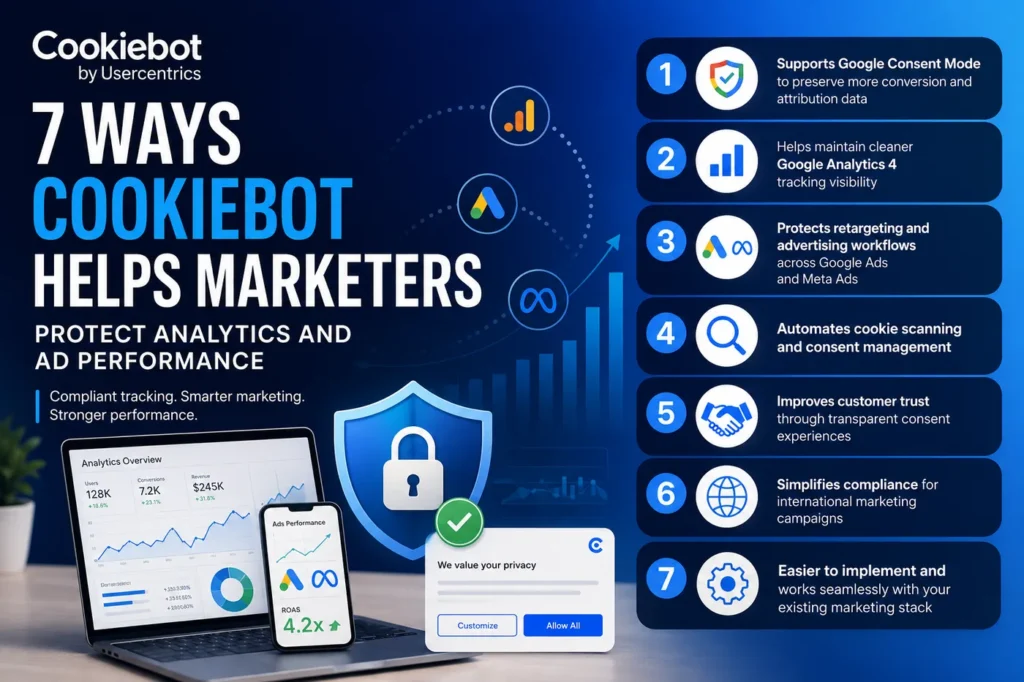
Cookiebot helps marketers protect analytics accuracy and advertising performance by managing cookie consent compliantly without completely sacrificing tracking visibility. Through Google Consent Mode support, automated cookie scanning, and consent-based tracking controls, it helps businesses maintain stronger attribution, cleaner analytics data, and more stable advertising optimization while respecting privacy regulations.
Modern marketing depends heavily on website analytics and advertising data.
Businesses use Google Analytics 4, Google Ads, Meta Ads, and other marketing platforms to understand website behavior and improve conversions. But privacy regulations such as GDPR and CCPA now require businesses to obtain user consent before activating many tracking technologies.
This creates a difficult challenge for marketers.
Businesses still need accurate analytics, attribution visibility, retargeting audiences, and conversion tracking to optimize campaigns effectively. At the same time, they must manage customer privacy transparently and compliantly.
That is why many marketing teams now use Cookiebot.
Quick Rundown
Here’s how Cookiebot helps marketers protect analytics and advertising performance:
• Supports Google Consent Mode to preserve more conversion and attribution data
• Helps maintain cleaner Google Analytics 4 tracking visibility
• Protects retargeting and advertising workflows across Google Ads and Meta Ads
• Automates cookie scanning and consent management
• Improves customer trust through transparent consent experiences
• Simplifies compliance for international marketing campaigns
Modern marketing depends heavily on customer data, but privacy regulations now require businesses to manage tracking more carefully. Cookiebot helps marketers balance compliance, analytics visibility, and advertising performance without creating major operational complexity.
Why Marketers Use Cookiebot for GDPR Compliance and Analytics Protection
Privacy compliance now directly affects marketing performance.
When businesses implement poor consent systems, analytics platforms may lose important conversion signals and attribution visibility. Advertising platforms may also receive incomplete audience data, making optimization harder.
This impacts nearly every major marketing workflow, including:
• Google Ads optimization
• Meta Ads retargeting
• ecommerce attribution
• lead generation campaigns
• loop marketing workflows
For example, a SaaS company running paid acquisition campaigns may rely heavily on Google Analytics 4 and connected sales or reporting systems to understand which campaigns generate qualified leads. If consent handling breaks attribution tracking, the marketing team may lose visibility into which channels actually drive revenue.
Businesses using Cookiebot CMP alongside Google Consent Mode can often preserve more modeled conversions compared to websites that fully block all tracking activity after consent rejection. This helps marketing teams maintain better reporting visibility while respecting user privacy preferences.
This is why marketers increasingly view consent management as part of marketing infrastructure rather than only a legal requirement.
Privacy transparency also affects customer behavior and brand trust. According to Cisco’s Consumer Privacy Survey, many consumers say they care about how businesses handle personal data and are more willing to engage with brands that communicate privacy practices clearly.
Cookiebot helps businesses manage both compliance and customer trust more effectively.
How Cookiebot Protects Google Analytics and Ad Tracking
One of the biggest reasons marketers use Cookiebot is Google Consent Mode integration.
Many businesses worry that privacy compliance will completely break analytics and advertising measurement. Cookiebot helps reduce this problem by integrating directly with Google Consent Mode.
Instead of fully disabling all measurement activity when users decline tracking cookies, Consent Mode adjusts how Google services behave based on user consent preferences. This allows businesses to preserve more conversion modeling and reporting visibility while respecting privacy choices.
Google also notes that Consent Mode helps advertisers recover measurement insights while respecting user consent choices, which has become increasingly important as privacy regulations evolve globally.
For example, an ecommerce brand running Performance Max campaigns may depend heavily on conversion signals to optimize bidding and product targeting. Cookiebot’s consent tools help preserve more measurement visibility so Google Ads can continue optimizing campaigns more effectively.
Improved attribution visibility can also help businesses reduce wasted ad spend across retargeting campaigns and audience targeting workflows.
This becomes especially important for businesses with large advertising budgets where inaccurate attribution can significantly affect return on ad spend.
Cookiebot software also works well with Google Tag Manager and Google Analytics 4 implementations commonly used by modern marketing teams.
1. Cookiebot Helps Maintain Cleaner Analytics Data
Analytics quality becomes unreliable when tracking systems are poorly configured.
Many businesses install multiple scripts across their websites, including analytics tools, advertising pixels, CRM integrations, heatmaps, live chat software, and marketing automation platforms. Without structured consent management, these systems can behave inconsistently.
Cookiebot helps organize how tracking technologies activate based on user consent.
For example, a publisher running Google Analytics 4, Meta Pixel, newsletter forms, and customer support chat tools may need to manage multiple tracking scripts simultaneously. Cookiebot helps control how these technologies load while supporting more compliant analytics workflows.
As businesses place greater emphasis on first-party data strategies, maintaining cleaner analytics visibility becomes increasingly important.
2. Cookiebot Helps Preserve Advertising and Retargeting Performance
Modern advertising systems depend heavily on behavioral data.
Retargeting campaigns, audience segmentation, lookalike modeling, and conversion optimization all rely on properly managed tracking systems.
The platform helps marketers manage advertising consent more effectively so platforms like Google Ads and Meta Ads can continue receiving cleaner consent-based signals.
Businesses improving campaign measurement commonly use tools for organic social media ROI tracking to better understand how marketing channels contribute to conversions and customer engagement.
Cookiebot’s consent management platform helps reduce disruption across retargeting workflows while maintaining stronger privacy compliance standards.
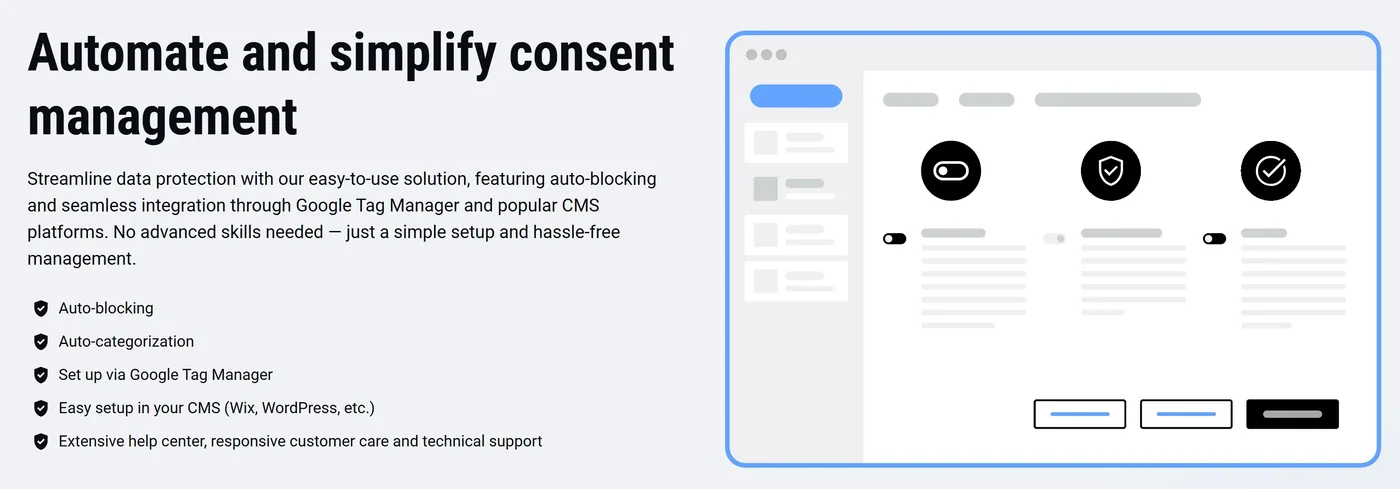
3. Cookiebot Automates Cookie Scanning and Consent Management
Marketing stacks change constantly.
Businesses regularly install new analytics platforms, advertising scripts, lead generation forms, customer support tools, and CRM integrations. Managing cookie compliance manually becomes difficult very quickly.
Cookiebot helps simplify this process through automated cookie scanning and dynamic cookie declarations.
Instead of manually reviewing every technology added to a website, the platform continuously scans for cookies and categorizes them automatically.
For example, a marketing agency launching seasonal campaigns for multiple clients may temporarily add several retargeting tools, tracking scripts, or personalization systems during campaign periods. Without automated scanning, teams can easily overlook technologies requiring consent management.
Cookiebot software helps reduce that operational burden while improving compliance consistency.
4. Cookiebot Improves Customer Trust Through Transparency
Consumers increasingly expect websites to explain how their data is being collected and used.
Poorly designed consent banners or aggressive tracking behavior can reduce trust and negatively affect brand perception.
Cookiebot helps businesses create clearer consent experiences through customizable banners, cookie categories, and detailed declarations.
This matters because customer trust now directly affects long-term marketing performance.
Brands using CRM software, marketing automation, customer support systems, and personalization tools all depend on customer willingness to share data voluntarily.
For example, an ecommerce brand using behavioral personalization and email automation may collect browsing activity to improve product recommendations and lifecycle campaigns. When users clearly understand how their information supports these experiences, they are often more comfortable engaging with personalized marketing.
5. Cookiebot Supports International Marketing Campaigns
International marketing creates additional privacy complexity.
A single business may receive traffic from Europe, North America, Asia, and South America simultaneously. Different regions often require different consent standards and privacy behavior.
Managing this manually becomes difficult as businesses scale globally.
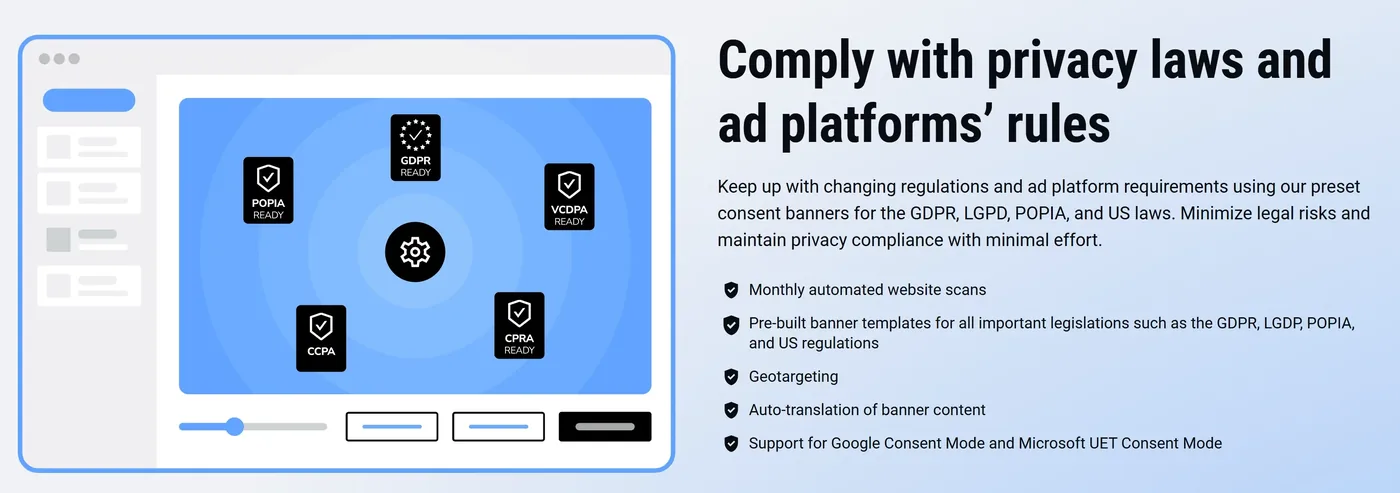
Cookiebot helps simplify international compliance through geo-targeted consent rules, multi-language support, and region-specific configurations.
For example, a SaaS company running global lead generation campaigns may require GDPR-compliant consent behavior for European visitors while maintaining different workflows for US traffic. Cookiebot helps automate much of this process without requiring businesses to manage multiple separate consent systems manually.
This allows marketing teams to scale campaigns more efficiently while maintaining stronger compliance standards.
6. Cookiebot Helps Support Long-Term First-Party Data Strategies
Many businesses are shifting toward first-party data strategies as third-party tracking becomes less reliable.
Cookiebot helps support this transition by helping businesses collect and manage consent more transparently.
This is especially important for businesses investing heavily in CRM software, customer support systems, marketing automation, and long-term customer retention strategies.
For example, a subscription business may rely on first-party customer behavior data to improve onboarding, personalize messaging, optimize retention campaigns, and reduce churn. Cookiebot’s consent tools help businesses manage these workflows more compliantly while supporting customer trust.
As privacy regulations continue evolving globally, businesses increasingly need consent systems that protect both compliance and marketing performance.
7. Better Visibility Into Consent-Based Analytics Data
Cookiebot also helps businesses better understand how consent choices affect analytics and advertising measurement across their websites. As privacy regulations continue evolving, companies need clearer visibility into which tracking technologies receive consent and how those choices impact reporting accuracy, attribution models, and campaign measurement.
When combined with Google Consent Mode, Cookiebot helps support more reliable consent-aware analytics while still respecting visitor privacy choices.
How to Use Cookiebot Without Losing Marketing Data
Here’s a simple process many marketing teams follow when implementing Cookiebot:
1. Install Cookiebot through Google Tag Manager or directly on the website.
2. Configure Google Consent Mode to support Google Analytics 4 and Google Ads tracking.
3. Categorize cookies properly across analytics, advertising, personalization, and functional tools.
4. Test consent behavior across desktop and mobile devices.
5. Monitor analytics visibility and attribution reporting regularly after implementation.
This process helps businesses maintain cleaner measurement workflows while reducing compliance risks.
Frequently Asked Questions
What is Cookiebot best for?
Cookiebot is best for businesses that need privacy compliance while protecting analytics visibility, advertising attribution, and marketing automation workflows.
Does Cookiebot work with Google Analytics 4?
Yes, it supports Google Analytics 4 and Google Consent Mode integrations commonly used by marketing teams.
Can Cookiebot help preserve ad performance?
Yes. The platform helps marketers manage compliant consent workflows while supporting cleaner attribution and advertising measurement.
Is Cookiebot useful for ecommerce marketing?
Ecommerce businesses often use the platform to support retargeting campaigns, customer segmentation, analytics visibility, and personalization systems.
Can Cookiebot support international marketing campaigns?
It supports geo-targeted consent rules, region-specific configurations, and multi-language consent banners for global marketing campaigns.
Final Thoughts
Privacy compliance and marketing performance are now deeply connected.
Businesses still need reliable analytics, attribution visibility, customer insights, and advertising optimization to grow effectively. But they also need transparent and compliant consent systems that respect evolving privacy regulations.
Cookiebot helps marketers manage both priorities more effectively.
The platform supports Google Consent Mode, protects analytics visibility, automates cookie scanning, improves transparency, and helps businesses maintain healthier marketing data workflows across CRM software, marketing automation systems, and advertising platforms.
For businesses investing heavily in analytics, customer support systems, personalization, retargeting, and loop marketing strategies, consent management is no longer just a compliance requirement. It has become part of maintaining sustainable long-term marketing performance.
If you want to protect analytics visibility and advertising performance while maintaining stronger privacy compliance, try Cookiebot for free.

We research and organize marketing software around practical use cases. Product claims are included only when supported by available sources.
Read our editorial policy →Related guides

5 Best Competitor Analysis Tools for Content Marketers in 2026
Compare 5 competitor analysis tools for content marketers to uncover keyword gaps, backlinks, top pages, and new content opportunities.
Best Omnichannel Engagement Platforms 2026
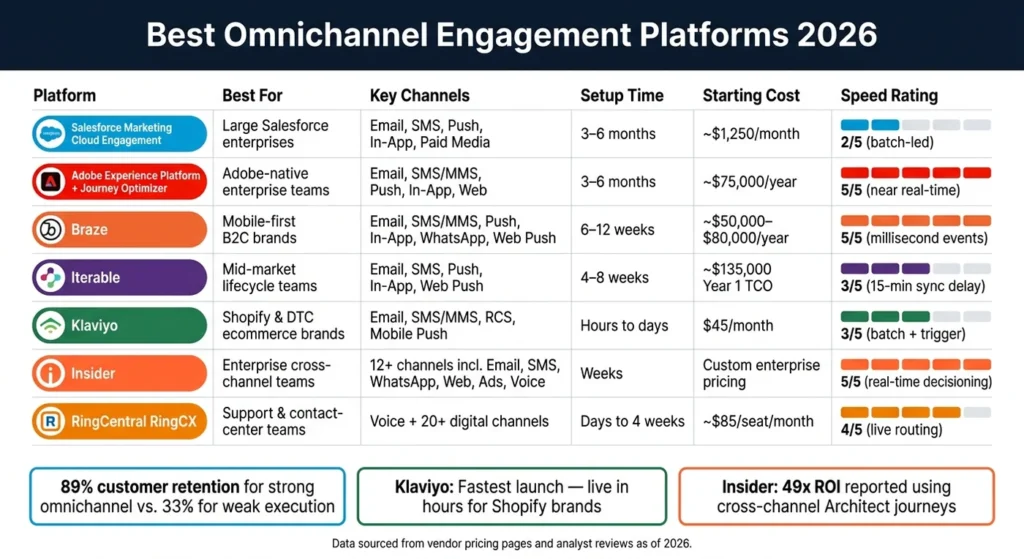
If you pick the wrong platform, you can waste months on setup and still miss the channels your team needs or fail to optimize AI based copywriting for SEO to engage them. The shortlist…
Ultimate Guide to Personalization in Display Ads
Personalized display ads can lift CTR by 34% and cut CPA by 38% when the setup is clean. My take is simple: if I want personalization to work, I need three things in place…