
This article may contain affiliate links. We may earn a commission at no additional cost to you; this does not determine our editorial conclusions.
If you pick the wrong platform, you can waste months on setup and still miss the channels your team needs or fail to optimize AI based copywriting for SEO to engage them. The shortlist here is simple: Salesforce, Adobe, Braze, Iterable, Klaviyo, Insider, and RingCentral. The best choice depends on your channels, your data setup, your team size, and your budget.
Here’s the short version:
- Salesforce fits large companies already deep in Salesforce
- Adobe fits Adobe-first teams that need near real-time journeys
- Braze fits mobile-led B2C brands with technical staff
- Iterable fits lifecycle teams that want flexible cross-channel flows
- Klaviyo fits Shopify and DTC brands that want to get live fast
- Insider fits enterprise teams that need many channels in one place
- RingCentral fits support and contact-center teams built around voice
A few numbers stand out:
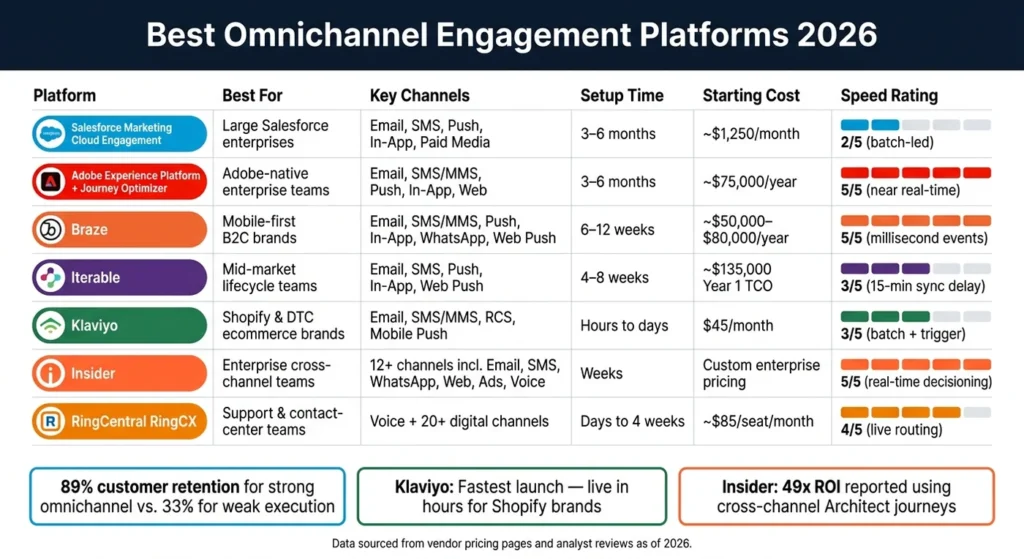
- Companies with strong omnichannel work retain 89% of customers, versus 33% for weak execution
- Salesforce pricing starts near $1,250/month, but yearly spend can go past $280,000
- Adobe Journey Optimizer starts around $75,000/year
- Braze often starts around $50,000 to $80,000/year for mid-market deals
- Klaviyo starts at $45/month for 1,500 contacts
- RingCentral RingCX starts near $85 per seat/month once the base plan is included
7 Best Omnichannel Platforms: Win Across Email, SMS, Push, Social & Store
sbb-itb-645e3f7
Quick Comparison
| Platform | Best for | Main channels | Speed | Setup lift | Cost range |
|---|---|---|---|---|---|
| Salesforce Marketing Cloud Engagement | Large Salesforce shops | Email, SMS, push, in-app, paid media | More batch-led unless paired with Data Cloud | High | From $1,250/month; often much higher in practice |
| Adobe Experience Platform + Journey Optimizer | Adobe-first enterprises | Email, SMS/MMS, push, in-app, web | Near real time | High | From $75,000/year |
| Braze | Mobile-first B2C brands | Email, SMS/MMS, push, in-app, web push, WhatsApp | Very fast event response | Medium to high | About $50,000 to $80,000/year and up |
| Iterable | Mid-market lifecycle teams | Email, SMS, push, in-app, web push | Event-led, but some sync delays | Medium | Custom; about $135,000 year 1 TCO in many mid-market cases |
| Klaviyo | Shopify and DTC ecommerce | Email, SMS/MMS, RCS, mobile push | Trigger + batch | Low | From $45/month |
| Insider | Enterprise cross-channel teams | 12+ channels, including email, SMS, WhatsApp, push, web, ads, voice | Real-time decisioning | Medium | Custom enterprise pricing |
| RingCentral | Service and contact-center teams | Voice + 20+ digital channels | Live interaction routing | Medium | From about $85/seat/month |
My takeaway: if you want the shortest path to launch, I’d look at Klaviyo. If I needed app-first journeys, I’d look at Braze. If I needed deep enterprise data ties, I’d start with Salesforce or Adobe. If voice and support matter most, RingCentral is the outlier on this list.
The rest of the article breaks down where each platform fits, where it falls short, and what kind of team should buy it.
1. Salesforce Marketing Cloud Engagement
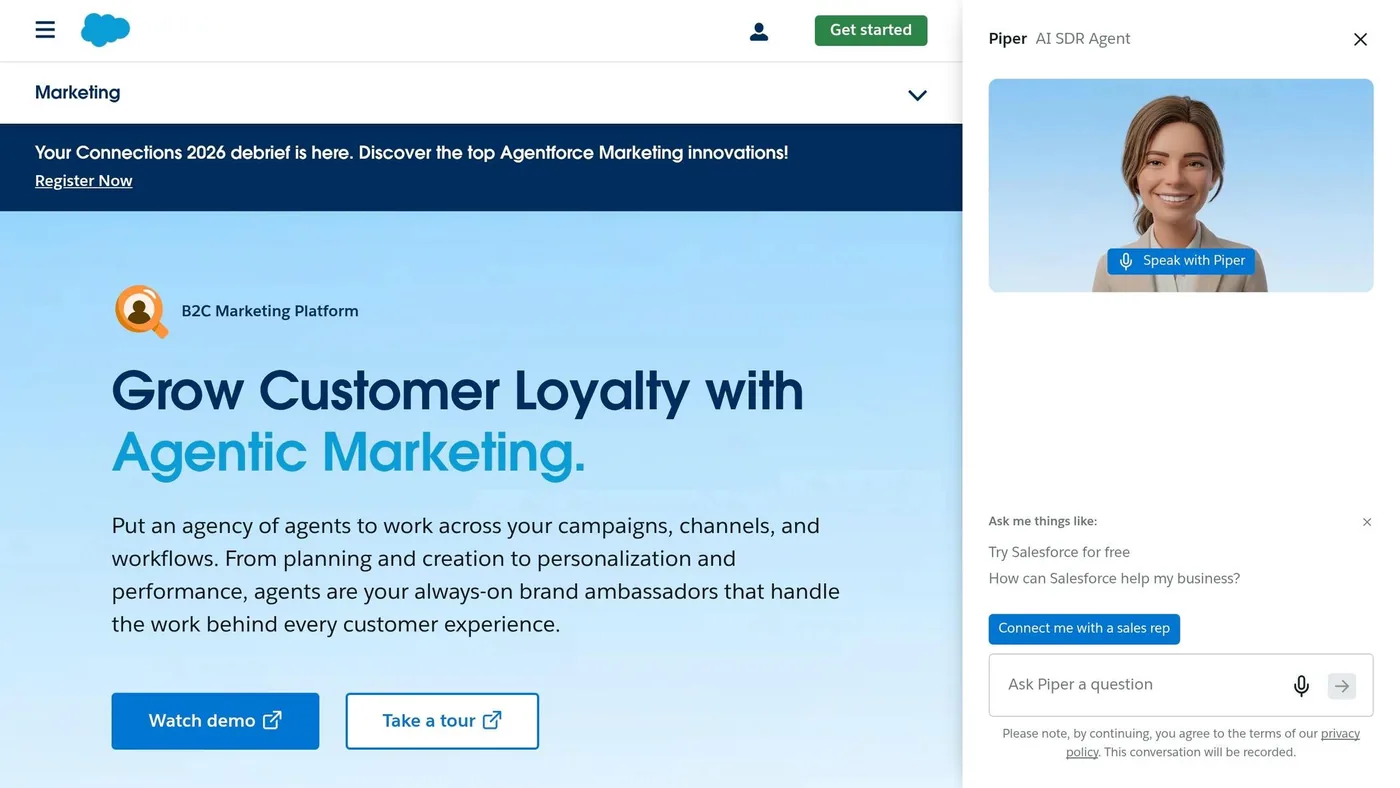
Salesforce stands out when a company needs omnichannel engagement tied straight to CRM, service, and commerce data. Salesforce Marketing Cloud Engagement is aimed at large enterprises that already run on Salesforce CRM. It offers serious scale, but there’s a trade-off: getting the most from it can take a lot of work.
The market view backs that up. It has a 4.1/5 rating on Gartner Peer Insights based on 454 validated enterprise reviews as of 2026, and Gartner has named Salesforce a Leader in the Magic Quadrant for Multichannel Marketing Hubs for eight consecutive years. Put simply, Salesforce shines because of how much customer context it can pull together. The catch is the setup.
Channel coverage
MCE supports email, SMS, push, in-app messaging, and paid media through its dedicated Studios. If you want web and mobile personalization, you’ll need Marketing Cloud Personalization. For deeper reporting, you’ll need Marketing Cloud Intelligence.
Real-time orchestration
Journey Builder handles orchestration, but MCE is still batch-first at its core. Real-time activation leans on Data Cloud, which can respond to customer signals at the millisecond level. MCE+ adds Flow and Agentforce for more autonomous orchestration.
That setup gives Salesforce strong data access. Where it can fall short is autonomous decision-making.
Data and AI depth
MCE uses Einstein AI for predictive scoring and send-time optimization, but analysts describe it as assistive AI, not a native autonomous system. Its biggest edge is that CRM data is already moving across sales, service, and commerce workflows. Data Cloud passed $1 billion in annual recurring revenue in Q1 FY26, with 120% year-over-year growth.
Implementation and cost
Pricing starts at about $1,250/month. In practice, annual cost often goes past $280,000 once implementation, partner support, and add-ons are factored in. Initial setup usually calls for external Salesforce partners and can add five to six figures on top of the license fee.
This is also where user feedback gets more mixed. Implementation and maintenance is rated 3.9/5, the platform’s lowest-rated feature area, largely because of architectural complexity. If your team doesn’t have in-house SQL and AMPscript skills, ROI may take longer.
Best fit: Large enterprises already using Salesforce that have the technical team and budget to handle a complex setup.
2. Adobe Experience Platform and Adobe Journey Optimizer
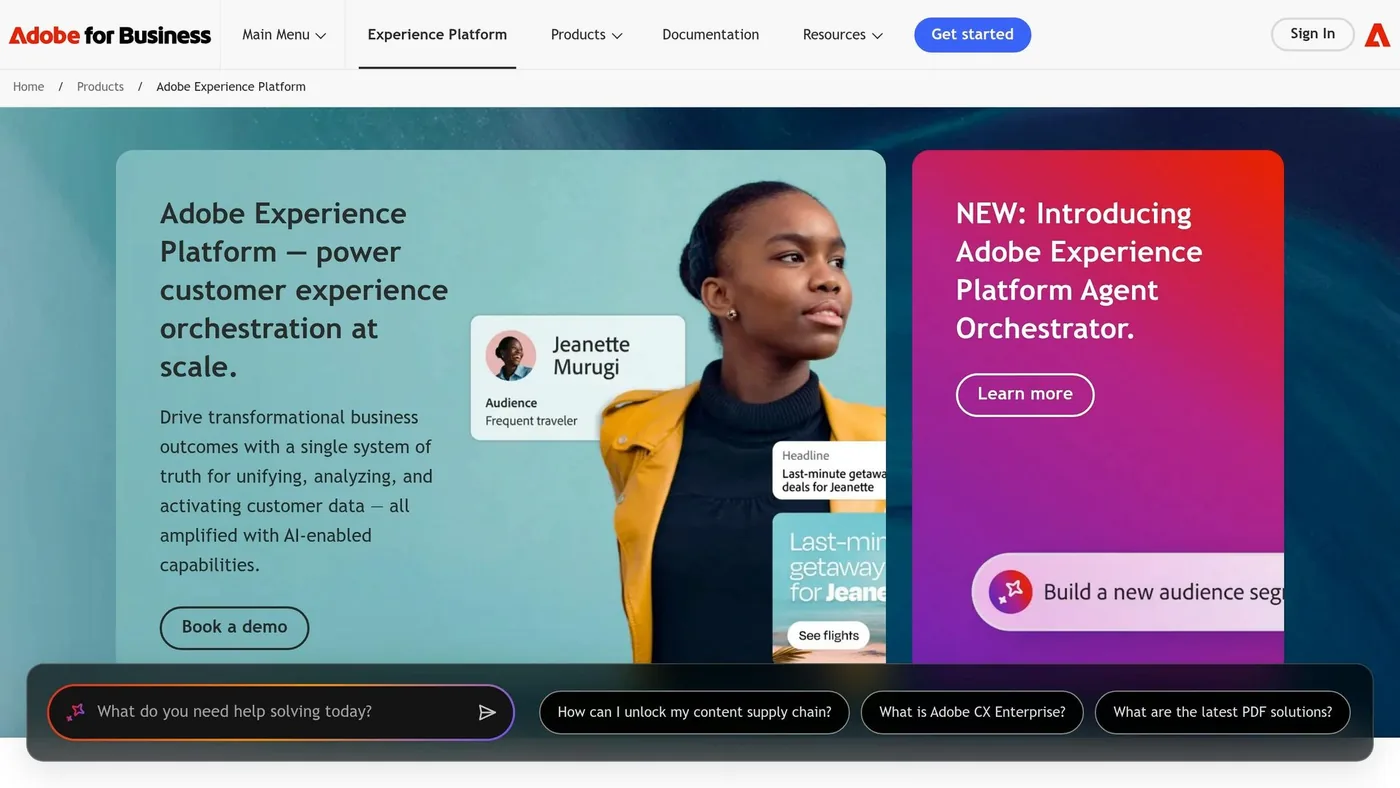
Adobe Journey Optimizer gets most of its punch from its native connection to Adobe Experience Platform and real-time customer profiles. That link is the big reason teams buy in. Step outside Adobe’s stack, though, and the argument gets thinner.
Channel coverage
AJO supports email, SMS/MMS, mobile push, in-app messaging, and web personalization out of the box. Web and mobile inbound engagement require Prime or above. That’s a lot of channel reach, but there’s a catch: setup can get heavy fast. Adobe tends to make the most sense when the rest of the Adobe stack is already up and running.
Real-time orchestration
This is the part where AJO shines. It updates journey states in under one second with streaming AEP data, which means cart abandons, app opens, and purchases can trigger the next step almost at once.
Journey Agent also adds natural-language journey building, simulation, and optimization. It includes synthetic-user testing before launch, which gives teams a way to pressure-test journeys before they go live.
Data and AI depth
AJO runs on AEP’s unified real-time profiles, which power native predictive decisioning and AI-driven personalization. In practice, that can have a big effect on performance.
Adobe’s Growth Marketing and Insights team reported a 44% jump in click-through rates for Creative Cloud emails after shifting from broadcast blasts to real-time behavioral microjourneys.
There’s one big caveat. Your event taxonomy needs to be clean. If the data structure has gaps, launch timelines can stretch by six to eight weeks.
Implementation and cost
Standalone licensing starts at about $75,000 per year. Implementation usually takes three to six months and requires a certified system integrator. For teams already on AEP, that may feel worth it because the real-time profile layer is the core upside.
If you want less platform overhead, many teams end up looking at lighter tools that are easier to roll out.
Best fit: Large Adobe-native teams that need real-time journey orchestration and can support a complex rollout.
3. Braze
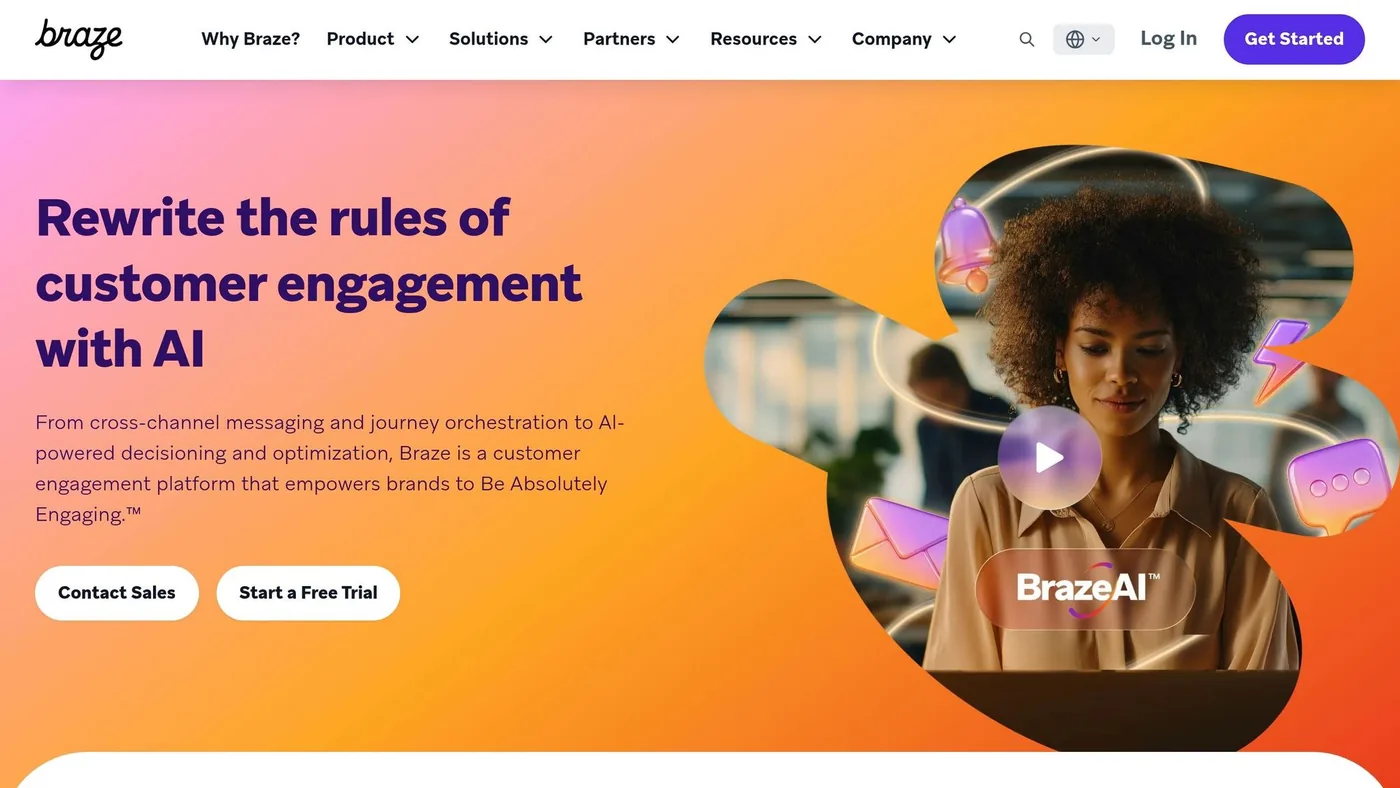
Braze is a good match for enterprise B2C teams that run app-led customer journeys, send a lot of messages, and have technical staff to keep things running. If mobile engagement sits at the center of how customers move from one step to the next, Braze often makes more sense than heavier enterprise suites.
Channel coverage
Braze supports email, SMS/MMS, mobile push, in-app messaging, web push, WhatsApp, and in-app Content Cards. For paid ads, though, you’ll need connectors and webhooks rather than built-in ad tools.
Real-time orchestration
One of Braze’s big draws is its millisecond-level event processing. In plain English: when a user does something, Braze can react across channels almost right away.
Its main journey builder, Canvas Flow, uses a visual drag-and-drop setup. Teams can build branches, run experiments, and trigger actions based on user behavior across supported channels.
Data and AI depth
Braze’s Sage AI includes predictive churn, purchase-likelihood scoring, send-time optimization, and AI copywriting. These predictive features tend to work best when a brand has more than 30,000 monthly active users.
In 2026, Braze added Sage agents and native MCP server support. That pushed the platform closer to autonomous orchestration.
Implementation and cost
Implementation usually takes 6 to 12 weeks. More complex enterprise rollouts can stretch to 12 months.
This isn’t the kind of tool you just switch on and forget. Brands need a technical owner to handle event modeling and ongoing maintenance.
Pricing is custom. Mid-market contracts often start around $50,000 to $80,000 per year, with costs based on monthly active users, message volume, and channels.
Best fit: Enterprise B2C brands with app-centric journeys, high message volume, and in-house technical support.
4. Iterable
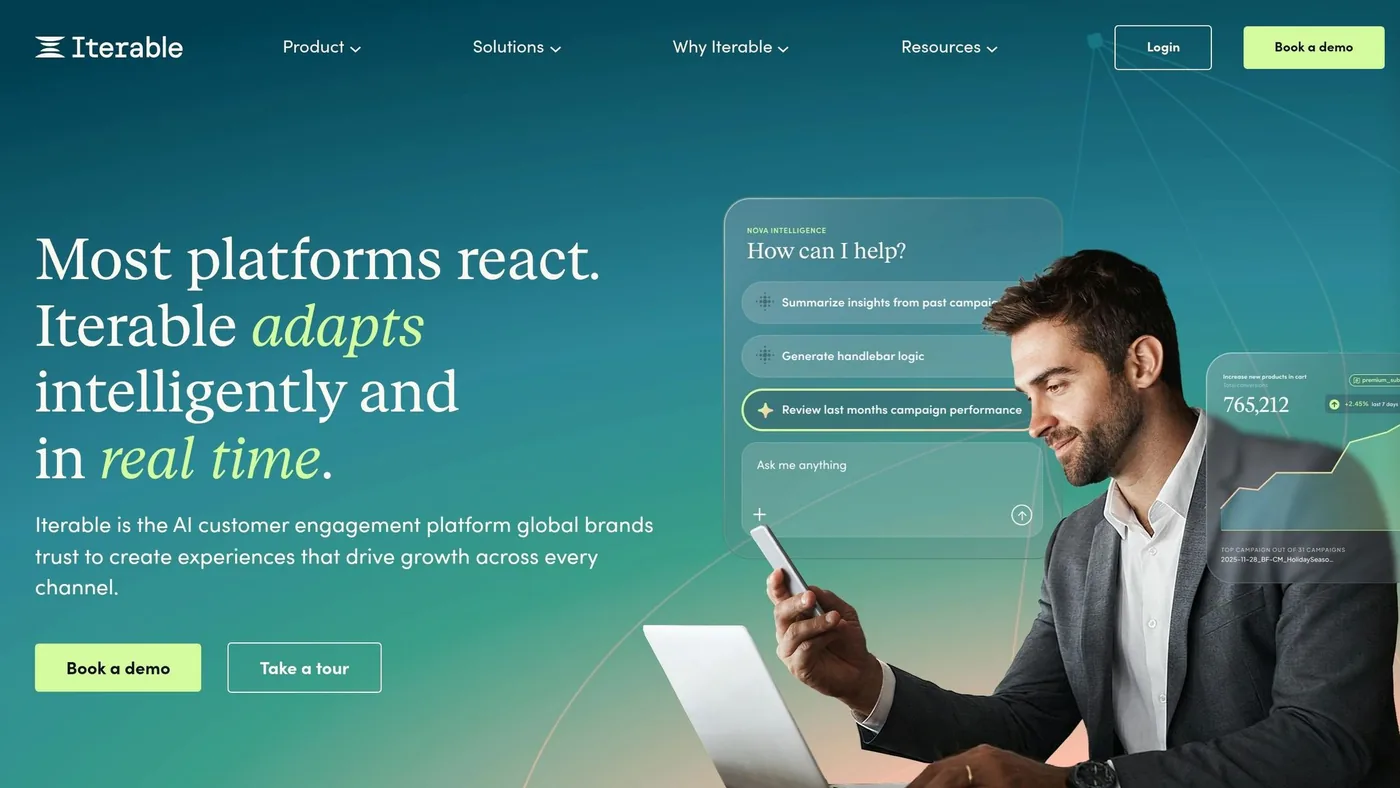
Iterable is a strong pick for mid-market and enterprise B2C teams that want flexible, multi-channel lifecycle messaging. Compared with heavier enterprise suites, it leans more toward flexible lifecycle automation and a faster rollout.
Channel coverage
Iterable natively supports email, SMS, mobile push, in-app messaging, and web push. WhatsApp, direct mail, and paid social depend on integrations. It also doesn’t include native list verification, so teams need separate hygiene tooling.
That setup matters most when customer journeys depend on fast, event-triggered actions across channels.
Real-time orchestration
One of Iterable’s biggest strengths is Workflow Studio, its visual journey builder. Teams can create multi-step, multi-channel flows with conditional branching, delays, and A/B/n testing across up to 10 variants.
There is one catch: Iterable is not fully real time. Smart Ingest syncs every 15 minutes, so if your brand depends on split-second triggers, that delay is worth a close look.
Data and AI depth
Iterable’s Nova AI suite includes Brand Affinity scoring, Send Time Optimization, and Channel Optimization. In April 2026, it launched Nova Agent, which lets marketers build journeys, generate copy, and run experiments with natural language prompts.
Catalog is another useful piece. It lets teams reuse one journey across many products, which helps a lot for brands managing large inventories.
Implementation and cost
Implementation usually takes 4 to 8 weeks and needs engineering support. Pricing is custom, and mid-market Year 1 TCO is about $135,000.
Best fit: Growth-stage and mid-market B2C brands that need flexible multi-channel journeys and have engineering resources to support setup.
5. Klaviyo
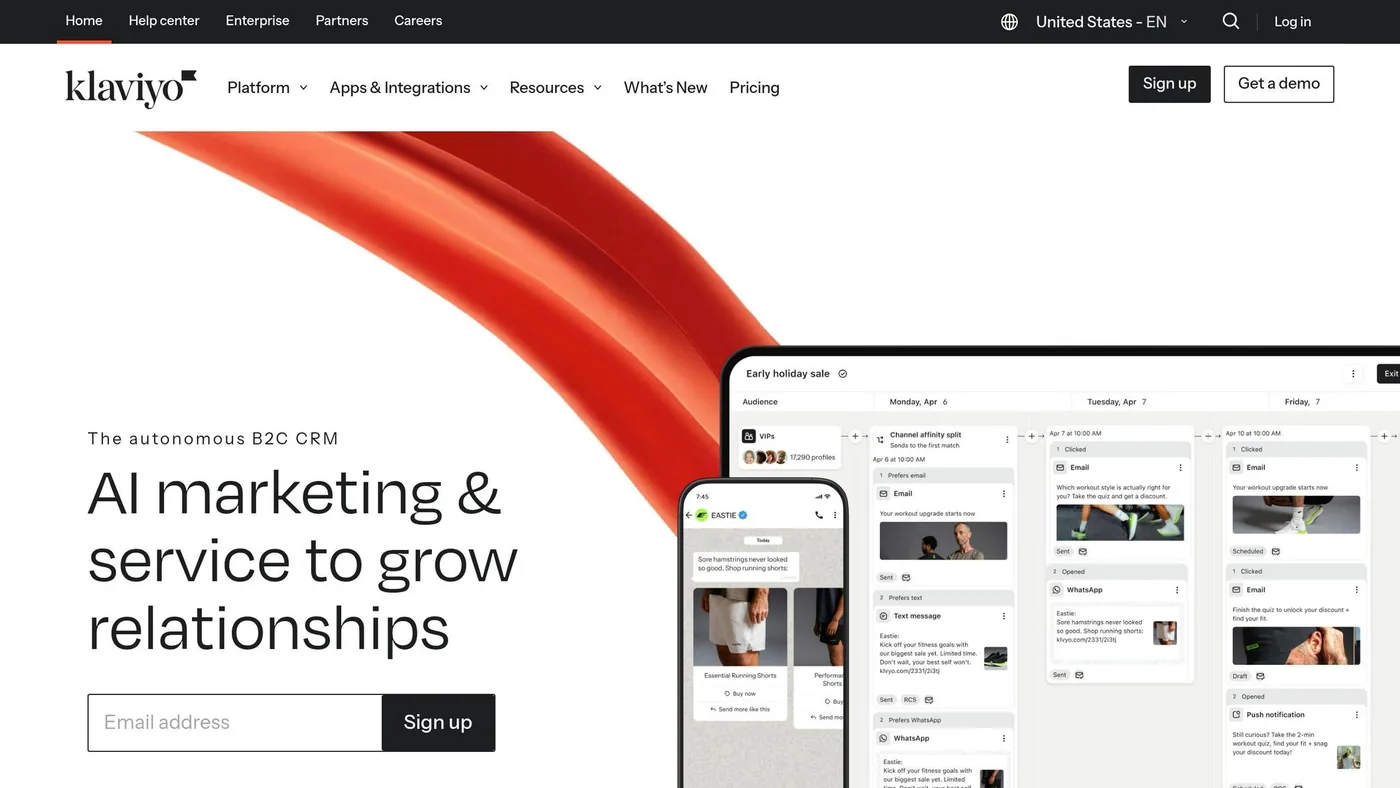
Klaviyo is the ecommerce-first pick for teams that want speed and simplicity instead of enterprise-heavy setup. As of 2026, it powers more than 193,000 brands and has passed $1.04 billion in ARR. About 90% of its customer base runs on Shopify, which helps explain why it tends to click with ecommerce teams that want retention quality content marketing tools tied closely to purchase data.
Channel coverage
Klaviyo natively supports email, SMS/MMS, RCS, and mobile push notifications. WhatsApp reached limited general availability in May 2026 for the UK, EU, and select APAC markets. If your team also needs in-app messaging or content cards, you’ll need third-party tools.
Real-time orchestration
Klaviyo uses a batch-and-trigger model with about a 15-minute Shopify sync. That delay puts some limits on more advanced orchestration, but it still handles staples like abandoned cart and browse-abandonment flows well. It’s a strong option for ecommerce-triggered messaging, though it’s less suited to fast-moving, cross-channel decisioning.
For Shopify brands that depend on live behavioral triggers, abandoned cart flows can drive 3x to 5x higher conversion rates than batch triggers.
Data and AI depth
Its CDP brings together purchase history, browsing behavior, and zero-party data from quizzes, surveys, and support tools. Segment Intelligence, launched in March 2026, uses behavioral clustering to surface high-value cohorts, and brands reported an 18% to 24% lift on win-back flows. Native predictive analytics cover churn risk, predicted LTV, and next-order date. The AI suite also includes autonomous Marketing, Customer, and Composer agents for campaign creation.
Klaviyo also supports MCP, which lets marketers query their data through tools like ChatGPT or Claude. That can make analysis feel a lot less clunky, especially for lean teams that don’t want to dig through dashboards for every answer.
Implementation and cost
A standard Shopify integration can go live in under two hours with no code, while a full historical sync usually takes 1 to 3 days. Email plans start at $45/month for 1,500 contacts, climb to about $1,700/month for 250,000 profiles, and often land around $2,200 to $2,800/month with SMS for 100,000+ contacts. Enterprise tiers include dedicated CSM support and custom data pipelines for larger teams.
Best fit: Shopify-native DTC brands in roughly the $1 million to $30 million revenue range that want email, SMS, and predictive analytics in one place without needing a dedicated data engineer to get started.
6. Insider
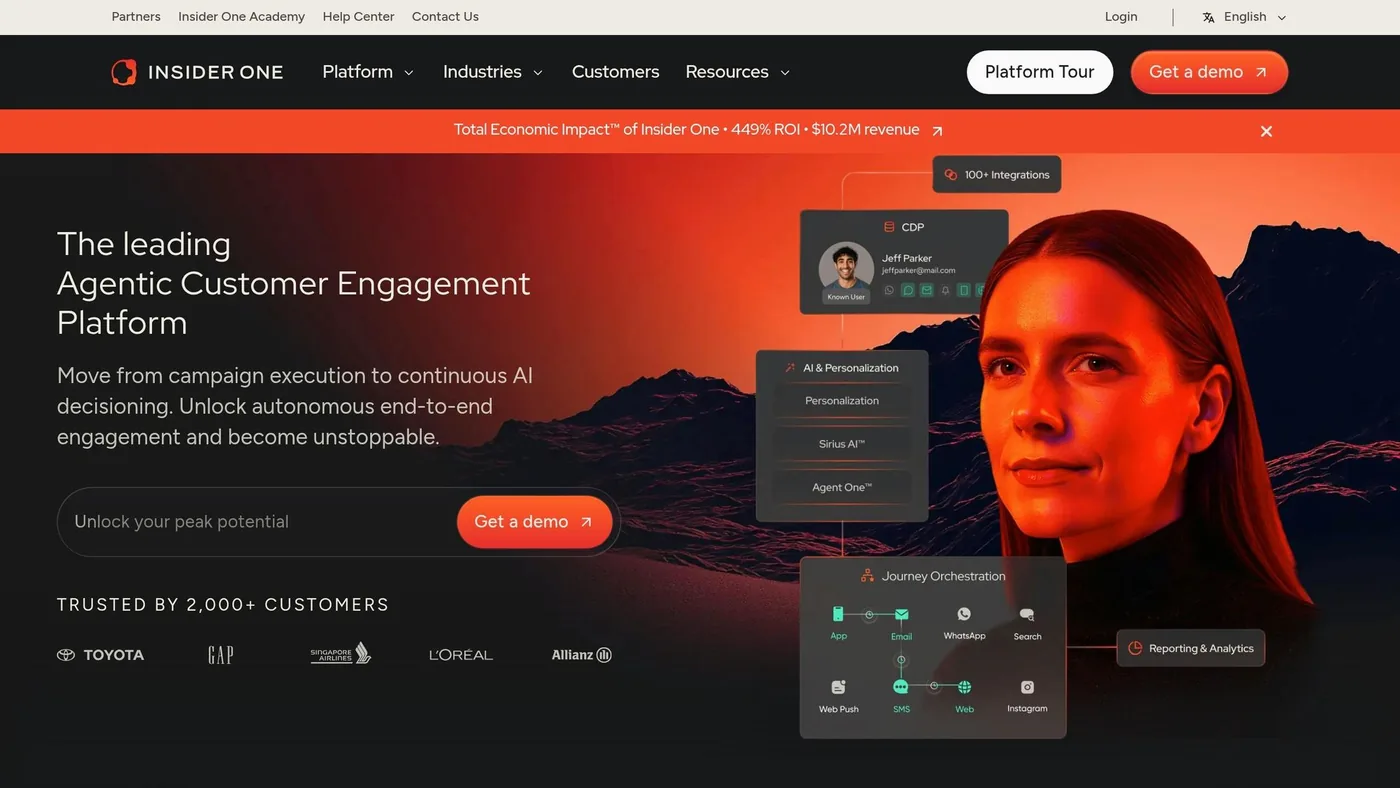
For teams that need more than what ecommerce-first tools usually handle, Insider is the heavier enterprise option. It’s built for large teams that want broad, cross-channel orchestration from one platform. Out of the tools in this group, Insider has the widest channel reach and some of the deepest autonomous decisioning. More than 2,000 global brands use it, and Gartner Peer Insights gives it a 4.9/5 rating.
Channel coverage
Insider natively supports 12+ channels, including email, SMS, WhatsApp, web push, app push, in-app messaging, web personalization, social ads, and AI voice calls. It also includes InStory, a Stories-style format for web and app.
That range matters for a simple reason: Insider doesn’t treat these as separate tools. It uses them inside one automated journey engine, so teams can coordinate messaging across channels instead of patching together disconnected campaigns.
Real-time orchestration
Its journey builder, Architect, lets teams create multi-step flows based on events, behaviors, attribute changes, or price drops. So if a customer ignores an email, Insider can switch to a push notification on its own, without someone going back in to rewrite rules.
Sirius AI adds another layer. It reacts to live behavior and picks the next channel, timing, and message automatically. That can take a lot of manual decision-making off a team’s plate, especially when journeys start getting large and messy.
In 2026, Slazenger reported 49x ROI and a 700% increase in customer acquisition after using Architect across email, web push, and SMS.
Data and AI depth
Insider’s CDP builds real-time customer profiles and processes behavioral signals in under 50 milliseconds. Its predictive AI, ATHENA, flags users who are likely to purchase or churn and also surfaces look-alike audiences automatically.
The platform also supports Zero Copy Segmentation through a native Snowflake integration. That means teams can activate data without manual syncing, which cuts down on extra data movement and the delays that often come with it.
Implementation and cost
Insider says it does not need third-party system integrators. Instead, its in-house global support team handles setup, which usually takes weeks rather than months. It also comes with 100+ pre-built connectors for CRMs, ad networks, ecommerce platforms, and loyalty tools.
Pricing is custom and enterprise-only, with most contracts based on contact volume and module selection. Setup, support, and integrations are generally bundled, with no hidden fees.
Best fit: Enterprise brands with 50,000+ contacts that need complex cross-channel orchestration and have the internal team to deal with a steep learning curve.
7. RingCentral
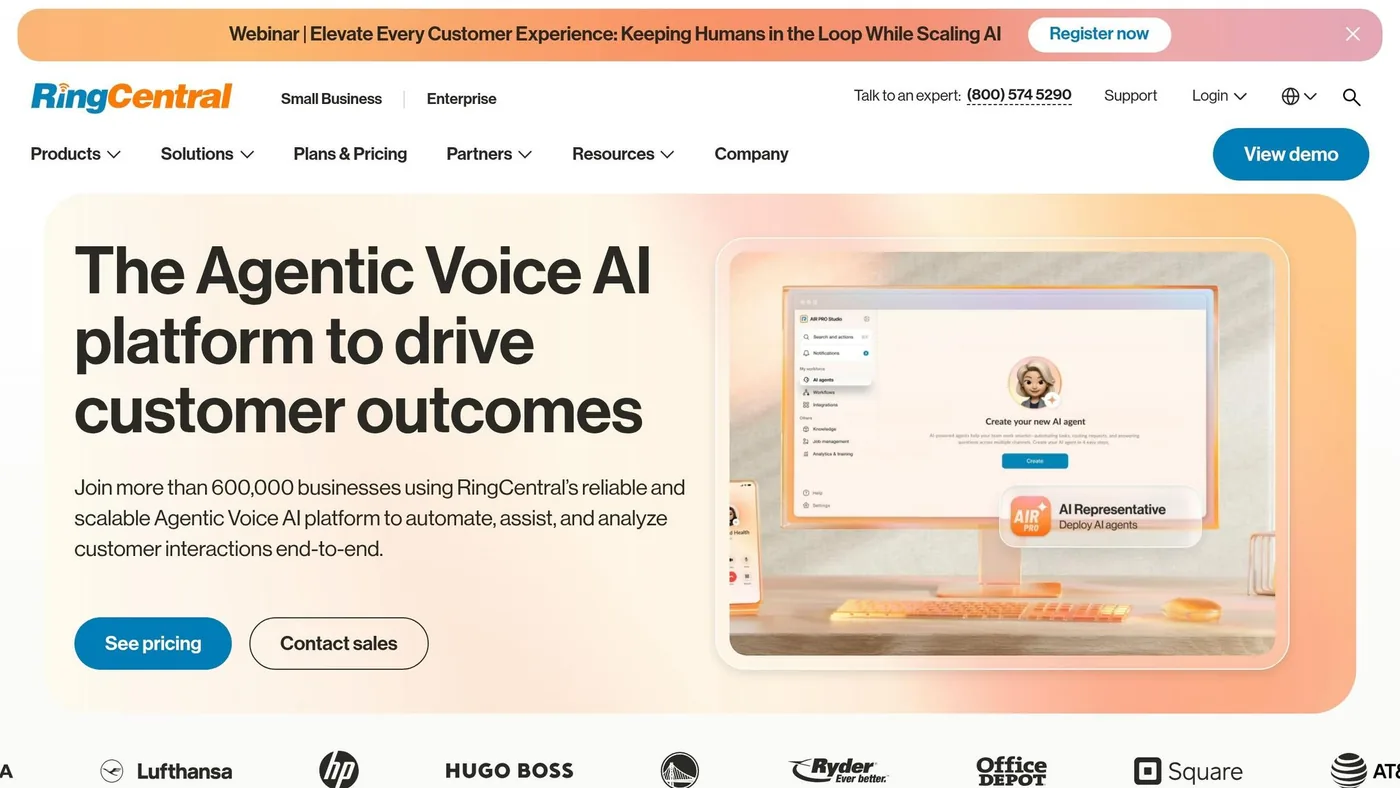
RingCentral is a different kind of tool from the earlier options on this list. It’s built for service conversations first, not marketing automation. More specifically, it’s a CCaaS and UCaaS platform made for service-first omnichannel engagement.
So, it only fits this list for teams that need voice plus digital support journeys. If your team is focused on support, omnichannel engagement means every live customer conversation, not just campaign sends. And that’s where RingCentral stands apart. Compared with marketing-first platforms, its edge is live service handling, not campaign automation.
Channel coverage
RingCentral’s RingCX platform handles voice and 20+ digital channels, including SMS, email, WhatsApp, Facebook Messenger, and social media, all from one agent workspace.
That said, it does not natively support marketing-led workflows like:
- Instagram comment-to-DM funnels
- Cart-recovery campaigns
- Mobile push lifecycle messaging
Real-time orchestration
RingCX uses Agentic AI (AVA) to manage interactions across the full customer lifecycle. The AI Receptionist greets callers, figures out intent, handles routine tasks like scheduling, and routes each person to a live agent with the transcript attached.
Routing is based on intent, history, and agent skill. But if you want routing based on deeper customer history, RingCentral still leans on CRM data from tools like Salesforce, HubSpot, or ServiceNow.
“What I appreciate most about RingCentral Contact Center is the unified and intuitive nature of the platform. Calls, messages, customer interactions, and reporting are all brought together in a single place.” – Eric P, Account Executive, Mid-Market
Data and AI depth
AI Quality Management automatically scores 100% of customer interactions. That’s a big jump from the industry norm of just 1% to 2% manual sampling. It also keeps historical interaction data for 25 months.
On top of that, RingCentral offers 500+ integrations and supports compliance needs like HIPAA, HITRUST, PCI DSS, and GDPR. That makes it a fit for teams in regulated industries.
Implementation and cost
RingCentral says standard setups can go live in days to 4 weeks because the platform is cloud-native.
Pricing starts at $65 per agent/month for RingCX. But there’s a catch: you also need a RingEX base plan at $20 per user/month. That puts the starting cost closer to $85 per seat/month.
AI add-ons push the price higher, and add-ons can bring total cost 40% to 60% above the base price.
User ratings are mixed. RingCentral has 4.0/5 on G2 and 4.3/5 on Capterra. Reviews often point to strong CRM integration and solid voice quality, while also calling out complex onboarding and auto-renewing contracts that are hard to exit.
Best fit: Mid-market and enterprise teams with 50+ seats that want UCaaS and CCaaS in one platform, especially in regulated industries where voice and service interactions are the main use case. RingCentral is at its best when voice and service workflows matter most. For marketing-led omnichannel teams, though, it’s a much tighter fit.
Pros and Cons at a Glance
Use this table to narrow the list fast. It sums up the tradeoffs that tend to matter first: speed, scale, and the amount of work your team has to carry.
| Platform | Primary Strengths | Weak Points | Setup Demand | Best-Suited Teams |
|---|---|---|---|---|
| Salesforce Marketing Cloud Engagement | Best CRM depth | Slow to implement; high admin overhead | 3–6 months; certified partner usually required | Large enterprises already in the Salesforce ecosystem |
| Adobe Experience Platform and Adobe Journey Optimizer | Best for Adobe-native real-time profiles | Complex data model; strongest inside AEP | 3–6 months; significant data and workflow configuration | Global enterprises standardizing on the Adobe stack |
| Braze | Strong real-time mobile orchestration | Requires engineering support | 6–12 weeks; engineering and dev resources required | Scaling B2C digital brands and mobile-first apps |
| Iterable | Event-based orchestration and flexible cross-channel workflows | Success depends on clean identity resolution and technical event instrumentation | 4–8 weeks; engineering support required | B2C teams that can support technical event setup |
| Klaviyo | Fastest launch for ecommerce teams | Less suited to complex enterprise orchestration | Hours to days for basic Shopify setup; broader rollout takes longer | DTC and ecommerce brands without a marketing engineering function |
| Insider | 12+ channel coverage with a built-in CDP | Broad channel scope can increase coordination needs | Weeks rather than months; CDP-native setup reduces data wiring | Mid-market to enterprise teams needing broad channel reach |
| RingCentral | Voice-first service orchestration across 20+ digital channels | Not built for marketing-led lifecycle automation | Days to 4 weeks | Support and contact-center teams, especially in regulated industries |
There’s a clear pattern here: the more power you get, the more data work and engineering support you usually need up front. Salesforce and Adobe both take 3–6 months to go live. Braze and Iterable move faster, but they still need technical setup, landing in the 6–12 week and 4–8 week ranges if engineers are ready to wire event streams from day one.
Klaviyo stands apart. It’s the only platform in this group that a lean marketing team can reasonably launch in under a week for basic ecommerce use, without dedicated technical help. That speed matters, especially for smaller teams that need to get campaigns out the door. The tradeoff is simpler: as your setup gets more advanced, you may outgrow it and need a platform with heavier engineering requirements.
Cost can trim the shortlist even faster. Braze mid-market contracts usually land between $60,000 and $80,000 per year, while standalone Adobe Journey Optimizer licensing starts at about $75,000 per year and is often linked to AEP pricing. In plain English, price helps you cut options early. The harder part is fit: your data setup, channel mix, and team capacity will decide what actually works.
From here, the best choice is the one that lines up with your channels, your data setup, and how much internal lift your team can handle.
Conclusion
The right pick comes down to your scale, channels, data quality, and how much your team can handle during setup.
In practice, fit matters more than feature count. Enterprise teams already committed to Salesforce or Adobe will usually do better staying inside those ecosystems. If you need reach across more channels without rebuilding your data layer, Insider’s 12+ channel coverage and unified AI-native CDP make it a strong match. Shopify-native DTC brands usually get moving fastest with Klaviyo. Braze works well for mobile-first lifecycle teams. And support-led organizations are better served by RingCentral RingCX, which connects proactive engagement with reactive customer service.
Pick for the next 18 months, not just the current quarter.
Choose the platform that fits your current channels and can keep up with where your growth is headed over the next 18 months.
FAQs
How do I choose the right platform for my team?
Pick a platform that matches your team size, technical setup, main channels, and how mature your data operation is. The best option on paper can still be the wrong fit if your team can’t run it day to day.
If you have a strong engineering team, API-first vendors may make more sense. They give you more control and room to build. If your main goal is retention and you don’t have much engineering support, look for visual journey builders and pricing that’s easy to understand.
Focus on:
- omnichannel orchestration
- integration depth
- built-in AI and automation
- total cost of ownership
What setup work should I expect before launch?
Before launch, get your data and tech setup in order. Put your attention on three areas:
- Data readiness: Make sure your CRM, analytics, and eCommerce systems can support a unified customer profile.
- Channel configuration: Map connections for email, SMS, push, and social.
- Resources: Plan for professional services or internal IT for onboarding, routing logic, and ongoing maintenance.
When should I prioritize voice over marketing channels?
Put voice first when your team handles a lot of one-to-one customer contact or when calls make up a big part of daily communication.
A good rule of thumb: if voice is more than 40% of total volume, a platform with native voice integration is usually the better fit.
Voice also plays a big role when you need one customer profile that spans digital channels and phone systems. That way, context stays intact across the entire customer lifecycle instead of getting lost every time someone switches channels.
Related Blog Posts

We research and organize marketing software around practical use cases. Product claims are included only when supported by available sources.
Read our editorial policy →Related guides

How to Outsource Content Creation Without Losing Your Brand Voice
Learning how to outsource content creation can solve one of the biggest problems in content marketing: there is always more content to create than there is time to create it. Blog posts need writing, landing pages need updating, emails need preparing, and social channels need a steady supply of useful material. But handing the work […]

Vista Social vs Metricool: Which Social Media Management Tool Is Better in 2026?
Vista Social vs Metricool is a close comparison because both platforms bring social media scheduling, analytics, content planning, and management into one place, but they approach the job differently. Vista Social puts more emphasis on engagement, team workflows, automation, and managing conversations alongside publishing, while Metricool has a particularly strong focus on planning, analytics, competitor […]
Content Marketing Tools: How to Build the Right Software Stack
Build a practical content marketing software stack for planning, writing, design, distribution and measurement without paying for overlapping tools.