

This article may contain affiliate links. We may earn a commission at no additional cost to you; this does not determine our editorial conclusions.
Running a business already means handling more jobs than you probably expected. Marketing is often one of them. You know you need to attract customers, stay visible, keep in touch with existing customers, and give people a reason to choose you—but there may be nobody whose full-time job is making all of that happen.
The good news is that marketing without a marketing team doesn’t require you to behave like a company with an entire marketing department. Trying to copy what larger businesses do can actually make marketing harder, especially when the same person is also dealing with customers, operations, finances, and everything else involved in running the business.
You don’t need to publish every day, maintain six social accounts, run paid ads, produce weekly videos, send constant emails, and chase every new marketing trend. A smaller number of well-chosen activities can be far more manageable—and more useful—than trying to maintain a presence everywhere.
The aim is to build a marketing approach that fits the business you actually have. That means deciding what deserves your attention, what can be simplified or automated, and what may eventually make more sense to outsource.

Quick Takeaways
• Start with a business goal rather than a list of marketing tactics.
• Be specific about the customers you’re trying to reach.
• Focus on a few channels you can realistically maintain.
• Make your website answer the questions prospects repeatedly ask.
• Create useful content instead of publishing simply to stay active.
• Automate repetitive marketing work where it genuinely saves time.
• Outsource specialist tasks when learning them yourself isn’t a good use of your time.
• Measure enquiries, leads, sales, and other meaningful outcomes—not activity alone.
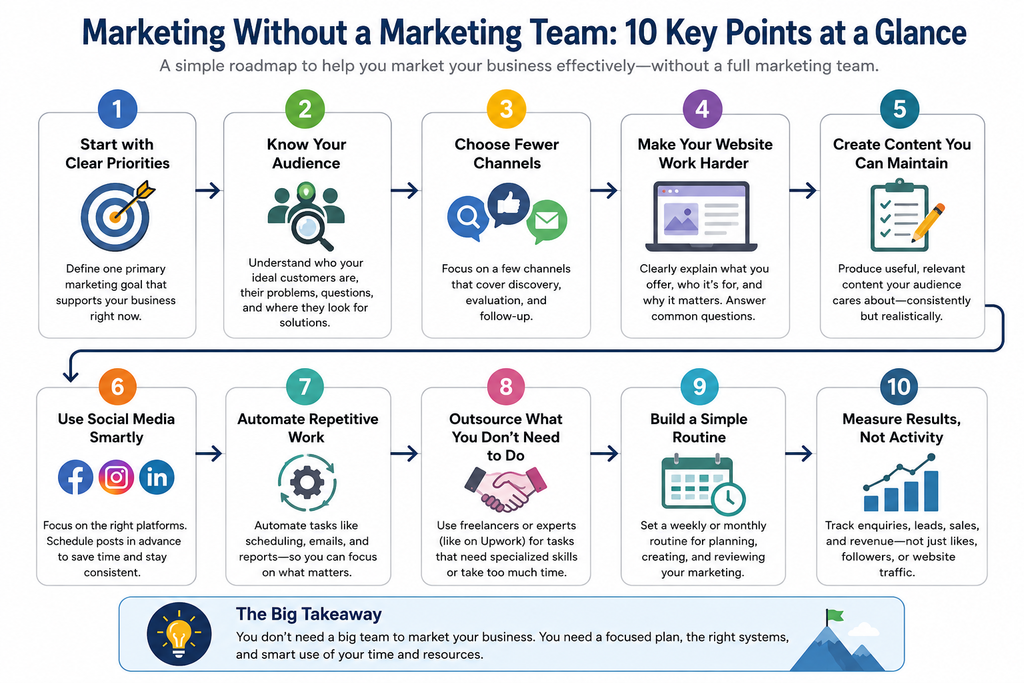
1. Marketing Without a Marketing Team Starts With Clear Priorities
One of the easiest ways to waste limited marketing time is to start with tactics instead of deciding what you’re actually trying to accomplish.
You see competitors posting regularly on Instagram, so you start posting there. Someone recommends Google Ads, so you experiment with a campaign. Then comes an email newsletter, a blog, LinkedIn, TikTok, SEO, webinars, and whatever marketing tactic happens to be getting attention that month.
Individually, none of those things is necessarily a bad idea. The problem is trying to do all of them without knowing which business result they’re supposed to produce.
Start with a much simpler question:
What does the business need marketing to accomplish right now?
A new business may primarily need awareness. An established service company may need more qualified enquiries. An ecommerce business might have enough new customers but need more repeat purchases. Another company may simply want to make its sales pipeline more predictable.
Those goals don’t necessarily require the same marketing activities.
This is also why having a basic content marketing strategy is useful even if content is only one part of your overall marketing. It helps connect what you create with a particular audience, business objective, and distribution plan instead of publishing simply because you feel you should be publishing.
Choose one primary marketing goal for the next few months. You can still have secondary goals, but having a clear priority makes it much easier to decide which activities deserve your limited time—and which ones can wait.
2. Know Who You’re Trying to Reach Before Choosing Marketing Channels
When resources are limited, marketing to “everyone who might be interested” becomes expensive very quickly.
You don’t necessarily need an elaborate customer persona describing an imaginary person’s favorite coffee shop, personality type, and weekend hobbies. You do need a practical understanding of the people most likely to buy from you.
Look at your better customers and consider what they have in common. What problem originally brought them to you? What were they trying to accomplish? What questions did they ask before buying? What alternatives were they considering? How did they discover your business—or businesses like yours—in the first place?
Those answers can tell you much more about where to spend your marketing time.
A local home-service company, for example, may get more value from local search, customer reviews, and referrals than from building a large LinkedIn following. A B2B consultancy targeting operations directors may have very different priorities. A visually driven consumer brand could require another mix entirely.
Understanding the audience also improves the marketing itself. Google’s guidance on creating helpful, reliable, people-first content recommends creating content for an existing or intended audience and making sure people leave feeling they’ve learned enough to help achieve their goal. That principle is useful beyond SEO.
Instead of starting every week by asking:
“What should we post?”
Start with:
“What does our audience actually need help with?”
The second question tends to produce much more useful marketing.
3. Choose Fewer Channels When Marketing Without a Marketing Team
Being everywhere sounds appealing until you have to maintain everywhere.
Every additional marketing channel creates work. Someone has to decide what to publish, create it, adapt it for the platform, respond to people, monitor results, and eventually determine whether any of that effort is contributing to the business.
For a small business, two or three channels that are actively maintained can be much more useful than seven neglected ones.
A practical way to choose them is to think about three jobs your marketing needs to perform:
Discovery: Where can people who don’t know your business find you?
Evaluation: Where will potential customers go when deciding whether you’re worth considering?
Follow-up: How will you stay connected with people who aren’t ready to buy immediately?
For one business, search might generate discovery, the website could handle evaluation, and email could provide follow-up. Another might rely heavily on LinkedIn, referrals, and direct conversations. There is no combination that works equally well for every company.
The goal is to find the smallest combination of channels that gives a potential customer a realistic path from discovering your business to considering it and eventually taking action.
Give those channels enough time to produce meaningful information before adding more. If one isn’t performing, don’t immediately replace it with whatever platform is currently popular. First determine whether the problem is the channel itself, the audience you’re reaching, or what you’ve been doing there.
4. Make Your Website Do More of the Marketing Work
When there isn’t a marketing team following up with every potential customer, your website needs to answer more questions on its own.
That doesn’t mean you need hundreds of pages or an expensive redesign. It means someone arriving on the site should quickly understand what you offer, who it’s for, why they should consider you, and what they can do next.
This is where otherwise good marketing can lose momentum.
A business might spend months improving search visibility or building a social audience, only to send those visitors to a homepage filled with statements such as “innovative solutions for modern businesses.” The words may sound professional, but they don’t necessarily help a potential customer understand what the company actually does.
Make important pages specific. Explain the problems you solve. Answer the questions customers repeatedly ask. Address reasonable concerns about your product or service. Where appropriate, show genuine examples, testimonials, case studies, or other evidence that helps people evaluate the business.
Useful articles can support this process as well. Someone who discovers your company while researching a problem may not be ready to enquire immediately. An article can answer the initial question and then point them toward another relevant resource, service page, product, or next step.
Your website then becomes more than somewhere you send traffic. It becomes the central point connecting the marketing activities you’re able to maintain.
That matters particularly when you’re marketing without a marketing team. The more useful information people can find without needing someone from the business to explain everything personally, the more work your existing marketing can do even when you’re busy elsewhere.
5. Create Marketing Content You Can Realistically Maintain
Content can be one of the most useful parts of marketing without a marketing team, but only if the workload is realistic.
A common mistake is deciding on a publishing schedule first and then scrambling to fill it. A business commits to three blog posts a week, daily social updates, a monthly newsletter, and regular videos because that sounds like what an active marketing operation should look like.
Within a few weeks, marketing starts competing with the work that actually runs the business.
A better approach is to create less content with a clearer purpose. One genuinely useful article that answers a question potential customers regularly ask may be worth far more than five rushed posts created simply to keep a publishing calendar full.
Look for topics that remain useful over time. Customer questions are an obvious starting point. So are common problems, comparisons, buying considerations, mistakes, processes, and situations where customers regularly need guidance before making a decision.
You can also get more from material you’ve already created. A useful article might provide ideas for several social posts, a section of an email newsletter, a short video, or an answer your sales team can send to prospects.
The aim isn’t to turn every article into ten pieces of content just because you can. It’s to avoid starting from a blank page every time you need something to publish.
6. Use Social Media Without Letting It Take Over Your Week
Social media can be useful for a small business, but it can also become an enormous consumer of time.
Posting manually is rarely just a five-minute task. You have to decide what to say, find or create an image, publish the post, repeat the process on another network, check comments, and then start again a few days later.
That’s manageable if social media is one of your most valuable marketing channels. It’s harder to justify if you’re spending several hours each week maintaining accounts that produce little meaningful business activity.
Start by deciding which networks actually matter to your customers. You may discover that you only need to be consistently active on one or two.
Then make the process easier to maintain.
Instead of creating every post on the day it needs to be published, you can prepare several at once and schedule them ahead of time. Social media management platforms such as Vista Social can help with this by bringing scheduling and account management into one place, particularly when you’re maintaining more than one social profile.
We’ve looked more closely at those features in our Vista Social review if you’re considering whether a dedicated management platform is worth adding to your workflow.
Automation doesn’t mean putting social media completely on autopilot. Questions, comments, and genuine conversations still benefit from a human response. The goal is simply to remove repetitive administrative work so that your limited time can go toward the parts where your involvement actually matters.
If content creation itself is taking too much time, some of the same principles can be applied there. Our guide to automating social media content creation for small businesses covers where automation can help without treating every part of the process as something that should be handed over to AI.
7. Automate Repetitive Marketing Work, Not the Decisions That Matter
Automation is particularly attractive when you’re doing your own marketing because there are only so many hours available in a week.
But the goal shouldn’t be to automate marketing simply because a tool allows you to.
Start with tasks you find yourself doing repeatedly.
Scheduling social posts is an obvious example. So are routine email sequences, basic lead follow-ups, appointment reminders, recurring reports, and moving information between tools.
If a task follows roughly the same process every time and doesn’t require much judgment, it’s a good candidate for automation.
Deciding what your customers care about is different. So is responding to an unusual customer concern, changing your positioning, deciding which offer to promote, or evaluating why a campaign isn’t working. Those decisions benefit from context that a predefined workflow may not have.
This distinction becomes important as AI and automation tools become capable of handling more marketing tasks. Saving time is useful, but producing more marketing activity isn’t automatically an improvement.
A business that automates ten unnecessary tasks has simply found a faster way to do work it may not need.
Before automating something, ask whether you’d still want the task done if it required your own time. If the answer is no, consider eliminating it instead.
8. Outsource the Marketing Work That Doesn’t Need to Stay With You
Not having a marketing team doesn’t mean you personally need to become a copywriter, graphic designer, video editor, SEO specialist, advertising manager, and web developer.
There is a difference between understanding enough about marketing to make good decisions and learning how to perform every specialist task yourself.
Suppose you need a short promotional video a few times a year. Learning professional video editing may take considerably more time than the project warrants. The same can be true of designing an ebook, fixing a technical website problem, creating a set of display ads, or setting up a complicated advertising campaign.
This is where freelance marketplaces such as Upwork can be useful. Instead of adding a permanent employee, a small business can bring in a freelancer for a specific project or skill when the need arises.
The important part is knowing what you’re outsourcing.
“Help with our marketing” is a difficult assignment for any freelancer.
“Design this 12-page guide using our existing brand guidelines” or “edit these four recorded videos into short clips for LinkedIn” gives someone a much clearer job to complete.
You should still understand the goal, audience, message, budget, and expected result. Outsourcing works best when you retain the marketing decisions that depend on knowledge of your business while handing off specialist execution that doesn’t require you personally.
9. Build a Simple Routine Instead of Constantly Thinking About Marketing
One reason marketing feels overwhelming for small businesses is that it never seems finished.
There’s always another post that could be written, another email that could be sent, another keyword to target, or another platform to try.
A simple routine makes that workload more predictable.
You might spend a short block of time once a week reviewing marketing performance and preparing anything that requires your input. Social posts can be scheduled together. Content projects can be planned in advance. Email campaigns can have defined dates rather than being created whenever someone remembers the mailing list exists.
Monthly, you can spend more time reviewing what’s working.
The exact schedule matters less than having one. Marketing shouldn’t require you to make the same decisions from scratch every morning.
A routine also makes it easier to notice when you’ve taken on too much. If your planned marketing work consistently doesn’t fit into the time you’ve allocated to it, that’s useful information. Something probably needs to be removed, automated, simplified, or outsourced.
For marketing without a marketing team, sustainability matters more than an ambitious schedule you can only maintain for a month.
10. Measure Business Results, Not How Busy Your Marketing Looks
A business can appear very active online without generating much business from that activity.
More followers, impressions, website visitors, video views, and email subscribers can all be encouraging. But none of those numbers tells the whole story.
The metrics that matter depend on the goal you established at the beginning.
If you’re trying to generate enquiries, measure enquiries and where they came from. If you sell online, look at purchases and revenue rather than stopping at website traffic. If repeat business is the priority, customer retention and repeat purchases deserve more attention.
Google’s guidance on marketing measurement similarly emphasizes connecting marketing interactions with meaningful business outcomes rather than looking at isolated activity.
You don’t need a complicated dashboard containing dozens of metrics. You need enough information to answer a few practical questions:
What’s bringing potential customers to us?
What’s helping those people take the next step?
What’s consuming time or money without producing much in return?
The answers can guide what you do next.
If one channel consistently brings qualified enquiries, it may deserve more attention. If another takes hours every week but rarely contributes anything meaningful, maintaining it simply because “businesses should be there” becomes harder to justify.
That’s one of the biggest advantages a small business has. You don’t have to maintain a complicated marketing operation simply because that’s how larger organizations work.
You can keep what works, improve what shows potential, and stop doing things that don’t justify the effort.
How to Put Your Small Business Marketing Plan Into Practice
After working through these ideas, resist the temptation to turn them into another long marketing checklist. You don’t need to change everything at once.
Start with the marketing you’re already doing. Look at where you’re currently spending time and money—social media, email, content, SEO, advertising, networking, referrals, direct outreach, or anything else you regularly maintain.
For each activity, ask:
• Is it reaching the type of customer we actually want?
• Is there evidence that it contributes to enquiries, sales, or another meaningful goal?
• Is the result worth the time and money we’re putting into it?
You won’t always have perfect attribution, especially in a small business. You don’t need it to make better decisions. You’re simply looking for enough evidence to decide what deserves your attention.
Then put each activity into one of four categories:
Keep it. It’s working well enough to justify the resources you’re putting into it.
Improve it. The channel makes sense, but something about the audience, message, offer, or execution could be better.
Simplify or automate it. It’s useful, but you’re spending more time on it than necessary.
Stop it. You’re continuing mainly because you’ve always done it, and there isn’t a convincing business reason to keep going.
This is worth repeating periodically because marketing plans have a habit of growing. New channels and tactics get added while old ones quietly remain on the to-do list.
Sometimes the best way to improve your marketing isn’t to add something new. It’s to free up time and budget from something that isn’t working and put those resources behind what is.
Frequently Asked Questions
Can a small business do marketing without hiring a marketing team?
Yes. Many small businesses can manage their core marketing with a focused strategy, a limited number of channels, and a realistic workload.
That doesn’t mean you need to do every task yourself. Automation can take care of repetitive work, while freelancers or specialists can handle projects that require skills you don’t regularly need in-house.
Which marketing channels should a small business start with?
Start with where your potential customers actually look for information and businesses like yours.
A local service business might prioritize local search, its website, reviews, and referrals. A B2B company could get more from search, LinkedIn, email, or direct outreach. A consumer brand may rely more heavily on visual social platforms and ecommerce channels.
Rather than starting everywhere, choose a few channels that give people a way to discover your business, evaluate what you offer, and take the next step.
How much time should a small business spend on marketing?
There isn’t a single number that works for every business.
What’s more important is deciding how much time you can consistently devote to marketing and building your approach around that constraint.
If your marketing plan requires 20 hours every week and you realistically have five, the problem isn’t necessarily your productivity. The plan itself probably needs to be simplified.
What marketing tasks should I automate?
Good candidates are repetitive tasks that follow a predictable process, such as scheduling social posts, routine email sequences, appointment reminders, and recurring reports.
Automation becomes less useful when a task requires judgment, context, or a genuine conversation. Strategy, positioning, important customer interactions, and major campaign decisions generally deserve more direct involvement.
When should I outsource marketing?
Consider outsourcing when a task requires specialist skills you only need occasionally or when doing the work yourself takes time away from more important parts of the business.
You don’t have to outsource your entire marketing operation. A freelancer can handle a clearly defined project—such as designing a guide, editing videos, writing specialist content, or setting up an advertising campaign—while you remain responsible for the overall direction.
Do I need expensive marketing software?
No. Start with the process, then decide whether software would genuinely make it easier.
A tool is worth considering when it solves a specific problem, saves meaningful time, or provides capabilities you actually need. Adding software without a clear purpose can simply give you another platform to manage.
How do I know whether my marketing is working?
Measure the outcome that matters to the business.
That might be qualified enquiries, appointments, purchases, repeat customers, or revenue. Traffic, impressions, followers, and engagement can provide useful context, but they shouldn’t automatically become the definition of successful marketing.
The goal is to understand which activities are helping move potential customers toward a meaningful business outcome.
Final Thoughts
Marketing without a marketing team doesn’t mean squeezing the workload of an entire marketing department into your spare time.
It means being more selective.
Choose a clear goal. Understand who you’re trying to reach. Concentrate on the channels that make sense for those customers. Let your website and useful content do some of the work for you, automate repetitive tasks where it helps, and outsource specialist work when doing it yourself isn’t a sensible use of your time.
Then pay attention to what actually produces results.
You don’t need the busiest marketing operation. You need one that’s simple enough to maintain and effective enough to help your business grow.

We research and organize marketing software around practical use cases. Product claims are included only when supported by available sources.
Read our editorial policy →Related guides

Black Friday Tracking Blind Spots: How Cookie Consent Affects Marketing Data and Attribution
Black Friday tracking blind spots can make campaign performance harder to interpret at exactly the time marketers need reliable data most. Ecommerce brands may see orders and leads increasing while analytics, advertising platforms, and other marketing systems provide an incomplete picture of which campaigns actually influenced those conversions. That doesn’t necessarily mean something is broken. […]
AI Marketing Video QA: A Pre-Publish Checklist for Small Teams
Check claims, product accuracy, permissions, captions and mobile readability before publishing an AI-assisted marketing video.
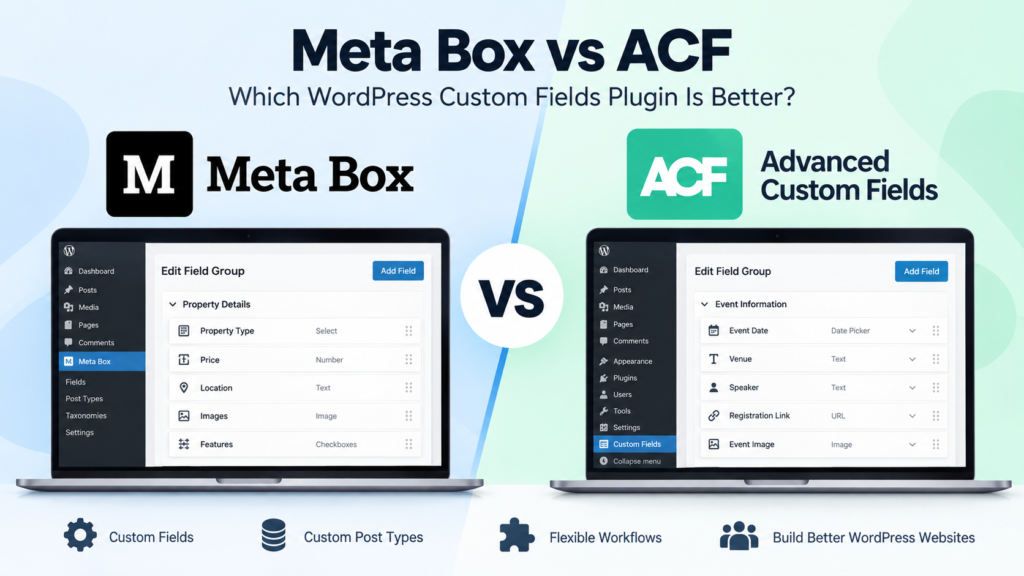
Meta Box vs ACF: Which WordPress Custom Fields Plugin Is Better in 2026?
Meta Box vs ACF is a common comparison when a WordPress website starts needing more flexibility than the standard post and page editor provides. Both plugins let you create custom fields, organize structured information, and build more dynamic WordPress websites without forcing everything into the main content editor. The differences become more important as the […]