
This article may contain affiliate links. We may earn a commission at no additional cost to you; this does not determine our editorial conclusions.
Creating more content has never been easier.
Creating content that actually generates traffic, builds trust, and helps grow a business is a different challenge entirely.
Many marketing teams fall into the same cycle. They publish social media posts because it’s time to post, write blog articles based on trending keywords, or produce videos simply because everyone else is doing it. They’re busy creating content, but they aren’t always creating the right content.
The result is familiar.
Traffic plateaus. Leads don’t improve. Sales teams still answer the same questions repeatedly. Marketing feels busy, yet business growth remains slow.
The problem usually isn’t the effort.
It’s prioritization.
Not every type of content delivers the same value. Some formats attract new visitors through search engines. Others help buyers compare solutions, answer objections before a sales call, or continue generating leads long after they’re published.
Businesses that see consistent marketing results don’t try to create everything. They invest in the content that supports their goals and delivers value throughout the customer journey.
Quick Answer
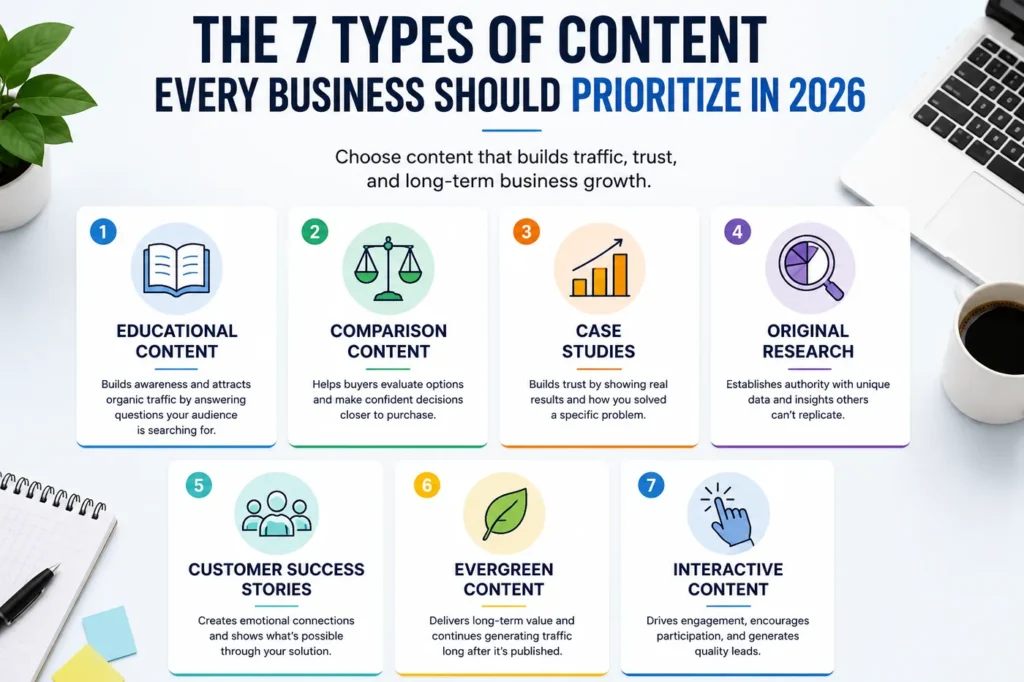
If you’re deciding where to invest your time and marketing budget, prioritize content that solves real customer problems and continues delivering value over time. Educational guides, comparison articles, case studies, original research, customer success stories, evergreen resources, and interactive content consistently provide the strongest long-term return because they attract visitors, build trust, and support buying decisions.
Why Most Businesses Create the Wrong Content
One of the biggest misconceptions in marketing is that publishing more content automatically produces better results.
It doesn’t.
A business might publish five social media posts every week yet struggle to generate qualified leads. Another company might publish one in-depth guide each month and consistently attract new customers through search.
The difference isn’t volume.
It’s choosing the right content for the right purpose.
Every piece of content should answer a simple question:
What business problem is this solving?
Sometimes the goal is attracting new visitors through search.
Sometimes it’s helping prospects compare products before making a purchase.
Sometimes it’s reducing support tickets or giving customers the confidence to move forward.
When every article, video, or downloadable resource has a clear purpose, content becomes an investment instead of another marketing task.
If you’re still building your long-term publishing plan, our guide on creating a content marketing strategy explains how to align content with your business goals before deciding what to publish.
If your current articles are not producing results, review why a business blog may fail to attract traffic or leads before choosing which content format to invest in next.
1. Educational Content: The Foundation of Long-Term Growth
If you could only invest in one type of content, educational content should almost always come first.
People search online because they’re trying to solve a problem.
They want to learn how to improve email marketing, choose the right CRM, optimize a landing page, or create a social media strategy. Businesses that consistently answer those questions position themselves as trusted resources long before a customer is ready to buy.
That’s why educational content remains one of the most valuable long-term investments in digital marketing.
Unlike advertisements that stop producing results when the budget ends, a well-written guide can continue attracting visitors for months or even years.
Educational content also performs well in AI-powered search because it focuses on answering questions clearly and thoroughly.
Examples include:
• Beginner’s guides
• Step-by-step tutorials
• Ultimate guides
• Checklists
• Frequently asked questions
The goal isn’t simply to explain a topic.
It’s to help readers accomplish something.
For example, instead of writing an article titled “What Is Email Marketing?”, create something like “How to Build Your First Email Marketing Campaign” that gives readers practical steps they can follow immediately.
The more useful your content becomes, the more likely readers are to bookmark it, share it, or return when they have another question.
2. Comparison Content: Help Buyers Make Better Decisions
Not every visitor is looking for education.
Some already know what they need.
They’re simply trying to decide which solution is right for them.
That’s where comparison content becomes incredibly valuable.
Searches such as “HubSpot vs Salesforce“, “Canva vs Adobe Express” or “Mailchimp alternatives” often come from people who are much closer to making a purchasing decision than someone searching for a general definition.
These readers aren’t looking for another feature list.
They’re looking for confidence.
A strong comparison article doesn’t try to convince readers that one product is always better than another. Instead, it explains who each solution is designed for, where it performs well, where it falls short, and which type of business is likely to benefit most.
Balanced comparisons build credibility because readers feel they’re receiving honest guidance instead of a sales pitch.
If you’re creating comparison content, include practical considerations such as pricing, ease of use, scalability, customer support, and ideal use cases rather than simply copying feature lists from product websites.
One common mistake businesses make is publishing comparisons without firsthand experience. If you haven’t tested a product yourself, be transparent about your research and avoid making claims you can’t support.
Comparison articles also age well because buyers continue searching for alternatives as new products enter the market.
3. Case Studies: The Content That Builds Trust
Advice is helpful. Proof is persuasive.
That’s why case studies continue to be one of the highest-performing content formats for businesses selling products or services.
Anyone can publish an article explaining best practices.
Far fewer businesses show what happened when those practices were actually applied.
A good case study doesn’t begin with impressive numbers.
It begins with a problem.
What challenge was the customer facing?
Why wasn’t the existing solution working?
What approach did you take?
What obstacles did you encounter?
Only after answering those questions should you discuss the results.
Readers don’t just want to see that traffic increased by 40% or conversions improved by 20%.
They want to understand why those improvements happened and what lessons they can apply to their own business.
Whenever possible, include screenshots, timelines, customer quotes, or before-and-after examples. These details make your story more credible while helping readers visualize the process.
Case studies also provide excellent material for multiple marketing channels. One detailed customer story can become a blog article, a short video, a webinar topic, several social media posts, or a sales presentation. If you’re looking to maximize the value of every article you publish, our guide to content repurposing explains how to turn one piece of content into multiple assets without constantly starting from scratch.
According to the Content Marketing Institute, marketers consistently rank educational and experience-based content among the most effective ways to build trust and support long-term marketing goals.
Likewise, Google’s guidance on creating helpful, reliable, people-first content emphasizes producing original content that demonstrates experience and provides genuine value rather than simply summarizing information already available elsewhere.
4. Original Research: The Fastest Way to Build Authority
One of the biggest challenges in content marketing today is standing out.
With AI making it easier than ever to create articles, many businesses are publishing similar content based on the same publicly available information. Original research changes that.
Instead of repeating statistics from another website, publish findings from your own business.
You don’t need thousands of survey responses to create valuable research. Your own analytics, customer surveys, campaign results, product usage trends, and sales data can all become valuable content when presented with useful insights.
For example, instead of writing another article about improving email marketing, analyze your last 100 campaigns and explain what patterns you discovered. Instead of summarizing SEO best practices, share what happened after updating your highest-performing pages.
Content based on firsthand data is more likely to earn backlinks because other websites prefer citing original sources instead of recycled information.
It also positions your business as a source of knowledge rather than a publisher of summaries.
5. Customer Success Stories: Show What’s Possible
Customer success stories are often confused with case studies, but they serve a different purpose.
A case study usually focuses on solving a specific business problem and explaining the process.
A customer success story focuses on the customer’s journey.
What motivated them to look for a solution?
What concerns did they have before making a decision?
How did your product or service fit into their workflow?
Most importantly, how did their business improve afterward?
Stories create emotional connections that statistics alone cannot.
When potential customers recognize challenges similar to their own, it’s easier for them to imagine achieving the same outcome.
Whenever possible, let customers speak in their own words. Quotes, testimonials, and short interviews add authenticity that polished marketing copy often lacks.
6. Evergreen Content: The Marketing Asset That Keeps Working
Not every article should focus on the latest trend.
Some of your most valuable content will be the articles people continue finding years after they’re published.
Evergreen content covers topics that remain relevant regardless of changing platforms or algorithms.
Examples include beginner guides, tutorials, glossaries, templates, checklists, and best practices that only require occasional updates.
The value of evergreen content compounds over time.
Instead of creating a brand-new article every month, you can improve existing resources by updating screenshots, refreshing statistics, expanding sections, and answering new questions readers are asking.
Businesses that consistently update their best-performing content often achieve better long-term results than businesses that constantly publish new articles and never revisit them.
If you’re using AI to speed up content creation, remember that AI should help improve quality rather than replace your expertise. Our article on using AI tools without losing authenticity explains how to balance efficiency with original thinking.
7. Interactive Content: Give People a Reason to Participate
Most content asks people to read.
Interactive content asks them to do something.
That simple difference often leads to higher engagement.
Interactive content includes calculators, quizzes, assessments, templates, worksheets, checklists, and downloadable planning tools.
For example, a mortgage calculator provides immediate value to home buyers. A marketing ROI calculator helps businesses estimate campaign performance. A content calendar template saves marketers hours of planning.
Unlike passive content, these resources solve a problem immediately.
They’re also highly shareable because people tend to recommend tools that make their work easier.
While interactive content usually requires more effort to create, it often delivers long-term value by attracting backlinks, generating leads, and encouraging repeat visits.
How to Decide Which Type of Content to Create First
A common mistake businesses make is trying to create every type of content at once.
A better approach is to match the content to your current business goal.
If your biggest challenge is attracting more visitors, prioritize educational content that answers the questions your audience is already searching for.
If prospects regularly compare your business with competitors, invest in honest comparison articles that help buyers make informed decisions.
If trust is slowing down sales, publish more case studies and customer success stories.
If you’re trying to build long-term authority, focus on original research that other websites can reference.
If you already have steady traffic but want better engagement, create interactive tools and downloadable resources that encourage visitors to take action.
The goal isn’t to publish everything.
It’s to publish the content your audience needs most right now.
If you are choosing these formats without a dedicated department, our guide to marketing without a marketing team explains how to set priorities and build a workload you can maintain.
Frequently Asked Questions
What type of content generates the best long-term marketing results?
Educational guides, comparison articles, case studies, original research, evergreen resources, customer success stories, and interactive tools consistently provide the greatest long-term value because they continue attracting visitors, building trust, and supporting buying decisions.
Which type of content is best for SEO?
Educational and evergreen content generally performs best because it answers questions people search for consistently. Updating high-performing articles regularly also helps maintain visibility over time.
Why is original research important?
Original research gives readers information they can’t find elsewhere. It also increases the likelihood of earning backlinks, media mentions, and citations from other websites.
Should every business create case studies?
If you have customer success stories or measurable results to share, yes. Case studies help demonstrate credibility by showing how your product or service solved a real problem instead of simply describing what it does.
How do I know what content to prioritize?
Start with your biggest business challenge. If you need more traffic, create educational content. If you need more trust, publish case studies and customer success stories. If you need stronger authority, invest in original research. Matching content to business goals usually produces better results than chasing every content trend.
Final Thoughts
One of the biggest mistakes businesses make is treating every piece of content as equally valuable.
It isn’t.
A social media post may generate attention for a day.
A paid advertisement may stop producing results when the budget runs out.
But a helpful guide, a thoughtful comparison article, a detailed case study, or a piece of original research can continue attracting visitors, building trust, and supporting sales long after it’s published.
That’s why successful content marketing isn’t about publishing more.
It’s about investing in content that becomes a business asset.
Before creating your next article, don’t ask:
“What should we publish this week?”
Ask:
“What type of content would create the most value for our audience—and our business—over the next year?”
The answer to that question will often determine whether your content becomes another post that disappears or an asset that continues delivering results for years.

We research and organize marketing software around practical use cases. Product claims are included only when supported by available sources.
Read our editorial policy →Related guides

Shopify vs Squarespace: Which Is Better for Selling Online in 2026?
Shopify vs Squarespace is a common decision for entrepreneurs and small businesses planning to sell products online. Both platforms allow you to create a professional website, manage products, accept payments, and operate an online store without building everything from scratch. However, they approach ecommerce differently, and those differences can become more important as your business […]

Parallels Desktop vs VMware Fusion: Which Is Better for Running Windows on Mac in 2026?
Parallels Desktop is best for Mac users who want seamless Windows integration and easy setup. VMware Fusion is better for those seeking free virtualization, especially developers and occasional Windows users.

Black Friday Tracking Blind Spots: How Cookie Consent Affects Marketing Data and Attribution
Black Friday tracking blind spots can make campaign performance harder to interpret at exactly the time marketers need reliable data most. Ecommerce brands may see orders and leads increasing while analytics, advertising platforms, and other marketing systems provide an incomplete picture of which campaigns actually influenced those conversions. That doesn’t necessarily mean something is broken. […]