
This article may contain affiliate links. We may earn a commission at no additional cost to you; this does not determine our editorial conclusions.
If I had to boil this down to one rule, it’s this: write anchor text that tells people where the link goes, then keep your anchor mix natural.
That means I avoid vague anchors like “click here”, limit exact-match anchors in backlinks, and use more branded, partial-match, and URL-based links. The article also points out a few numbers worth watching: top-ranking pages often keep exact-match backlink anchors around 3%–8%, while branded anchors tend to make up the largest share. For internal links, the article notes that pages with at least one exact-match internal anchor saw about 5x more search traffic in one Zyppy study.
If you want the short version, here it is:
- Use clear anchor text that says what the page is about
- Pick anchor types on purpose: exact, partial, branded, URL, generic, and image alt text
- Keep anchors natural so they read like normal English
- Match the sentence around the link to the destination page
- Use internal links well because you control them
- Keep backlink anchors mixed so the profile looks normal
- Watch for spam signs like repeated exact-match anchors across many sites
For a fast gut check, I’d use this:
| Rule | What I do |
|---|---|
| Clarity | Use short, descriptive anchors |
| Match type | Use exact match rarely, partial and branded more often |
| Readability | Make the anchor fit the sentence |
| Context | Keep the paragraph and destination aligned |
| Internal links | Use descriptive keyword phrasing where it fits |
| Backlinks | Lean on branded and URL anchors |
| Spam checks | Audit exact-match share, repetition, and weak generic anchors |
Bottom line: I’d treat anchor text as both a UX and SEO signal. Clear internal anchors, a mixed backlink profile, and regular content audits are the main takeaways from this piece.
STOP Using “Click Here”: The Anchor Text Secret That Guarantees SEO Rankings
sbb-itb-645e3f7
1. Use Clear, Descriptive Anchor Text
Descriptive anchor text tells both readers and search engines what the linked page is about. When the anchor lines up with the page title or H1, it sends a stronger relevance signal. For example, “how to audit your backlink profile” says a lot more than “this article.” The goal is simple: be clear first, then think about match type.
Keep it short. Aim for 2 to 5 words when you can, using the shortest phrase that still feels natural in the sentence. Long anchors that run like full sentences can feel awkward and make the page harder to scan.
It also helps to avoid leaning too hard on exact-match anchors. Descriptive partial-match phrasing can keep the topic clear while reducing risk. The next step is picking the right match type with intent.
2. Match Anchor Text Types on Purpose
Each anchor type has a different role. It brings a different level of risk, and it works best in different spots. Once your wording is clear, the next step is picking the right anchor type.
| Anchor Type | Example | Best Use Case | External Target Range |
|---|---|---|---|
| Exact Match | “anchor text best practices” | High-value target pages, used rarely | 1–5% |
| Partial Match | “tips for better anchor text” | Blog content, guest posts, internal links | 15–25% |
| Branded | “Content and Marketing” | Homepages, citations, guest posts | 40–50% |
| Naked URL | “content-and-marketing.com” | Citations, forums, resource lists | 10–20% |
| Generic | “click here”, “read more” | Common in citations; weak for internal links | 5–10% |
| Linked image alt text | alt="anchor text guide" |
Linked logos, infographics, button images | 5–10% |
Top-ranking pages use exact-match anchors sparingly and lean more on branded anchors. That makes sense. Exact match can help, but too much of it starts to look forced.
For internal links, use exact-match and partial-match anchors only when they describe the destination page in a clear, natural way. If the anchor sounds like something a person would say in the sentence, you’re on the right track. Generic anchors like “click here” don’t help much for internal links because they give search engines no topic signal.
For external backlinks, branded anchors should make up the biggest share. Naked URLs help mix things up, and exact-match anchors should stay rare. The best choice depends on the page, where the link appears, and what that link is supposed to do.
Once the match type is right, the next move is making the anchor fit smoothly into the sentence.
3. Keep Anchor Text Natural and Readable
Once you’ve picked the right anchor type, the wording still has to sound right. If anchor text feels forced or stuffed with keywords, it creates two problems at once: it hurts the reading experience, and it can send the wrong signal to search engines.
If the anchor makes the sentence clunky, fix the sentence. Simple as that. For example, “Use our backlink monitoring tool” reads smoothly. But “We offer the best backlink monitoring tool software” feels pushed and awkward before the reader even clicks.
Using the exact same phrase every time can also look manufactured. Small shifts in wording like “SEO audit tool,” “run a site audit,” and “check site health” help your link profile look more natural while still staying on topic. That way, the link feels like part of the page instead of something bolted on.
Natural wording is only half the job. The sentence around the link also needs to back it up.
4. Write Anchor Text to Fit Its Surrounding Context
Once the anchor sounds natural, look at the copy around it too. Search engines don’t read anchor text in isolation. They use the surrounding sentence, the paragraph, and the page topic to figure out what the link means.
That means the anchor, the sentence around it, and the destination page should all point in the same direction. If the anchor promises one thing but the linked page covers something else, the relevance signal gets weaker. In that case, don’t just swap a few words in the anchor. Rewrite the full sentence until all three line up.
Placement matters as well. Links in the main body usually carry more context than links in the footer, sidebar, or navigation, because search engines tend to treat contextual links as part of the page’s main topic signal. The same idea applies to internal links too: the topic around the link matters just as much as the anchor itself.
5. Use Anchor Text to Build Stronger Internal Links
Now take that same idea and use it on your internal links.
Internal link anchors tell people and search engines what the destination page is about. They also pass authority from strong pages to the pages you care about most.
Use descriptive keyword anchors when linking from strong pages to priority pages, especially service and product pages. A 2023 Zyppy study found that pages with at least one exact-match internal anchor got about 5 times more search traffic.
Internal links give you more room to use keyword-aligned anchors because they carry less spam risk than external backlinks. Still, the wording should vary. If every link to the same page uses the exact same phrase, the pattern can feel forced. It’s better to mix in natural variations and related terms so the links read like normal editorial copy, not a template.
Internal links also add context for search engines. That’s why anchor clarity matters here just as much as it does with external links.
Before you publish, cover the sentence around the link and see if the anchor text still explains the page on its own. If it doesn’t, that’s a red flag. Generic anchors like “click here” and “read more” fail this test. They add no topic signal and hurt accessibility.
The same idea applies to image links. For image links, Google uses alt text as anchor text. If the alt text is empty or just describes the visual without page context, it adds no relevance signal.
6. Keep Your Backlink Anchor Mix Varied and Natural
Internal links can lean more on keywords. Backlinks are different. Their anchor text needs more variety.
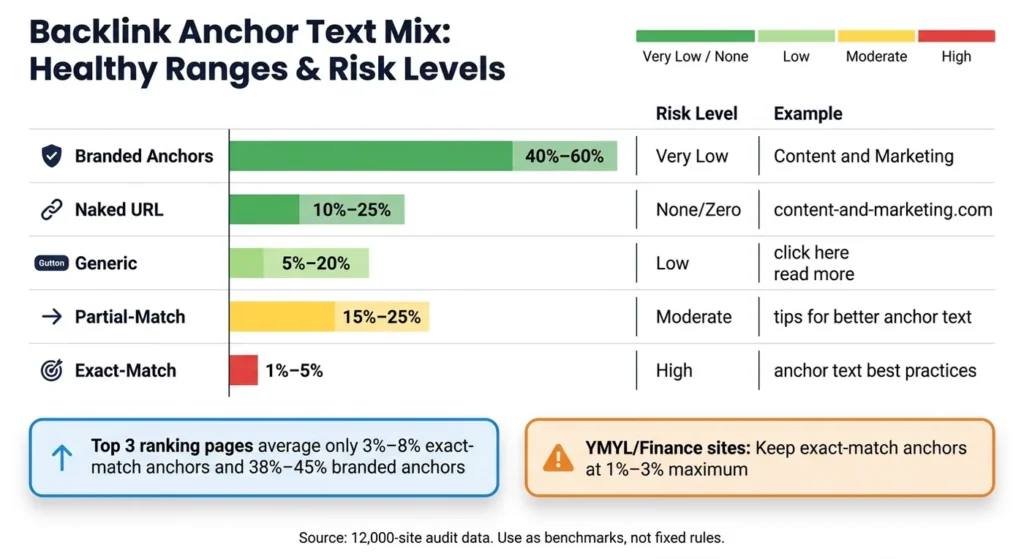
The goal is simple: backlink anchors should look earned, not manufactured. Google can flag link patterns that seem manipulated. And the numbers back that up. In a 12,000-site audit, pages ranking in positions 1–3 usually had only 3%–8% exact-match anchors. Sites ranking in positions 20–50 often had 14%–25%. In finance and other YMYL niches, the margin gets even tighter. Exact-match anchor tolerance can drop to as low as 3%.
Use the ranges below as a quick gut check, not a hard rule.
| Anchor Type | Recommended Range | Risk Level |
|---|---|---|
| Branded | 40%–60% | Very Low |
| Partial Match | 15%–25% | Moderate |
| Naked URL | 10%–25% | Zero |
| Generic | 5%–20% | Low |
| Exact Match | 1%–5% | High |
If your link profile leans too hard on exact-match anchors, pull it back. A simple fix is to add more branded and URL-based links. In plain English: build new branded, generic, and naked-URL backlinks to rebalance the profile before going back to keyword-rich outreach.
7. Spot and Avoid Anchor Text Spam Signals
Once you know what a healthy anchor text mix looks like, the next step is spotting the patterns that can get you into trouble.
The biggest warning sign is exact-match overuse. If the target keyword shows up in more than 10% of external links, that’s a strong sign of manipulative link building.
Other red flags tend to stack up fast. A low branded share can be a problem. So can cross-domain repetition: when unrelated sites all link to the same page using the same commercial phrase, it looks manufactured. Mismatched anchors are another issue, because search engines may devalue links when the anchor text doesn’t line up with the destination page. And on your own site, generic internal anchors waste context and make accessibility worse.
You should also watch for link-velocity spikes and repeated AI-generated anchor phrases across large site sections.
Here’s how to clean things up:
- Replace generic internal anchors with descriptive text
- Vary outreach language so it includes branded and partial-match options
- Audit your backlink profile every quarter to catch anchor concentration early
Use the table below to spot these patterns fast and rebalance your anchor mix.
Anchor Text Types: A Quick Reference Table
Anchor text types do different jobs. These six cover most SEO needs, from internal linking to outreach. In most natural backlink profiles, branded anchors lead the way. Exact-match anchors, on the other hand, should stay uncommon.
Use this table as a quick gut check before you publish content for your website or build links.
| Anchor Type | Description | Typical Use Case | Internal Links | Backlinks | Risk Level |
|---|---|---|---|---|---|
| Exact-Match | Precise target keyword only (e.g., “SEO audit tool”) | High-value target pages | Use rarely for priority pages | Use sparingly | High |
| Partial-Match | Keyword within a natural phrase (e.g., “run a quick SEO audit”) | Informational guides and outreach | Use for descriptive context | Use for balance | Low–Medium |
| Branded | Brand or company name only (e.g., “Content and Marketing”) | Homepage and trust building | Navigational (nav/footer) | Should dominate profile | Very Low |
| Branded partial-match | Brand name + descriptive term (e.g., “Content and Marketing’s audit guide”) | Product or service pages | Commercial priority pages | Use for natural variation | Very Low |
| Naked URL | The raw web address (e.g., “content-and-marketing.com”) | Citations, forums, social media | Rare; used for diversity | Use for natural look | None |
| Generic | Non-descriptive phrases (e.g., “click here”, “read more”) | CTAs and low-value link text | Avoid; use descriptive text instead | Normal in small amounts | None |
The big split here comes down to control. You control internal links. You don’t control backlinks in the same way. That means you can use keyword-rich anchors more often on internal links, while external anchors should stay more branded and mixed up. For backlinks, branded anchors should make up most of the profile.
Generic anchors are fine in backlinks. They happen all the time, and that’s normal. But for internal links, they don’t do much heavy lifting because they give little context.
Next, compare these anchor types in stronger and weaker link contexts.
Strong vs. Weak Link Context: Side-by-Side Examples
The words around a link matter just as much as the anchor itself, especially when using AI-based copywriting for SEO to maintain relevance. If the sentence sets clear expectations, readers can guess where the link goes before they click. That’s usually a good sign.
Strong context makes the destination easy to predict. Weak context does the opposite. It hides the point, blurs relevance, and makes the link feel dropped in.
| Context Type | Surrounding Text Description | Likely SEO/UX Impact |
|---|---|---|
| Strong | A paragraph discussing mid-market onboarding challenges links to a tool as the specific solution for that audience. | Strong topical signal. |
| Strong | A sentence introduces recent 2026 CRM adoption data and links directly to the dataset. | Helpful for long-tail relevance. |
| Strong | A descriptive noun phrase such as “eco-friendly packaging materials” is woven naturally into the sentence flow. | Clarifies topic for readers and crawlers. |
| Weak | A generic marketing article links “best CRM software” to an affiliate page without discussing CRM systems in the surrounding text. | Loses value; weak relevance. |
| Weak | A “click here” or “read more” link appears at the end of a generic template snippet. | Low context; weak signal. |
| Weak | A link is placed in a list of unrelated products, such as a finance tool next to a task manager. | Weak semantic value. |
Here’s the simple test: does the sentence around the link support the anchor, or does it just leave it hanging?
A strong anchor can still fall flat if the promise and destination don’t line up. When that happens, people click, feel misled, and leave. That can push up bounce rates and chip away at relevance.
Backlink Anchor Mix: Healthy Range Benchmarks
Once you’ve flagged spam signals, the next step is simple: check whether the anchor mix looks natural. These ranges work best as audit benchmarks, not fixed rules.
Context matters a lot here. A finance or YMYL site should usually keep exact-match anchors on the lower end, around 1%–4%. Affiliate and review sites can often handle a bit more, usually 8%–14%. At the same time, sites in the top 3 positions tend to have just 3%–8% exact-match anchors and about 38%–45% branded anchors.
| Anchor Type | Typical Range (Healthy Profiles) | Risk if Overused |
|---|---|---|
| Branded | 35%–60% | Very low |
| Naked URL | 10%–25% | Very low |
| Generic | 5%–20% | Low |
| Partial-Match | 15%–25% | Moderate |
| Exact-Match | 1%–10% | High |
If your exact-match share starts creeping up, the usual fix is to add more branded and naked URL links to bring the profile back into balance.
And here’s the part many people skip: compare these ranges with the actual anchor mix used by the top 3–5 competitors ranking for your main keywords. That gives you the baseline that matters most.
Use the table to spot outliers fast, then feed those fixes straight into your link-building process.
How to Apply These Rules in Day-to-Day SEO Work
These rules only help if you use them all the time.
Make them part of a workflow you can repeat. Start with a crawl in Screaming Frog and export every internal link with its anchor text. Drop that export into a pivot table, then filter for anchors like “click here”, “read more”, or “here.” In many cases, the fastest fix is simple: swap vague internal anchors for text that tells people, and Google, what the linked page is about.
Next, check backlinks one page at a time. Don’t just look at anchor text across the whole site. Pull anchor distribution for each landing page and look for patterns that stand out. If a non-branded anchor shows up above 15%, flag it. Also keep an eye on sudden jumps in the same anchor pointing to key URLs. If a page leans too hard on exact-match anchors, offset that with branded anchors and naked URL links.
Those page-level patterns should guide your outreach. If you’re building a batch of links to one URL, spread the anchors across a mix like:
- Brand variants
- Naked URLs
- Generic phrases
- Partial-match terms
- No more than one exact-match anchor
That keeps the profile looking natural.
Run an anchor audit every four months. Between audits, automation tools can suggest internal links and help maintain anchor variety as new pages go live. A set review schedule keeps small problems from turning into bigger ones.
Conclusion
After the audit steps above, the takeaway is simple: anchor text should be clear, varied, and tied to the page around it.
Good anchor text isn’t about cramming keywords into links. It’s about making each link useful for readers and clear to search engines. The best anchor profiles stay descriptive, balanced, and low-risk. These seven rules work together: they help users, send cleaner signals to search engines, and lower spam risk. Start with what you can control first. Fix vague internal anchors, diversify new backlinks, and review your profile on a set schedule.
FAQs
How do I choose the right anchor text type?
Choose anchor text that fits the page, reads naturally, and doesn’t feel forced. For internal links, lean on descriptive and partial-match anchors. For external backlinks, branded anchors usually look more natural in the link profile.
Use exact-match keywords sparingly. Most of the time, natural phrasing, semantic variants, and clear descriptive language work better because they match the linked page’s topic without sounding stiff. And skip vague phrases like “click here” when a clearer anchor will do the job.
What anchor text ratio is considered natural?
There’s no single “correct” natural anchor text ratio. The mix changes based on your niche, your site’s authority, and what competitor profiles look like. That said, a varied anchor text profile can help you avoid spam signals.
In most cases, branded anchors make up the biggest share, often around 40% to 50%. Partial-match anchors tend to land in the 15% to 25% range. Exact-match anchors usually should stay below 5% to 10%. You’ll also commonly see generic anchors and naked URLs in the mix.
How often should I audit anchor text?
Audit your anchor text on a regular basis so your internal links stay natural and you can catch over-optimization before it turns into a mess.
There’s no set schedule that works for everyone. Still, checking in from time to time helps you swap weak anchors like “click here” for text that tells readers what they’ll get. It also helps you spot landing pages that are piling up too many exact-match anchors.
Related Blog Posts

We research and organize marketing software around practical use cases. Product claims are included only when supported by available sources.
Read our editorial policy →Related guides

5 Best Competitor Analysis Tools for Content Marketers in 2026
Compare 5 competitor analysis tools for content marketers to uncover keyword gaps, backlinks, top pages, and new content opportunities.
Content Marketing Strategy eBook Template Guide
The short answer: pick the eBook template based on the job it needs to do. If your goal is leads, use a short layout with clear CTA blocks. If your goal is planning, use…

Best Shopify Apps for Content Marketers in 2026 (Top Picks Compared)
Creating content for a Shopify store is easier than turning that content into traffic and sales. The best Shopify apps for content marketers help optimize blog posts for search engines, automate email marketing, showcase…