
This article may contain affiliate links. We may earn a commission at no additional cost to you; this does not determine our editorial conclusions.
A business blog should be one of your company’s most valuable marketing assets.
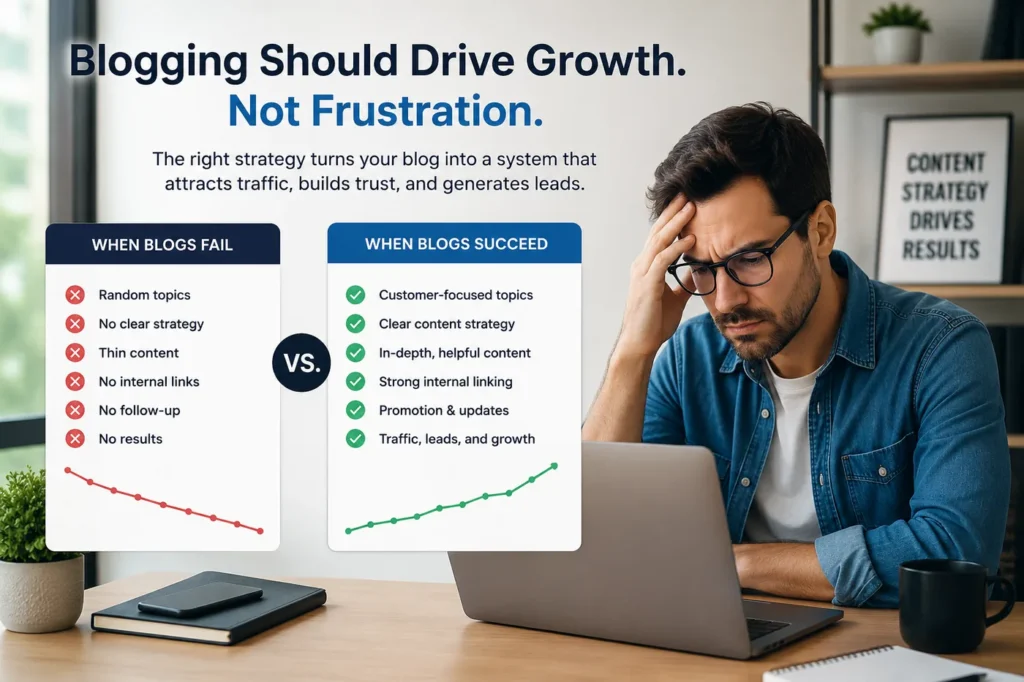
Unlike paid advertising, a well-written article can continue attracting visitors, answering customer questions, and generating leads long after it’s published. Yet many businesses invest months—or even years—into blogging without seeing meaningful results.
The problem usually isn’t a lack of effort. Marketing teams publish consistently, follow SEO advice, and share articles across social media, but traffic remains flat and leads rarely improve. After a while, it’s easy to question whether maintaining a business blog is worth the time.
In most cases, blogging isn’t the problem.
The strategy behind the blog is.
Successful business blogs aren’t built around publishing schedules. They’re built around customer questions, buying decisions, and long-term business goals. Every article has a purpose beyond filling next week’s content calendar.
If your blog isn’t contributing to business growth, chances are you’re making one—or several—of the common mistakes below.
Quick Answer
Most business blogs fail because they prioritize publishing over solving customer problems. Instead of creating articles that answer buying questions, build trust, and support the sales process, many businesses chase random keywords or trending topics. A successful business blog attracts the right audience, demonstrates expertise, and guides readers naturally toward the next step in their journey.
Why Most Business Blogs Struggle
One of the biggest myths in content marketing is that consistency alone produces results.
Consistency certainly matters, but publishing an article every week doesn’t guarantee more traffic or better leads. If the topics are disconnected, written for the wrong audience, or fail to answer meaningful customer questions, the result is simply a larger collection of content—not a stronger marketing asset.
Think about the last time you visited a business blog that impressed you.
The articles probably felt connected. One guide naturally led to another. The content answered questions you didn’t even know you had, and by the time you finished reading, you understood the company, its expertise, and how it could help.
That’s not an accident.
The best business blogs are planned around a clear strategy instead of a publishing schedule.
Before creating another article, ask yourself one simple question:
“Will this genuinely help a potential customer make a better decision?”
If the answer isn’t immediately obvious, the topic probably needs more work.
If you’re building or refining your editorial plan, it’s important to learn more about creating a content marketing strategy that actually works as this helps you align every article with your business objectives instead of simply producing more content.
1. You’re Publishing Articles Instead of Solving Customer Problems
Many businesses begin the content planning process by looking at keyword search volume.
There’s nothing wrong with keyword research, but it should never replace customer research.
The most successful business blogs are built around the questions customers ask before they buy. Sales conversations, support tickets, onboarding calls, and product demonstrations all reveal problems your audience is actively trying to solve. Those insights are often far more valuable than a list of high-volume keywords because they’re based on real conversations instead of assumptions.
Imagine two article ideas.
The first is titled:
“What Is Project Management Software?”
The second is:
“Why Is My Team Still Missing Deadlines Even With Project Management Software?”
The first explains a topic that hundreds of websites have already covered.
The second addresses a specific frustration that potential customers genuinely experience.
Which one would you be more likely to read?
When your content starts with customer problems instead of keywords, your articles naturally become more useful, more original, and more difficult for competitors to copy.
This approach also aligns with Google’s guidance on creating helpful, reliable, people-first content, which encourages businesses to demonstrate real expertise and focus on helping readers rather than simply producing content for search engines.
2. You’re Chasing Traffic Instead of Potential Customers
Traffic is important.
But traffic without business results can become a vanity metric.
Imagine one article attracts 20,000 visitors every month because it targets a broad informational keyword. Another article receives only 600 monthly visitors, but those readers regularly request product demos because the article answers a question buyers ask immediately before making a decision.
Which article creates more value?
Many businesses celebrate page views without asking whether the right audience is visiting their website. High traffic means very little if readers leave without exploring another page, subscribing to your newsletter, or contacting your team.
Instead of asking, “How many people read this article?”, ask questions that relate to business outcomes.
Did the article answer an important customer question?
Did readers continue exploring your website?
Did it help move someone closer to becoming a customer?
The best-performing business blogs don’t attract everyone.
They attract the right people.
That’s why educational content should be balanced with comparison articles, implementation guides, pricing explainers, and customer success stories that support buyers further along the decision-making process.
3. Your Blog Has No Clear Journey for Readers
Imagine walking into a bookstore where every book has been placed on a random shelf.
You might eventually find something useful, but the experience would feel frustrating and disorganized.
Many business blogs create the same experience.
A visitor reads one article, reaches the bottom of the page, and leaves because there’s nowhere else to go. There are no related resources, no helpful next step, and no indication of what they should read next.
Every article should be part of a larger journey.
Someone researching SEO may also want to learn about content planning. A reader exploring AI writing tools might naturally be interested in maintaining an authentic brand voice. A business owner reading about blogging should be able to continue learning without returning to Google to search for another answer.
That’s where thoughtful internal linking makes a difference.
For example, readers interested in balancing efficiency with originality may also find value in using AI tools without losing authenticity. Likewise, a detailed article shouldn’t simply end after the conclusion. It should introduce another useful resource that helps readers continue solving their problem.
Strong internal links improve navigation, strengthen topical authority, and help search engines understand how your content relates to one another. More importantly, they create a better experience for readers by turning individual articles into a connected library of knowledge instead of isolated blog posts.
According to the Content Marketing Institute, organizations that consistently create audience-focused, strategically connected content are more likely to achieve long-term marketing success than those publishing isolated pieces without a broader plan.
To turn that reader journey into a practical process, see how to build a lead generation system from existing content, including relevant next steps, forms and follow-up.
4. You’re Publishing and Forgetting
Publishing a blog post shouldn’t be the finish line.
Unfortunately, that’s exactly where many businesses stop.
An article goes live, gets shared on social media for a few days, and then slowly disappears into the archives. Six months later, it may still receive a handful of visitors, but nobody has updated the statistics, improved the examples, or expanded the sections readers found most useful.
That’s a missed opportunity.
Some of your highest-performing articles are probably already sitting on your website. They simply need attention.
Instead of constantly creating new content, make it a habit to review older posts every few months. Update outdated information, replace broken links, add recent examples, improve internal links, and answer new questions you’ve heard from customers since the article was first published.
Refreshing existing content often requires far less effort than starting from scratch, yet it can have a significant impact on search visibility and reader engagement.
If an article has already proven that people are interested in the topic, improving it is usually a better investment than publishing another article covering something completely new.
5. You’re Using AI to Replace Thinking Instead of Supporting It
AI has changed the way businesses create content, but it hasn’t changed what readers value.
Many teams now rely on AI to generate outlines, draft articles, and summarize research. Those are all productive uses of the technology.
Problems arise when AI becomes the source of every idea.
If every article starts with the same prompt and is based on the same publicly available information, it’s difficult to produce content that feels original. Readers notice when an article repeats advice they’ve already seen elsewhere, and search engines are becoming better at identifying content that lacks genuine expertise.
The businesses getting the most value from AI aren’t replacing writers.
They’re giving writers more time to think.
Use AI to organize information, improve readability, brainstorm headlines, or repurpose existing content into newsletters and social media posts. Let your team provide the customer stories, campaign lessons, product knowledge, and industry experience that AI simply doesn’t have.
6. Successful Business Blogs Follow a Repeatable System
One reason successful business blogs continue growing year after year is that they rarely depend on inspiration.
They depend on systems.
Every article starts with a customer question, a recurring sales objection, or a problem the business has solved. Before writing begins, the team validates whether people are actively searching for that topic and whether it supports a broader content strategy.
Once the article is published, the work doesn’t stop.
It becomes part of a larger ecosystem.
The article links to related resources, supports another stage of the customer journey, and is repurposed into email newsletters, social media posts, videos, or downloadable guides.
That’s one reason content marketing becomes more effective over time. Each new article strengthens the value of everything that already exists.
If you’re looking for ways to maximize every article you publish, our guide to content repurposing shows how a single blog post can become multiple marketing assets without multiplying your workload.
Instead of thinking about individual blog posts, think about building a connected library of knowledge. Every article should make the next article easier to discover.
A Simple Blog Health Check
If your business blog isn’t producing the results you expected, ask yourself these five questions.
• Does every article answer a real customer question?
• Does each article naturally guide readers to another relevant resource?
• Is the content updated regularly instead of being forgotten after publication?
• Does the article include insights, examples, or experiences competitors can’t easily copy?
• Is every article written with a business goal in mind, whether that’s attracting visitors, generating leads, or helping existing customers?
If you answered “no” to several of those questions, your blog probably doesn’t need more content.
It needs a better strategy.
Frequently Asked Questions
Why do most business blogs fail?
Most business blogs fail because they publish content without a clear strategy. Articles often target random topics instead of answering customer questions, supporting buying decisions, or contributing to broader business goals.
How often should a business publish blog posts?
Consistency matters more than volume. Publishing one high-quality article every week or every two weeks is generally more effective than publishing frequent low-value content that doesn’t address customer needs.
Should I update old blog posts?
Yes. Updating existing articles with new information, examples, screenshots, and internal links can improve their usefulness and help maintain their relevance over time.
Can AI write business blog posts?
AI can help with research, outlining, editing, and improving readability, but the most valuable articles still rely on human expertise, customer insights, and real-world experience.
What makes a business blog successful?
Successful business blogs consistently solve customer problems, build topical authority, connect related content through thoughtful internal linking, and support business objectives such as generating leads, educating customers, or strengthening brand credibility.
Final Thoughts
The businesses with the most successful blogs don’t necessarily publish the most content.
They publish the most useful content.
Every article has a job to do. It should answer a customer’s question, remove a buying objection, demonstrate expertise, or help someone take the next step with confidence. If a blog post doesn’t accomplish at least one of those goals, it’s simply adding to the noise.
That’s why successful business blogs don’t grow because they’re updated every week. They grow because every article strengthens the value of everything that came before it. One article leads naturally to another. One customer question uncovers the next topic to write about. Over time, the blog becomes more than a collection of posts—it becomes one of the company’s most valuable business assets.
Before you publish your next article, ask yourself one simple question:
“If this article disappeared tomorrow, would our customers lose something genuinely useful?”
If the answer is yes, you’re creating content that matters.
If the answer is no, don’t publish it yet.
Keep improving it until it’s something your audience would actually miss.
That’s the difference between maintaining a blog and building one that drives meaningful business growth.

We research and organize marketing software around practical use cases. Product claims are included only when supported by available sources.
Read our editorial policy →Related guides

Shopify vs Squarespace: Which Is Better for Selling Online in 2026?
Shopify vs Squarespace is a common decision for entrepreneurs and small businesses planning to sell products online. Both platforms allow you to create a professional website, manage products, accept payments, and operate an online store without building everything from scratch. However, they approach ecommerce differently, and those differences can become more important as your business […]

Parallels Desktop vs VMware Fusion: Which Is Better for Running Windows on Mac in 2026?
Parallels Desktop is best for Mac users who want seamless Windows integration and easy setup. VMware Fusion is better for those seeking free virtualization, especially developers and occasional Windows users.

Black Friday Tracking Blind Spots: How Cookie Consent Affects Marketing Data and Attribution
Black Friday tracking blind spots can make campaign performance harder to interpret at exactly the time marketers need reliable data most. Ecommerce brands may see orders and leads increasing while analytics, advertising platforms, and other marketing systems provide an incomplete picture of which campaigns actually influenced those conversions. That doesn’t necessarily mean something is broken. […]