Measuring organic social media ROI is about connecting unpaid efforts to real business outcomes like traffic, leads, and revenue. The right tools can help you track performance, justify budgets, and refine strategies over time. Here's a quick summary of the top tools for U.S. marketers:
- Hootsuite Advanced Analytics: Tracks organic vs. paid performance, integrates with Google Analytics, and provides historical data across platforms.
- Sprout Social: Offers detailed ROI reports, integrates with Meta's Conversions API and Google Analytics, and tracks long-term performance trends.
- Agorapulse: Simplifies UTM-based ROI tracking, integrates with Google Analytics, and provides customizable reports.
- Sprinklr Social: Enterprise-focused, connects with multiple analytics tools, and supports long-term data storage.
- Social Status: Separates organic, paid, and influencer data with campaign-specific insights.
- Socialinsider: Focuses on competitive benchmarking and trend analysis across platforms.
- Keyhole: Specialized in hashtag and campaign tracking with cross-platform insights.
These tools help marketers differentiate organic results, track long-term trends, and connect social media efforts to revenue. Choose a tool based on your goals, budget, and required integrations.
Quick Comparison Table:
| Tool | Key Features | Supported Platforms | Starting Price (USD/month) |
|---|---|---|---|
| Hootsuite | ROI tracking, unified dashboard, analytics | Instagram, Facebook, LinkedIn, X | $99 |
| Sprout Social | Meta API, reporting, historical tracking | Instagram, X, LinkedIn | $249 |
| Agorapulse | UTM-based tracking, customizable reports | Facebook, Instagram, X, LinkedIn | $69 |
| Sprinklr | Enterprise analytics, multi-channel insights | 30+ platforms | Custom |
| Social Status | Campaign-specific insights, AI-generated data | Facebook, Instagram, TikTok | ~$200-$500 |
| Socialinsider | Competitive benchmarks, trend analysis | Instagram, Facebook, LinkedIn, X | $99 |
| Keyhole | Hashtag tracking, campaign insights | Instagram, X, Facebook, YouTube | $79 |
Each tool offers unique features suited to different needs - from small teams to large enterprises. Start with a free trial to ensure the tool aligns with your objectives.
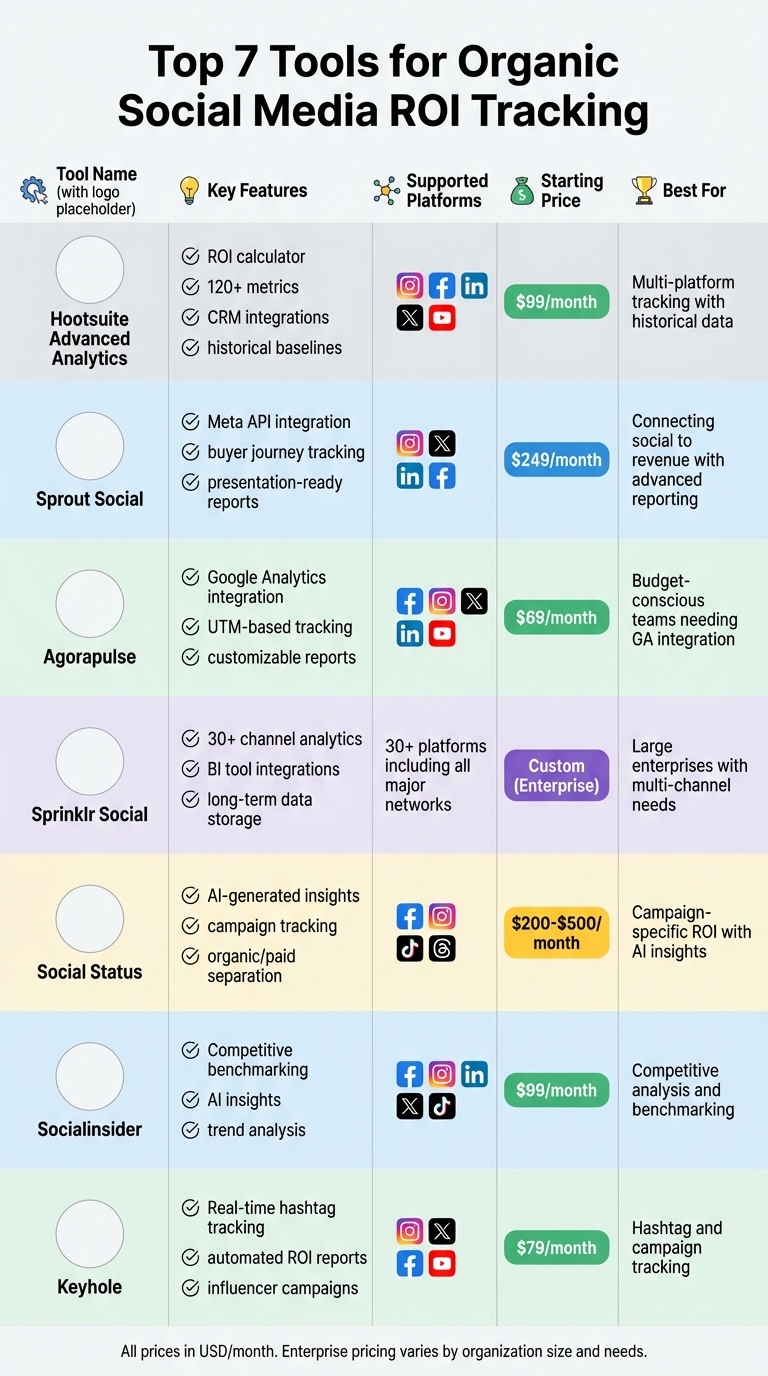
Comparison of 7 Top Organic Social Media ROI Tracking Tools
The Organic Value of Social Media w/ Brooke Sellas
How Organic Social Media ROI Tracking Works
Tracking the return on investment (ROI) for organic social media involves connecting social platforms to web analytics tools like Google Analytics and GA4 through APIs. U.S. marketers often use UTM parameters in their organic posts (e.g., utm_source=instagram, utm_medium=social, utm_campaign=fall_drop). These parameters allow GA4 to log sessions and conversions tied to specific clicks. By combining social metrics and web data into a single dashboard, marketers can calculate metrics like revenue per visit or conversion rates for each social network or even individual posts. This setup helps differentiate organic performance from paid efforts.
To separate organic from paid traffic, marketers rely on UTM parameters and tracking pixels. For organic links, they typically use utm_medium=social, while paid campaigns use tags like utm_medium=paid or utm_medium=cpc. This distinction ensures dashboards can filter and report exclusively on organic activity. Tracking pixels further enhance accuracy by capturing on-site events and linking them to social interactions, even if the actual conversion happens later. Together, these tools provide a clearer picture of organic ROI. For deeper insights, advanced attribution models come into play.
Sophisticated tools use multi-touch attribution to credit organic social media at various points in the customer journey, not just at the final conversion. By connecting data from social platforms, web analytics, and CRM systems through user or session identifiers, these tools can trace how organic social introduced prospects, nurtured engagement, and contributed to eventual conversions. For marketers dealing with longer sales cycles, this approach ensures organic posts get credit for their role in influencing revenue over time. This is especially important for showcasing the long-term impact of organic efforts.
Key metrics for U.S. marketers include revenue influenced (the total value of transactions where organic social played a role), lead value (calculated by multiplying the close rate by the average deal size for leads originating from organic social), and customer lifetime value (the projected revenue from a customer, broken down by acquisition source). CRM data, such as Closed-Won deals, integrates into ROI tools to aggregate revenue and pipeline metrics by social network or campaign. This comprehensive view allows marketers to track metrics like cost per organic lead, pipeline influenced, and revenue per organic follower, ensuring social media efforts align with broader sales goals.
For accurate long-term tracking, standardized UTM naming conventions and seamless integration between systems are essential. Marketers should adopt consistent UTM tags for all organic links and ensure smooth data flow between web analytics, social platforms, and CRM systems - either directly or through aggregation tools. Defining clear conversion events with U.S. dollar values and scheduling regular ROI reports can simplify budget decisions and refine content strategies. Resources like Content and Marketing offer curated tools for social media management, analytics, and growth, helping marketers identify platforms that support detailed ROI tracking and integration with systems like GA4, CRMs, and ecommerce platforms.
1. Hootsuite Advanced Analytics
Integration with Web Analytics Tools
Hootsuite Advanced Analytics integrates seamlessly with tools like Google Analytics and Adobe Analytics, giving you a clear picture of how your organic posts impact website traffic, conversions, and revenue. By using standardized UTM parameters, Hootsuite tracks the performance of your content, while Google Analytics captures on-site user behavior. For example, a SaaS company in the U.S. could combine Hootsuite data - like impressions, engagements, and clicks - with web and CRM metrics to pinpoint which posts, formats, and publishing times drive the most conversions and revenue per session. For more advanced setups, you can export data to calculate metrics like cost-per-lead for organic content or assess pipeline influence. This level of detail ensures you can clearly differentiate between the performance of organic and paid campaigns.
Separation of Organic vs. Paid Performance Data
Hootsuite's dashboards make it easy to compare organic and paid content side by side. You can filter by network, campaign, hashtag, or media type, which is critical because blending organic and paid data can distort key metrics. Agencies often use this feature to create tailored reports that highlight the long-term value of organic efforts while keeping them distinct from paid campaigns.
Long-Term Data Tracking and Historical Reporting
Understanding the ROI of organic content requires tracking performance trends over time. Hootsuite Analytics provides access to historical data across all connected profiles, allowing marketers to review trends in impressions, follower growth, engagement rates, clicks, and conversions over periods like 3, 6, or 12 months. This tool also lets you compare current performance to past benchmarks, helping identify seasonal patterns, evaluate strategy changes, and measure progress against key metrics.
Cross-Channel Coverage for Organic Social Media Platforms
Hootsuite brings together analytics from all major social platforms - Facebook, Instagram, X (Twitter), LinkedIn, YouTube, and TikTok - into one streamlined dashboard. This consolidated view allows teams to compare metrics like revenue per organic post on Instagram versus LinkedIn or lead generation from Facebook versus YouTube. With these insights, you can shift your content efforts toward platforms and formats that deliver the best ROI, instead of relying on surface-level metrics like follower counts. This unified approach supports a more strategic focus on maximizing the long-term value of organic social media efforts.
2. Sprout Social Analytics and ROI Reports
Integration with Web Analytics Tools
Sprout Social takes tracking a step further by integrating with Meta's Conversions API and Google Analytics. This allows you to connect social media engagement directly to business outcomes. Using standard UTM settings, the platform tracks how organic posts contribute to website traffic, lead generation, and sales. This means you’re not just looking at likes and shares - you’re tying your organic efforts to measurable revenue.
Additionally, Sprout Social provides detailed insights into organic metrics, helping you maintain consistency in your overall ROI tracking approach.
Separation of Organic vs. Paid Performance Data
Sprout Social’s dashboard makes it easy to separate organic and paid performance data. You can analyze metrics like engagement rates, reach, and conversions specifically for unpaid content. This distinction is invaluable when showing how organic efforts drive meaningful results without relying on ad spend.
Long-Term Data Tracking and Historical Reporting
One of Sprout Social’s standout features is its ability to track data over extended periods. The platform offers custom date ranges and historical comparisons, along with exportable white-label reports. These reports help identify seasonal trends, measure changes in strategy, and showcase long-term growth. This kind of historical analysis is essential for demonstrating sustained ROI and providing stakeholders with clear evidence of organic content’s value over time.
Cross-Channel Coverage for Organic Social Media Platforms
Sprout Social consolidates analytics from platforms like Instagram, Facebook, X (Twitter), and TikTok into a single dashboard. This unified view allows you to compare how organic content performs across different networks. By doing so, you can focus your resources on the platforms that deliver the best results, aligning with your broader tracking and optimization strategy.
3. Agorapulse ROI Tracking
Integration with Web Analytics Tools
Agorapulse works seamlessly with Google Analytics to bring in data on web traffic, leads, and sales. By connecting your Google Analytics property to Agorapulse, you can assign UTM parameters, ensuring accurate tracking of sessions and conversions. This integration makes it easy to differentiate between organic and paid performance data.
Separation of Organic vs. Paid Performance Data
Using UTM parameters, Agorapulse separates organic and paid sessions. Organic posts can be tagged as "social", while paid campaigns are labeled as "paid." This automatic filtering simplifies data analysis. Just make sure to use consistent UTM naming conventions to avoid any mix-ups in classification.
Long-Term Data Tracking and Historical Reporting
Agorapulse doesn’t just track data - it also provides customizable, presentation-ready reports. These ROI reports can be scheduled monthly or quarterly, offering valuable insights into long-term trends. By combining data from Agorapulse and Google Analytics, you can analyze historical performance, including traffic, leads, and revenue from past organic campaigns. This feature is especially helpful for marketers and agencies to showcase month-over-month or year-over-year growth in revenue driven by organic efforts, making it easier to justify budgets with concrete data.
Cross-Channel Coverage for Organic Social Media Platforms
Agorapulse supports publishing, monitoring, and analytics for all major social networks, including Facebook, Instagram, X (Twitter), and LinkedIn. By maintaining consistent UTM conventions, the platform enables performance comparisons across channels. For instance, you might find that LinkedIn posts generate more leads, while Instagram posts deliver higher revenue per click. This insight helps allocate resources more effectively, based on measurable ROI.
4. Sprinklr Social and Unified Analytics
Integration with Web Analytics Tools
Sprinklr seamlessly connects with leading analytics platforms like Google Analytics and Adobe Analytics, ensuring that campaign, post, and UTM data flow directly into your digital analytics systems. This integration gives marketers a clear view of how organic social sessions influence on-site actions, such as page views, sign-ups, and revenue. By standardizing and appending UTM parameters, Sprinklr aligns downstream metrics - like goal completions and ecommerce transactions - in tools like GA or Adobe Analytics. The result? A complete organic ROI picture that finance and analytics teams can rely on. This capability also makes it easier to distinguish between organic and paid results.
Separation of Organic vs. Paid Performance Data
Sprinklr’s unified data model allows users to tag and categorize content as either organic or paid, ensuring that reporting remains clean and comparable. When paired with proper UTM conventions - such as labeling the medium parameter as "social" for organic and "paid-social" for ads - marketers can filter out ad-driven sessions and conversions. This leaves only organic performance data in ROI dashboards. This distinction is key for understanding the unique value of non-promoted content, helping marketers evaluate organic impact and refine budget allocations. The ability to clearly separate and analyze this data also supports in-depth historical performance reviews.
Long-Term Data Tracking and Historical Reporting
When it comes to tracking ROI over extended periods, Sprinklr stands out by storing data far beyond the typical retention limits of platforms like Instagram or X. It serves as a long-term repository for social data at both the post and profile levels. This feature enables multi-year trend analysis, such as comparing organic click-through rates or revenue contributions from Q1 2023 to Q1 2025. It also helps marketers assess the impact of major strategy changes on conversions over time. With this preserved historical data, analysts can calculate the lifetime ROI of evergreen content that continues to drive traffic and sales.
Cross-Channel Coverage for Organic Social Media Platforms
Sprinklr integrates with all major social platforms, including Facebook, Instagram, X, LinkedIn, TikTok, and YouTube, consolidating metrics into one unified analytics environment. This cross-channel approach lets marketers evaluate organic performance across platforms using consistent KPIs such as reach, engagement rate, link clicks, and assisted conversions. By providing a unified view, Sprinklr helps marketers identify which channels deliver the best long-term organic value, especially in the U.S. market. This comprehensive perspective is essential for optimizing organic social strategies over time.
sbb-itb-645e3f7
5. Social Status Campaign and Organic Performance
Keeping Organic and Paid Data Separate
Social Status simplifies the process of distinguishing between organic, paid, and influencer posts by automatically categorizing them based on ad spend. By pulling data directly from social platform APIs, it ensures that posts are clearly labeled as organic, paid, or influencer content. This includes tagging dark ads and boosted posts to avoid any confusion. This clear separation prevents inflated metrics, making it easier to evaluate the genuine impact of your organic efforts.
Detailed Campaign and Content Reporting
With campaign dashboards, Social Status consolidates all posts and Stories tied to specific campaigns, focusing exclusively on organic content metrics like impressions, video views, clicks, and engagements. These reports break down performance by platform and content type - whether it’s Reels, Stories, or static images - so you can pinpoint what resonates most with your audience. This granular view helps refine your content strategy without increasing your budget, ultimately improving your return on investment over time.
Unified Metrics Across Platforms
Social Status also provides a cross-channel view, pulling together metrics from major platforms like Facebook, Instagram, X (Twitter), LinkedIn, and TikTok. This unified dashboard lets you see key stats - reach, engagement rate, clicks, and conversions - all in one place. By comparing platform performance, you can identify which channels are driving the most valuable organic actions, such as website visits or email sign-ups. These insights help you prioritize resources where they’ll make the biggest impact.
Tracking Long-Term Trends
To help you analyze performance over time, Social Status archives historical data for periods of 6, 12, or 24 months. This long-term tracking allows you to monitor trends in follower growth, impressions, and conversions. Align this data with key moments like product launches or content strategy changes to see how organic efforts contribute to your overall goals. You can also export reports to connect organic performance with revenue, giving you a complete picture of your long-term return on investment. This historical perspective is essential for understanding how organic strategies evolve and deliver value over time.
6. Socialinsider Analytics for Organic Benchmarks
Cross-Channel Coverage for Organic Social Media Platforms
Socialinsider provides a comprehensive view of organic performance across major social platforms like Instagram, Facebook, X (Twitter), TikTok, LinkedIn, YouTube, Pinterest, Threads, and Bluesky. For marketers in the U.S., this means you can easily compare metrics like Instagram engagement rates with TikTok reach or LinkedIn follower growth with Facebook performance - all using consistent benchmarks. By consolidating cross-platform data, Socialinsider helps identify which channels are driving the best results.
Separation of Organic vs. Paid Performance Data
One of Socialinsider's standout features is its ability to separate organic metrics from paid ones. It offers detailed post-level breakdowns and profile summaries, focusing on non-paid KPIs such as engagement rate and reach. This makes it simple to create reports - monthly or quarterly - that highlight organic-only performance, like engagement rates, reach, and video completion rates. These insights can be particularly useful during budget reviews to showcase the value of organic content.
Long-Term Data Tracking and Historical Reporting
Socialinsider also excels in long-term data tracking, storing historical post and profile data for in-depth analysis over extended periods. You can perform year-over-year comparisons, such as analyzing organic reach and follower growth from Q2 2024 to Q2 2025, to uncover seasonal trends in performance. Additionally, the platform allows you to export reports in formats like CSV or Excel, making it easy to connect organic trends with metrics from tools like Google Analytics 4 or your CRM.
Integration with Web Analytics Tools
While Socialinsider doesn’t integrate directly with Google Analytics or Adobe Analytics, it supports ROI estimation through UTM-tagged links. By using consistent UTM parameters (e.g., "utm_medium=social", "utm_source=instagram", "utm_campaign=organic_q1_2025"), you can align post-level data with traffic, conversions, and revenue from your web analytics tools. Combining this data in a spreadsheet or BI platform lets you calculate revenue or lead value per post, platform, or campaign. For example, you could determine that "Instagram organic influenced approximately $85,000 in revenue last quarter." This approach makes it easier to demonstrate the financial impact of organic social efforts and secure future budgets. Socialinsider’s ability to connect qualitative social insights with quantitative data further strengthens its role in tracking long-term ROI.
7. Keyhole for Organic Hashtag and Campaign Impact
Cross-Channel Coverage for Organic Social Media Platforms
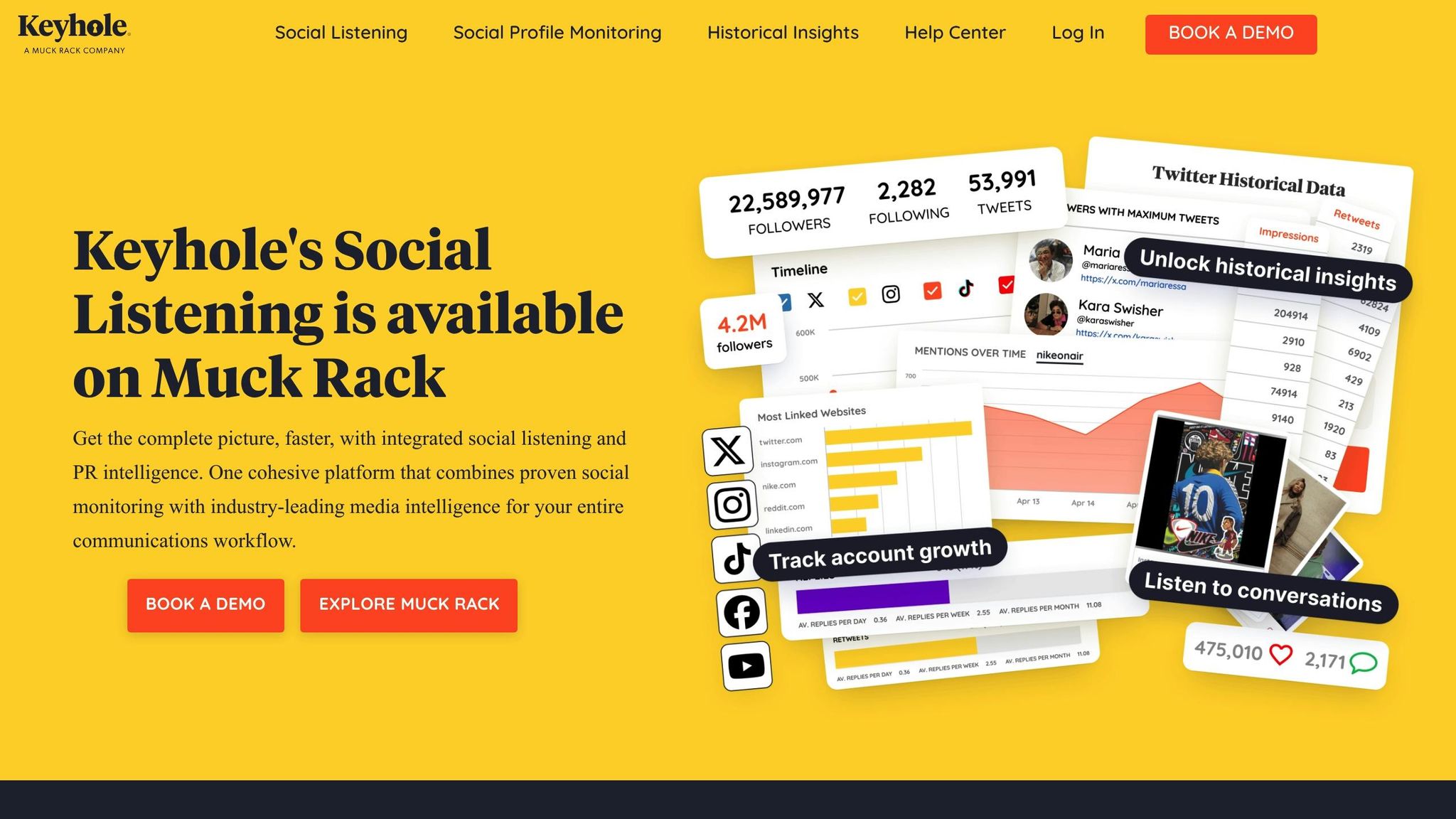
Keyhole monitors hashtags, keywords, and account performance across major platforms like Instagram, X (Twitter), Facebook, YouTube, and Pinterest. This provides a clear picture of how hashtags and campaigns perform across platforms. For instance, you can track how #SustainableFashion performs on Instagram versus Twitter, comparing metrics like reach and engagement to uncover your strongest organic channels. Plus, with real-time tracking, you can identify trending hashtags as they gain traction and tweak your organic content strategy on the fly. This kind of cross-platform insight lays the groundwork for analyzing broader trends over time.
Long-Term Data Tracking and Historical Reporting
Keyhole’s customizable reports let you track hashtag performance over extended periods. This means you can analyze historical data, like comparing how an organic campaign performed across different quarters. The platform also offers enterprise-level reporting, enabling you to export data for more detailed analysis. However, some users have reported occasional discrepancies when cross-checking metrics, so it’s wise to double-check critical numbers. To get the most out of this data, it’s essential to align Keyhole’s insights with your website’s performance metrics.
Integration with Web Analytics Tools
Keyhole focuses exclusively on social data and doesn’t integrate directly with tools like Google Analytics or Adobe Analytics. To bridge this gap, make sure to use consistent UTM tags (e.g., utm_medium=organic_social) to connect hashtag performance with conversion metrics. This approach helps tie social media insights to website conversions, making Keyhole a valuable part of your ROI tracking toolkit.
Separation of Organic vs. Paid Performance Data
Keyhole categorizes campaigns as organic, so it’s important to use UTM parameters to differentiate between organic and paid efforts. Since the platform relies on data from social media platforms themselves, marking campaigns as "organic" or "paid" in the medium field ensures precise ROI analysis. This clear distinction is crucial for accurately tracking the long-term impact of your organic efforts.
Comparison Table
Here’s a quick overview of seven tools designed to help track organic social media ROI. The table below highlights their key features, supported platforms, pricing, and ability to track performance over time. It serves as a handy reference to determine which tool aligns best with your tracking needs.
| Tool | Main Features | Supported Networks | Starting Price (USD/month) | Long-Term Tracking |
|---|---|---|---|---|
| Hootsuite Advanced Analytics | ROI calculator, 120+ metrics, custom reports, CRM integrations (HubSpot, Salesforce) | Instagram, Facebook, LinkedIn, X, YouTube | $99/user | Benchmarks by period/network, historical baselines |
| Sprout Social Analytics | KPI templates, 2025 Content Benchmarks Report, presentation-ready decks, organic vs. paid comparison | Instagram, X, LinkedIn | $249 | Historical performance, buyer journey tracking |
| Agorapulse ROI Tracking | Google Analytics integration, revenue tracking from events/profiles, UTM filtering for organic data | Facebook, Instagram, X, LinkedIn, YouTube | $69 | Website conversion tracking over time |
| Sprinklr Social | Unified analytics across 30+ channels, advanced social listening, BI tool integrations (Tableau) | Facebook, X, LinkedIn, Instagram, 30+ others | Custom (enterprise) | Harmonized datasets, cross-channel optimization |
| Social Status | Campaign tracking, AI-generated insights, white-label reports, first-party benchmarks from 150,000+ campaigns | Facebook, Instagram, Threads, TikTok | Custom (~$200-$500) | AI insights, campaign impressions/clicks history |
| Socialinsider Analytics | Performance metrics, AI-powered insights, competitive benchmarking, Instagram-specific listening | Facebook, Instagram, LinkedIn, X, TikTok | $99 | Trend analysis, follower growth history |
| Keyhole | Real-time hashtag/keyword tracking, automated ROI reports, brand mention analysis, influencer campaigns | Instagram, X, Facebook, YouTube | $79 | Long-term hashtag performance, enterprise reporting |
The pricing for these tools ranges from $69/month to custom enterprise quotes. Agorapulse and Keyhole are more budget-friendly, while Sprinklr caters to enterprises with advanced multi-channel requirements. If network coverage is a priority, Hootsuite and Keyhole offer broader platform support, including YouTube. For those focused on connecting organic social efforts to revenue, Sprout Social and Agorapulse stand out. Keyhole, on the other hand, is a solid choice for tracking hashtags over extended periods. Additionally, Sprout Social’s 2025 Content Benchmarks Report offers valuable historical data for benchmarking.
Conclusion
Measuring the ROI of organic social media isn’t just about crunching numbers - it’s about securing larger budgets, fine-tuning your content strategy, and showing how social engagement drives real business growth. Turning social metrics into financial results that resonate with stakeholders is crucial for long-term success. Choosing the right tool is the first step toward achieving this.
Platforms like Hootsuite, Agorapulse, Sprout Social, Sprinklr, Keyhole, Socialinsider, and Social Status each bring something unique to the table. The best choice for you will depend on your specific goals and priorities.
For instance, solopreneurs working with limited budgets might lean toward more affordable options. Agencies needing advanced analytics and white-label reporting can explore tools offering deeper insights. Larger enterprises managing multiple channels should prioritize platforms with robust analytics and flexible pricing structures.
Start by defining your must-haves - whether it’s seamless integration with Google Analytics, precise hashtag tracking, or polished, presentation-ready reports. Take advantage of free trials to ensure the tool you choose can clearly attribute revenue to your organic efforts. Setting benchmarks based on past performance or competitor activity can help you push results further, while auto-tagging ensures you can separate organic data from paid campaigns.
The right tool doesn’t just organize your social metrics - it turns them into actionable insights that drive growth and financial impact. With the right approach, your organic social media efforts will stand out as a key contributor to your business’s success.
FAQs
How do I find the social media platform with the best ROI for organic efforts?
To figure out which social media platform gives you the best bang for your buck when it comes to organic efforts, dive into metrics like reach, engagement, and conversions for each platform. Use tools like Search Atlas and Woxo to monitor performance data specific to each platform and compare the results. Prioritize platforms where your audience is most active, and where your content sparks the most interaction and delivers clear, measurable results.
What are UTM parameters, and how can they help track the ROI of organic social media?
UTM parameters are little snippets of text you can tack onto the end of a URL. They’re like digital breadcrumbs, helping you track where your website visitors are coming from. These tags capture details such as the source (e.g., Facebook), medium (e.g., social), and campaign name.
Using UTM parameters allows you to pinpoint which organic social media posts or platforms drive the most traffic, clicks, or conversions. This insight makes it much simpler to assess how well your social media efforts are working and tweak your strategy to get the best return on investment.
Why should you track organic and paid social media data separately?
Tracking organic and paid social media data separately is key to understanding how each approach is performing. This separation ensures you can assess the results of your organic efforts without the influence of paid campaigns, giving you a clearer picture of your return on investment (ROI).
When you keep these data streams distinct, it becomes easier to allocate resources wisely, pinpoint the strengths and weaknesses of each strategy, and make smarter decisions to fine-tune your overall social media plan.