Measuring social media ROI (Return on Investment) is crucial for understanding if your efforts are translating into financial success. Here's how you can calculate it and why it matters:
-
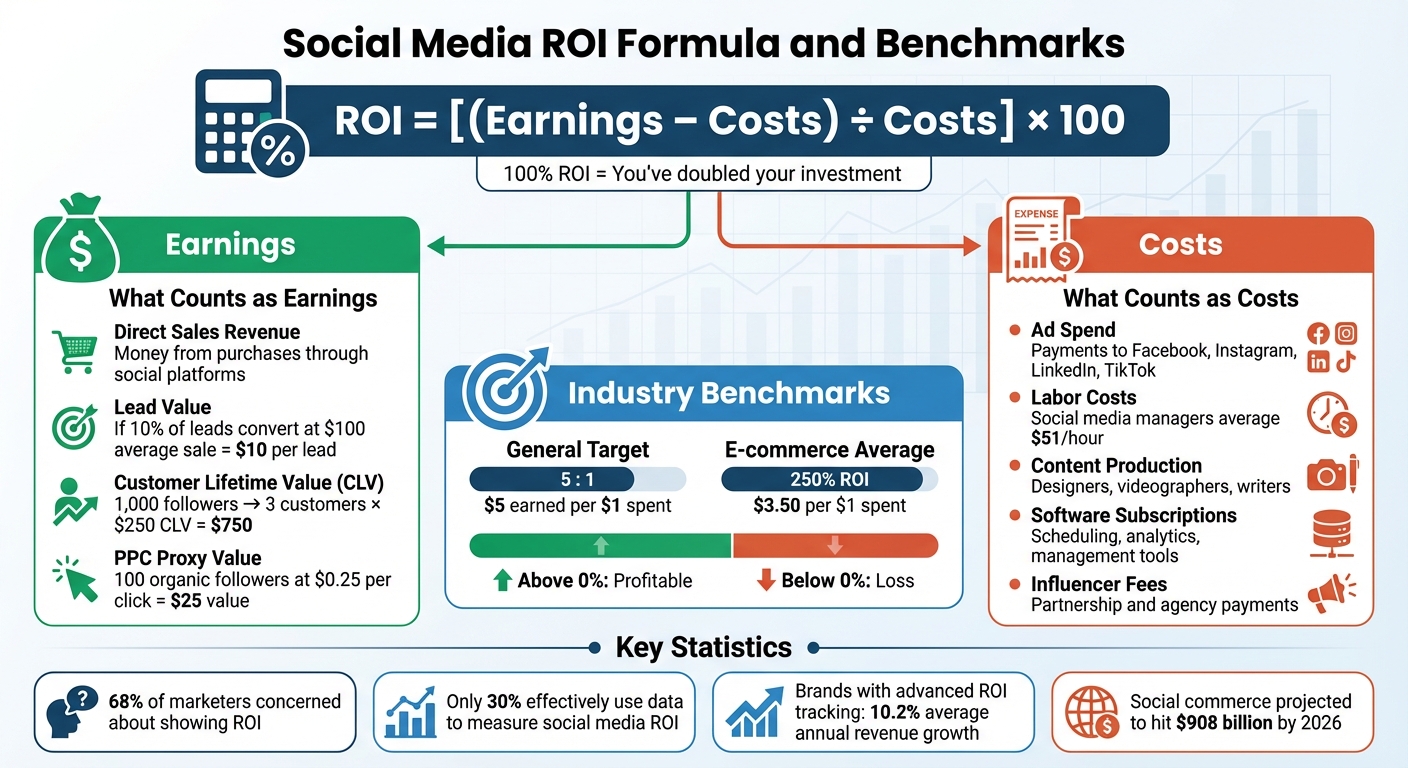
Formula: ROI = [(Earnings – Costs) ÷ Costs] × 100
Example: An ROI of 100% means you've doubled your investment. - Earnings: Includes revenue from direct sales, lead value, or customer lifetime value (CLV). You can also assign monetary value to non-monetary results like followers or impressions using paid ad benchmarks.
- Costs: Covers ad spend, labor, content creation tools, and software like analytics software.
- Benchmarks: Aim for a 5:1 ratio ($5 earned for every $1 spent). For e-commerce, a 250% ROI is considered average.
- Challenges: Assigning value to intangible results (like brand awareness) and tracking across multiple platforms can complicate ROI measurement.
Social Media ROI Formula and Benchmarks Guide
How to Calculate Social Media Return on Investment (ROI)?
sbb-itb-645e3f7
The Social Media ROI Formula Explained
The formula for calculating social media ROI is: ROI = [(Earnings – Costs) ÷ Costs] × 100 . This calculation provides a percentage that represents the return on every dollar spent. For example, an ROI of 100% means you’ve earned back your initial dollar plus an additional dollar in profit, while anything below 0% indicates a loss.
The general industry target is a 5:1 ratio, meaning you should aim to earn $5 for every $1 invested. For e-commerce campaigns, an ROI of 250% (or $3.50 for every $1 spent) is considered average. To hit these benchmarks, it’s essential to understand what goes into each part of the formula. Let’s break it down.
What Counts as Earnings
Earnings encompass all measurable value generated by your social media efforts. The most straightforward example is direct sales revenue - money earned from purchases made through social platforms. Beyond that, earnings also include the value of leads. For instance, if 10% of your leads convert and your average sale is $100, each lead can be valued at $10.
Another key factor is Customer Lifetime Value (CLV). For example, if 1,000 new followers typically result in three customers, each with a CLV of $250, this adds up to $750 in earnings. Alternatively, you can use a PPC proxy to assign a dollar value to non-monetary results. For example, if gaining 100 organic followers would cost $25 through paid ads (at $0.25 per click), those followers are valued at $25.
What Counts as Costs
To calculate ROI accurately, all costs - whether monetary or time-based - must be accounted for. The most obvious expense is ad spend, which includes payments to platforms like Facebook, Instagram, or LinkedIn to promote your content. However, the real cost goes beyond just ad budgets.
Labor costs are a major component. With the average hourly rate for social media managers around $51, you’ll need to calculate the total hours spent planning, creating, and analyzing campaigns. Don’t forget content production expenses, such as payments to designers, videographers, or freelance writers.
Other costs include software subscriptions for scheduling, analytics, and management tools, as well as influencer fees and agency payments. It’s crucial to account for every expense, no matter how small. Overlooking even a few hundred dollars in software fees or a few hours of labor could distort your ROI calculation and lead to misguided strategic decisions.
How to Calculate ROI for Different Campaign Types
The basic formula for ROI remains consistent across all campaign types, but the way you define earnings and costs depends on your campaign goals. A paid ad campaign focused on direct sales will have a very different calculation compared to a brand awareness initiative aimed at long-term impact. Here’s how you can adjust your approach for each scenario.
Paid Advertising Campaigns
For paid ad campaigns, the ROI formula is: ((Total Revenue - Total Investment) / Total Investment) × 100. Your total investment should include everything from ad spend to labor costs, content creation fees, and software subscriptions.
A key metric to track here is Return on Ad Spend (ROAS), which measures the revenue generated for every dollar spent on advertising. To calculate this effectively, assign specific dollar values to actions like purchases, lead form submissions, or app downloads. Metrics like cost-per-click (CPC), cost-per-lead (CPL), and cost-per-acquisition (CPA) will help you identify where your ad dollars are working hardest.
Accurate tracking is just as important as the math itself. Use UTM parameters in your ad URLs to pinpoint which ads drive conversions. Install tracking tools like the Facebook Pixel to monitor user actions after they click on your ad, ensuring precise revenue attribution. For a clearer picture of your campaign’s impact, consider multi-touch attribution models instead of relying solely on "last-touch" methods. Paid ads often contribute to the customer journey long before the final sale.
Lead Generation Campaigns
Lead generation campaigns require a slightly different ROI calculation since leads don’t generate immediate revenue. Instead, you assign a value to each lead based on historical data or customer lifetime value (CLV). For instance, if 10% of your leads typically convert to a $1,000 sale, each lead is worth $100.
The formula becomes: ROI = ((Number of Leads × Lead Value) - Cost of Campaign) / Cost of Campaign × 100%. Your campaign costs should include ad spend, labor, content creation, and tools like CRM software or social media management platforms.
Social media often plays a key role in the early or middle stages of the B2B sales cycle. To get the full picture, use multi-touch attribution. One team that switched from last-touch to multi-touch attribution discovered a 4,800% increase in pipeline influenced by their social media efforts.
"You don't know what your ROI is until you've laid out the goals you are tracking towards." – Eileen Kwok, Social & Influencer Marketing Strategist, Hootsuite
Track specific lead actions such as webinar registrations, whitepaper downloads, or free trial sign-ups. Use dedicated landing pages for your campaigns to keep data clean and evaluate ROI over a period that matches your average sales cycle - typically 60 to 180 days for B2B businesses.
Brand Awareness Campaigns
For brand awareness campaigns, the returns are often indirect, so assigning value requires a different approach. A common method is to estimate what it would cost to achieve similar results through paid advertising. For example, if your organic content generates 100,000 impressions and Facebook charges $0.59 per 1,000 impressions, those impressions are worth $59.
This valuation is referred to as Owned Media Value, representing the cost of achieving the same results through paid ads. Once you’ve assigned these proxy values, you can calculate ROI using the standard formula: ROI % = [(Total Value Generated - Total Investment) / Total Investment] × 100.
To measure the success of awareness campaigns, track metrics like share of voice (your brand’s presence in online conversations compared to competitors) and sentiment scores to assess how people feel about your brand. Since awareness is often the first step in a longer buyer journey, attribution models can help connect early interactions to eventual revenue. Companies that use analytics for awareness campaigns report 15-20% better ROI compared to those that don’t.
Common Problems When Measuring Social Media ROI
Measuring social media ROI comes with its fair share of challenges. While the formula may be straightforward, putting it into practice often exposes a host of complications. Data doesn’t always align perfectly, and some outcomes are notoriously hard to quantify. Let’s dive into two key hurdles marketers face and explore practical ways to tackle them.
Putting a Dollar Value on Intangible Results
How do you assign a monetary value to a "like", a positive comment, or a boost in brand awareness? These are tough questions, even for experienced marketers. Unlike direct sales, intangible results - like customer loyalty or sentiment - don’t come with a clear price tag.
This challenge becomes even trickier when dealing with attribution lag. Picture this: someone sees your Instagram post in February, spends weeks considering their options, and finally makes a purchase in April after clicking on a Google ad or email link. How do you figure out which channel gets the credit? It’s a common issue, especially since only 30% of marketers effectively use data to measure their social media ROI.
One way to address this is by using paid benchmarks as a reference. For instance, if a Facebook like costs $0.50 in paid ads, then 100 organic likes could be valued at $50. Another approach is to leverage Customer Lifetime Value (CLV). By calculating the average revenue a customer generates over time, you can estimate the value of new leads or followers based on historical conversion rates.
For metrics that are harder to pin down, proxy indicators can help. Track increases in branded Google searches, direct website visits, or brand mentions to gauge awareness. You can also create a points system, assigning higher values to actions that align closely with your goals. For example, a "share" might carry more weight than a "like" because it amplifies your reach.
But valuing engagement is just one piece of the puzzle. Tracking performance across multiple platforms introduces another layer of complexity.
Tracking Campaigns Across Multiple Platforms
Managing campaigns across platforms like Facebook, Instagram, LinkedIn, and TikTok often means juggling multiple analytics dashboards and reporting formats. It’s no wonder that only 44% of marketing leaders feel their social teams excel at measuring business impact. Consolidating all this data into a single ROI calculation can feel overwhelming.
One solution is to use UTM parameters for every link. These help GA4 identify the platform, campaign, or post driving traffic and conversions. Automating this process through your social media management tool ensures consistency. Once set up, you can use GA4’s Reports > Acquisition > Traffic Acquisition to compare traffic and conversions across platforms in one view.
Centralized dashboards can also streamline the process by pulling data from various platforms into a single interface, making ROI calculations far easier. For even deeper insights, integrate your social tools with a CRM like Salesforce. This allows you to link social interactions directly to revenue.
Consider the example of Jimmy Choo’s 2024 "Jimmy Choo Trainer Hunt." This real-time treasure hunt spanned Foursquare, Twitter, and Facebook, treating all efforts as part of a unified campaign rather than separate initiatives. The result? A 33% sales increase.
Don’t forget about "dark social" - shares that happen in private channels like WhatsApp, email, or SMS. These can account for up to 95% of web traffic. Using trackable shortened URLs and share buttons can help capture this otherwise hidden activity, giving you a more complete picture of your campaign’s performance.
Addressing these challenges is essential for refining your social media strategies and ensuring your ROI calculations are as accurate as possible.
| Tool Type | Primary Function for ROI | Key Integration |
|---|---|---|
| Social Management (Hootsuite/Sprout) | Aggregates cross-platform engagement data | CRM (Salesforce), GA4 |
| Web Analytics (GA4) | Tracks on-site conversions and referral sources | UTM Parameters |
| CRM (Salesforce/HubSpot) | Connects social leads to actual revenue | Social Management Tools |
How to Use Your ROI Results
Once you've calculated your ROI, it's time to let those numbers guide your strategy. ROI figures aren't just stats - they're your roadmap for smarter decisions and better investments. They provide the clarity you need to make tactical adjustments that align with your goals.
What ROI Numbers Tell You
Your ROI reveals profitability, plain and simple. An ROI above 0% means you're earning more than you're spending - a clear indicator that your campaign is in the green. But just being profitable isn't the whole story.
Many marketing teams aim for a 5:1 ratio (or 500% ROI), which means earning $5 for every $1 spent. Falling below 0% signals a loss, but hitting benchmarks like 5:1 shows you're on track for success.
However, context is key. Different campaigns serve different purposes. A brand awareness campaign might not deliver the same immediate ROI as a direct sales campaign, but that doesn't mean it failed. As Susan Chang, Director of Social Media at Dropbox, explains:
"The metrics we care the most about will change as the needs of our business evolve".
Instead of relying solely on universal benchmarks, compare your ROI to your specific goals and industry standards. For instance, social-first brands with established strategies often experience an average year-over-year revenue growth of 10.2%, showing the potential of sustained investment in social media.
| Campaign Type | Primary KPI to Compare | What Good ROI Looks Like |
|---|---|---|
| Paid Advertising | ROAS / CPA | 5:1 ratio or higher |
| Lead Generation | MQLs / SQLs | Conversion rate improving quarter-over-quarter |
| Brand Awareness | Reach / Impressions | Growing share of voice vs. competitors |
| Engagement | Interaction Rate | Increasing shares and saves, not just likes |
Adjusting Your Strategy Using ROI
With clear benchmarks in hand, use your ROI data to fine-tune your approach. When a platform or campaign type delivers strong returns, scale it up. If something underperforms, it’s time to pivot or cut your losses.
Start by breaking down your ROI data. Don’t settle for an overall view - dig deeper into performance by platform, ad format, and even individual posts. For example, you might find that LinkedIn drives high-value leads, while Instagram excels at building awareness. If your goal is conversions, shift your budget toward LinkedIn.
Sprout Social’s team made a major discovery when they switched from last-touch to multi-touch attribution: they uncovered a 4,800% increase in the pipeline impacted by social media efforts. This kind of insight comes from analyzing your data closely and questioning assumptions.
Experimentation is key. Test small variations in ad formats, copy, or targeting before making big changes. For instance, Hootsuite compared Instagram carousels to Reels and found carousels delivered better engagement and reach. Based on this, they optimized their content strategy.
Reallocating your budget is an obvious step, but don’t forget the "Investment" part of ROI. Andrew Faris, an e-commerce expert at Shopify, advises:
"The goal is to think about how to generate the highest profit number in your business possible over whatever time period. So sometimes that's about savings, and sometimes it's about growth".
You can also improve ROI by cutting costs. Consider automated workflows and AI-powered content creation tools to streamline processes and reduce expenses.
Lastly, review your goals every quarter. Social media trends shift quickly, and what worked in January might not make sense by April. Use your ROI results to guide both tactical tweaks and bigger strategic decisions - whether that’s doubling down on successful efforts or trying something entirely new.
Tools and Resources for Social Media ROI
To measure social media ROI effectively, you need the right mix of tools. By combining native analytics, specialized tracking, and management platforms, you can gain a clearer picture of your returns.
Start with the basics: native platform analytics. Tools like Meta Business Suite, X Analytics, LinkedIn Analytics, TikTok Business Center, and Pinterest Analytics offer essential metrics for free. These include data on reach, engagement, and audience demographics - key indicators to understand how your content is performing on each platform. Think of these as your starting point for platform-specific insights.
For a deeper dive, social media management platforms provide advanced features. These tools go beyond the basics, offering cross-platform reporting, automated ROI tracking, and competitive benchmarking. They help map out the entire customer journey, not just the final click, giving you a more comprehensive view of your efforts.
Google Analytics 4 (GA4) is another must-have. It tracks website traffic, conversions, and revenue generated from social media channels. When used with UTM parameters, GA4 ensures accurate attribution of your social media efforts. Pair GA4 with tracking pixels like Meta Pixel, TikTok Pixel, and LinkedIn Insight Tag to monitor user actions across devices and measure direct conversions from your ads. Together, these tools form a solid foundation for a cohesive ROI strategy, seamlessly linking your social media efforts to broader marketing goals.
Content and Marketing Directory
Analytics tools are just one piece of the puzzle. Finding the right resources to enhance your ROI strategy can be overwhelming, especially when juggling analytics, content creation, and campaign execution. That’s where Content and Marketing comes in. This curated directory simplifies your search for marketing tools, helping you find the exact solutions you need.
The directory organizes tools by function, making it easy to locate resources for tasks like ad creation, AI blog writing, social media management, influencer and PR campaigns, video production, and press release distribution. This saves you time and ensures you’re using tools that align with your goals.
For instance, if you’re looking to cut labor costs, you’ll find AI-powered content creation and automation tools that allow you to do more with fewer resources. If you’re struggling to connect social media engagement with revenue, the directory includes CRM integrations and social listening tools to bridge the gap and link audience interactions to your sales pipeline.
The reality is that many marketers face challenges in measuring ROI. About 34% of global marketers admit they don’t know how to calculate social media ROI, and 44% of CMOs can’t quantify its business impact. A resource like Content and Marketing can help close this gap, offering access to a comprehensive range of tools for tracking, attribution, content optimization, and reporting - all essential for building an effective marketing tech stack.
Conclusion
Calculating social media ROI is more than just running numbers - it’s about proving the value of your efforts and protecting your budget. By providing the hard data executives need, you can justify continued investment in your social strategy. With 68% of social media marketers concerned about showing ROI, mastering the formula ((Value Generated – Cost of Investment) / Cost of Investment) * 100 becomes a must.
Measuring ROI accurately empowers smarter decisions. When you identify which platforms and content types deliver the best results, you can reallocate resources from underperforming areas to those that drive success. In fact, brands with advanced ROI tracking strategies report an average annual revenue growth of 10.2%. That’s a clear sign that focusing on ROI isn’t just about metrics - it’s about fueling real business growth and setting precise goals for future campaigns.
To get started, set measurable, well-defined goals before launching your next campaign. Whether it’s generating 500 new leads or securing 40 newsletter sign-ups, clear targets make it easier to evaluate success. Use tools like UTM parameters to track traffic sources, assign monetary value to less tangible outcomes like brand awareness through Customer Lifetime Value (CLV), and review your results every quarter to adapt to changing business needs.
The formula is simple, but the impact can be transformative. Keep a close eye on costs and earnings, and let the data shape your strategy. With social commerce projected to hit $908 billion by 2026, the potential is massive - but success hinges on your ability to measure and refine your approach effectively.
FAQs
How do I calculate the monetary value of intangible social media results?
To put a dollar figure on intangible social media results like brand awareness or engagement, consider using proxy metrics. These might include cost-per-impression, average lead value, or estimated sales growth. For instance, if higher engagement translates into more leads or sales, you can estimate the financial impact based on those outcomes.
Once you've calculated the estimated return, plug the numbers into the ROI formula: [(return - cost) ÷ cost] × 100. This will give you the percentage return on your social media investment. Just remember, using proxy values requires careful estimation to ensure they align with your specific business objectives.
What are the key tools for measuring social media ROI effectively?
To get a clear picture of your social media ROI, you need tools that bring together data collection, attribution, and reporting. A social media management platform like Hootsuite can be a game-changer. It lets you track key metrics, schedule posts, and generate reports that link engagement directly to revenue. Some platforms even include ROI calculators to help you estimate returns based on factors like ad spend, content production costs, and customer lifetime value.
Analytics tools like Sprout Social go a step further by offering dashboards that connect impressions, clicks, and leads to your revenue goals. If you're looking for more specialized insights, tools like Keyhole can analyze hashtag performance and gauge audience sentiment. For precise tracking, pairing UTM parameters with a web analytics tool like Google Analytics ensures you can attribute conversions and revenue accurately. By integrating these tools, you’ll have a solid framework to showcase the impact of your social media efforts.
How can I refine my social media strategy using ROI data from different campaigns?
Refining your social media strategy begins by evaluating the return on investment (ROI) for each campaign type and reallocating resources to maximize results. For instance, if your Facebook ads are pulling in $5 for every $1 spent, while organic Instagram posts yield only modest engagement, it might be time to shift some of your Instagram budget to Facebook ads. Alternatively, you could experiment with paid Instagram boosts to see if performance improves.
When campaigns aimed at brand awareness or influencer collaborations lead to more impressions or follower growth but don’t immediately translate into revenue, view these metrics as stepping stones. To convert this awareness into tangible sales, integrate clear conversion paths - like dedicated landing pages or tracked calls-to-action - into your strategy.
To measure ROI, use this formula: (Total Revenue – Total Investment) ÷ Total Investment × 100%. If a campaign shows a negative ROI, it’s time to make adjustments. This could involve tweaking ad copy, refining your audience targeting, or improving the conversion funnel. For campaigns that perform well, consider scaling up your budget, targeting lookalike audiences, or repurposing effective creative elements across other platforms.
Keep everything organized by utilizing a centralized dashboard to track ROI across different campaign types, such as paid ads, organic posts, or influencer partnerships. This approach helps you spot trends and make faster, data-driven decisions. Tools and services from the Content and Marketing directory can simplify this process by automating tracking, assigning values to conversions, and streamlining your optimizations.