
This article may contain affiliate links. We may earn a commission at no additional cost to you; this does not determine our editorial conclusions.
Real-time lead scoring can drastically improve how businesses convert leads into customers. Traditional systems often rely on delayed batch processing, resulting in missed opportunities. In contrast, real-time scoring analyzes customer behavior instantly, allowing sales teams to act within seconds. Here’s why this matters:
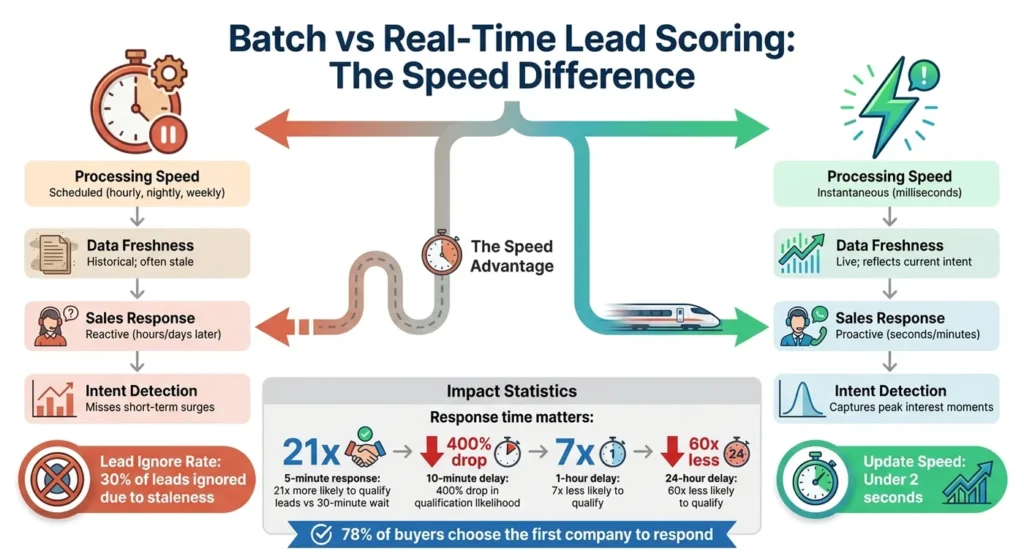
- Speed is critical: Companies responding to leads within 5 minutes are 21x more likely to qualify them than those waiting 30 minutes.
- Behavior-driven insights: Real-time systems track hundreds of actions, like visiting pricing pages, to identify high-intent leads with 85–92% accuracy.
- Higher conversions: Businesses using real-time scoring see MQL-to-SQL conversion rates jump from 13–21% to 35–52%.
- Shorter sales cycles: Sales cycles can shrink by 15–25%, letting teams focus on leads ready to buy now.
Real-time scoring works by integrating with tools like HubSpot or Salesforce, updating scores in under two seconds, and notifying sales teams immediately. This ensures faster responses, better prioritization, and more closed deals. If your team is still relying on outdated batch scoring, you’re likely losing leads to faster competitors.
Dynamic Scoring tracks real time engagement to close more sales
sbb-itb-645e3f7
Problems with Delayed Lead Scoring
How Response Delays Hurt Conversions
The numbers don’t lie: 82% of consumers expect a response within 10 minutes, yet the average B2B company takes a staggering 42 to 47 hours to respond. This delay isn’t just inconvenient – it’s costly.
Every minute of delay chips away at your lead’s interest. For instance, the likelihood of qualifying a lead drops by 400% when the response time increases from 5 to 10 minutes. Stretch that delay to an hour, and your chances of qualification plummet to nearly 7 times less likely. By the time 24 hours pass, you’re looking at being 60 times less likely to qualify that lead.
“A 30-minute delay isn’t just a small hiccup – it’s basically handing your lead to a competitor.”
- Sophie Ricci, Salesso
Beyond just losing immediate opportunities, slow response times send a troubling signal to prospects. If your company takes too long during the evaluation phase, it could suggest unreliability once the deal is sealed. Adding to the issue, 55–58% of inbound leads don’t even receive a response within five business days. That’s not just a missed opportunity – it’s a complete waste of your marketing spend.
These delays highlight the inefficiencies of batch scoring and set the stage for why real-time scoring is a game-changer.
Batch Scoring vs. Real-Time Scoring
At its core, batch scoring struggles with timing. When every second counts, processing leads on a set schedule creates bottlenecks that can sink your conversions. On the other hand, real-time scoring works the moment an event happens. For example, if a prospect visits your pricing page multiple times in an hour, your sales team gets notified immediately – while the lead is still engaged and browsing your site.
| Feature | Batch Scoring | Real-Time Scoring |
|---|---|---|
| Processing Speed | Scheduled (hourly, nightly, weekly) | Instantaneous (milliseconds) |
| Data Freshness | Historical; often stale | Live; reflects current intent |
| Sales Response | Reactive (hours/days later) | Proactive (seconds/minutes) |
| Intent Detection | Misses short-term surges | Captures peak interest moments |
Batch scoring doesn’t just slow things down – it actively undermines your efforts. Leads generated through marketing campaigns often go stale before sales teams can act on them. In fact, sales reps may ignore up to 30% of leads simply because they’re outdated by the time they’re received.
How Real-Time Scoring Works
Tracking Behavior in Real-Time
Real-time scoring captures every prospect action – whether it’s visiting a pricing page, downloading a whitepaper, or clicking on an email link – and feeds it directly into the scoring engine. This eliminates delays caused by batch processing.
With each new event, scores are updated in less than two seconds. This rapid update provides your sales team with a live view of buyer intent. For instance, if a prospect checks out a competitor comparison page and then quickly reviews your pricing, the system identifies this sequence as a high-intent signal.
Modern platforms go beyond just tracking actions; they monitor engagement velocity (like a spike in website visits within a week) and detailed micro-behaviors such as scroll depth, hover time, and click speed. This helps differentiate between casual browsing and serious research.
When a prospect’s score crosses a specific threshold, the system takes immediate action. This could mean sending Slack alerts, updating the CRM, or routing the lead to your top sales rep, ensuring your team can respond within that crucial 5-minute window. This seamless flow of data prepares your entire system to act instantly, as explained further in its integration with marketing and CRM tools.
Integration with Marketing and CRM Tools
Real-time scoring seamlessly connects with your existing tools by syncing live data from marketing automation and CRM platforms. For example, it integrates with systems like HubSpot, Marketo Engage, and ActiveCampaign to pull in data on email engagement and website activity. At the same time, it works bidirectionally with CRM platforms such as Salesforce Einstein, HubSpot, and Microsoft Dynamics 365, ensuring sales teams have easy access to scores where they work most efficiently.
Additionally, tools like Clearbit, 6sense, and Apollo enhance lead profiles by supplying firmographic information and third-party intent data. For product-led growth teams, platforms like Segment, Amplitude, and Mixpanel contribute product usage data to the scoring model, helping identify key conversion points based on real user behavior.
The true strength of real-time scoring lies in orchestration tools like LeanData and Gumloop. These tools ensure that high-scoring leads are routed immediately to the right sales rep. Instead of just being a static number in a database, the score becomes a call to action – whether it’s an automated calendar link, a “call now” priority alert, or a direct handoff to your best closer.
Benefits of Real-Time Scoring
Data and Case Studies
Predictive lead scoring has been shown to boost lead generation ROI by 70% compared to older methods. But when real-time, AI-driven scoring is added to the mix, conversion rates for qualified leads jump by an impressive 300%.
Consider this: sales teams using real-time scoring closed 23% of their leads, compared to 21% for teams that didn’t use it. High-opportunity deals identified through advanced scoring achieved win rates of 35%, nearly double the 18% seen with traditional processes. On top of that, companies saw their sales cycles shrink by 25% after adopting these tools.
The productivity benefits are just as striking. By combining scoring with automated workflows that disqualify low-fit leads, sales teams reported productivity gains of 22–35%. This lets reps concentrate on high-potential prospects instead of spending time chasing leads that are unlikely to convert.
Real-time scoring also eliminates the delays tied to batch processing. This shift to instantaneous engagement ensures faster, more effective lead responses, which translates into better outcomes for sales teams.
Higher Conversions from Faster Responses
Speed matters – a lot. Rapid responses can dramatically increase the chances of qualifying a lead. Research shows the first vendor to respond wins 35–50% of sales, and 78% of buyers go with the first company to answer their inquiry.
“98% of sales teams using AI say it helps them prioritize leads better.” – Databar.ai
Real-time scoring enables these rapid responses by sending immediate alerts when a prospect meets the qualification criteria. For example, instead of waiting for an overnight batch process, a top sales rep might get a Slack notification while the prospect is still browsing pricing options. This eliminates the typical 42-hour response time many B2B companies face, allowing reps to connect with buyers at the peak of their interest.
This approach fundamentally changes how quickly and effectively interest is converted into a solid sales pipeline. By addressing delays and ensuring timely engagement, businesses can maximize every conversion opportunity.
How to Implement Real-Time Scoring
Define Scoring Criteria
Start by setting up two scoring models: one for demographic fit (e.g., job title, company size) and another for behavioral engagement (e.g., visits to the pricing page, content downloads). To identify patterns, analyze your last 50 closed-won and closed-lost deals. It’s crucial to involve sales early in the process. As the Prospeo Team wisely advises, “Scoring without sales alignment is an exercise in self-congratulation.”
Establish clear thresholds for action:
- 40+ points: Route immediately to sales.
- 15–39 points: Nurture through marketing efforts.
- Below 15 points: Keep in top-of-funnel programs for further qualification.
Incorporate score decay by reducing behavioral scores by 25% each month if there’s no activity. Exclude irrelevant prospects like competitors, partners, or existing customers (unless tracking them for upsell opportunities). For instance, Meritt, a B2B company, achieved impressive results in early 2026 by using verified data to cut email bounce rates from 35% to under 4%, tripling their pipeline from $100,000 to $300,000 weekly – without making other changes.
Avoid scoring unreliable signals like email opens or demo requests; instead, route demo requests directly to sales. By focusing on accurate, timely signals, your team can engage prospects when they’re most interested.
Once your criteria are set, the next step is selecting the right tools to capture and process these signals in real time.
Deploy Scoring and Tracking Tools
Choose marketing platforms that support real-time scoring. Tools like HubSpot, Marketo Engage, and Pardot offer both rule-based and AI-driven scoring options. For smaller teams handling fewer than 5,000 leads per quarter, a well-tuned rules-based approach with 5–7 key criteria can often outperform more complex AI solutions.
To enhance your scoring, use data enrichment tools such as Clearbit, Clay, or Apollo.io to fill in firmographic details automatically. Pair these with intent data providers like 6sense or Bombora, which track activity on third-party sites, giving you insight into prospects’ research behavior before they even land on your site. The tools you choose will directly impact your team’s ability to respond quickly – something that can make or break your competitive edge.
For teams using AI-based scoring, ensure your system has access to data from several hundred closed deals (both won and lost). Strong AI models typically achieve an Area Under the Curve (AUC) of at least 0.75, with scores above 0.85 indicating excellent predictive accuracy.
Once you’ve set up your scoring tools, integrate them seamlessly with your CRM to automate workflows.
Integrate with CRM and Automate Workflows
Connect your scoring engine to your CRM to store scores in custom lead fields and automatically alert sales teams through Slack, SMS, or mobile apps when leads cross specific thresholds. Alan Zhao, Co-founder & Head of Product & Marketing at Warmly, highlights the urgency of acting quickly: “Intent signals decay fast. A pricing page visit is most valuable in the first hour.” Reaching out to a lead within five minutes of a Marketing Qualified Lead (MQL) trigger can be up to 100 times more effective than waiting 30 minutes.
Set up tiered workflows to manage leads based on their scores:
- Hot leads (70–100 points): Route directly to sales for immediate follow-up.
- Warm leads (40–69 points): Place into active nurture sequences.
- Cold leads (below 40 points): Assign to long-term educational campaigns or suppress them from further outreach.
When implementing a new scoring property in tools like HubSpot, ensure the system retroactively evaluates historical data for consistency.
Revisit and refine your scoring model every quarter, incorporating feedback from sales to adjust point values and improve conversion rates. A well-maintained real-time scoring system can boost MQL-to-SQL conversion rates to between 25% and 45%.
Using Content and Marketing for Real-Time Scoring
Once your real-time scoring framework is in place, finding the right tools becomes essential. Content and Marketing (https://content-and-marketing.com) serves as a centralized directory designed to help businesses navigate scoring system options, CRM integrations, and conversion tools – all from one convenient platform. It simplifies the search process, offering a curated selection of solutions that can seamlessly integrate with your existing systems.
The platform organizes scoring tools into three clear categories: CRM-native systems (like Salesforce Einstein and HubSpot), dedicated scoring platforms (such as MadKudu and 6sense), and enrichment-scoring hybrids. This organization helps businesses pinpoint tools that support event streaming – capturing real-time actions like website visits, form submissions, and email clicks instead of relying on delayed batch processing.
Find Lead Scoring Systems
One standout feature of the directory is its emphasis on time decay models, ensuring that lead scores reflect current interest levels rather than outdated activity. This is crucial because, as Databar.ai highlights, buyers often make decisions within hours, not days. With 78% of buyers choosing the first company to respond to their inquiry, having a system that alerts your team to score spikes in real time can make all the difference in closing deals.
The directory also highlights platforms offering surge detection – instant notifications when a previously inactive lead suddenly becomes engaged. For businesses that lack enterprise-level CRMs, tools like RightMessage are included, which allow behavioral scores to sync directly with email platforms as custom fields. This makes real-time scoring accessible for smaller teams as well.
Other Conversion and Engagement Tools
In addition to its lead scoring resources, the directory offers tools for broader conversion strategies. These include video creation tools and influencer management services, helping businesses create more comprehensive engagement strategies. Content and Marketing also provides specialized guides for Email, Marketing, Conversion, Ads, and SEO, along with practical resources like a Sales Funnel Automation Guide and a CRM Setup for Startups guide.
The platform offers a founding member rate of $9.99/month (regularly $15.99/month) and includes a 14-day free trial. For teams just starting out, there’s even a “get started free” option that doesn’t require a credit card. These additional tools enhance the value of real-time scoring by creating engagement opportunities across every stage of the buyer journey.
Conclusion
Real-time scoring eliminates the delays that can cost you new business. With 78% of buyers going with the first company that responds, and a 30-minute delay making it 21 times less likely to qualify a lead compared to responding in 5 minutes, speed isn’t just important – it’s critical. Traditional batch scoring slows down the process, giving faster competitors the upper hand.
To implement this effectively, start by refining your CRM data and setting up clear, actionable scoring criteria. Then, link these scores to automated workflows to ensure your sales team responds within that crucial 5-minute window.
The benefits are hard to ignore. Real-time AI scoring can increase conversion rates by 30–50%, deliver 85–92% accuracy, and reduce sales cycles by 15–25%. Many businesses see ROI within just 1 to 3 months.
Think of scoring as a trigger for immediate action, not just a way to categorize leads. For example, if a previously inactive lead suddenly visits your pricing page three times in ten minutes, your team should be notified right away – not after a batch update the next day. This shift from reactive to proactive engagement turns scoring into a powerful revenue-driving tool.
To see its impact, run a 4–8 week pilot program before fully rolling it out. The ability to act while buyer intent is at its highest – rather than hours or even days later – gives you a clear edge over competitors. Real-time scoring isn’t just a tool; it’s a game-changer for businesses looking to boost conversions and turn engagement into revenue.
FAQs
What data is required to start real-time lead scoring?
To get started with real-time lead scoring, you’ll need at least six months of data and a minimum of 10 qualified conversion events for each prediction goal. This baseline ensures there’s enough historical data to build reliable scoring models.
How do I pick the right score thresholds for sales alerts?
When setting score thresholds for sales alerts, dive into your historical data to uncover what works. Look at past closed deals to spot trends in lead scores that led to successful conversions. Use these insights to fine-tune your thresholds. Once adjusted, test their effectiveness by monitoring conversion rates and revenue across various score levels. This approach helps ensure your alerts are tuned to catch the most promising opportunities.
How can I avoid false positives from noisy behavior signals?
To minimize false positives caused by noisy behavior signals, it’s essential to implement a structured behavioral scoring model. This approach combines multiple engagement factors with rules that account for signal decay over time. Prioritize clear intent indicators, such as page visits or demo requests, and assign weights based on their relevance to your goals. Regular calibration of the model is key – use metrics like recency and frequency to identify genuine interest. Additionally, applying time-based score decay ensures that outdated signals don’t artificially inflate scores.
Related Blog Posts

We research and organize marketing software around practical use cases. Product claims are included only when supported by available sources.
Read our editorial policy →Related guides

5 Best Competitor Analysis Tools for Content Marketers in 2026
Compare 5 competitor analysis tools for content marketers to uncover keyword gaps, backlinks, top pages, and new content opportunities.
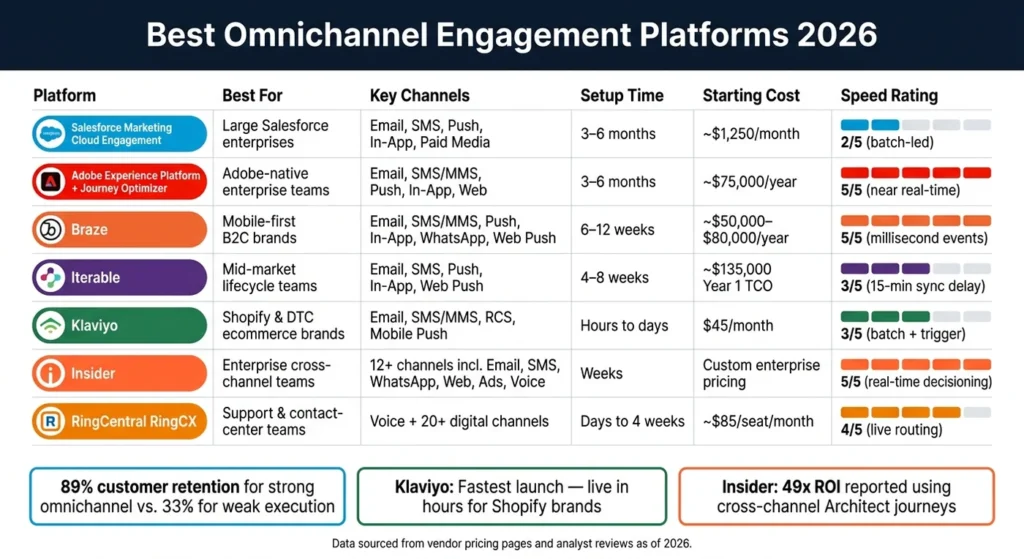
Best Omnichannel Engagement Platforms 2026
If you pick the wrong platform, you can waste months on setup and still miss the channels your team needs or fail to optimize AI based copywriting for SEO to engage them. The shortlist…
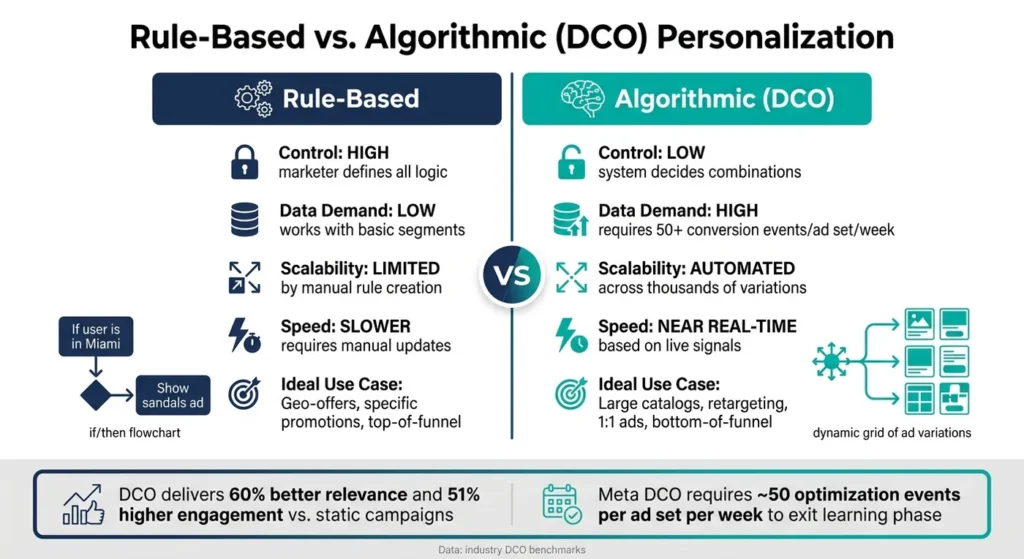
Ultimate Guide to Personalization in Display Ads
Personalized display ads can lift CTR by 34% and cut CPA by 38% when the setup is clean. My take is simple: if I want personalization to work, I need three things in place…