
This article may contain affiliate links. We may earn a commission at no additional cost to you; this does not determine our editorial conclusions.
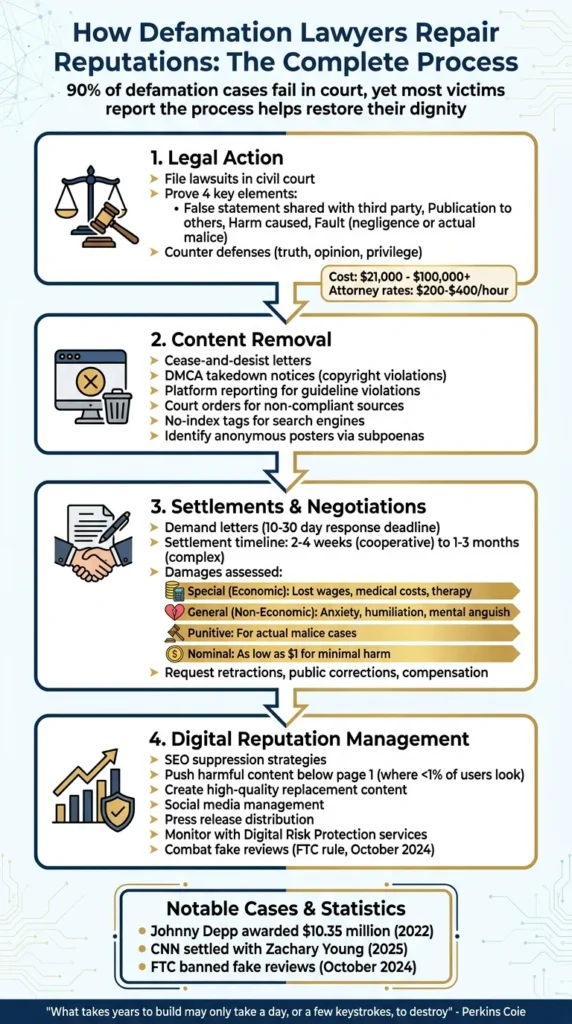
Defamation can ruin reputations almost instantly, especially online. Defamation lawyers specialize in addressing false statements that harm individuals or businesses. Their work includes:
- Legal Action: Filing lawsuits, proving defamation elements (falsehood, publication, harm, fault), and countering defenses like truth or opinion.
- Content Removal: Using legal tools (cease-and-desist letters, DMCA notices) and working with platforms to delete damaging content.
- Settlements: Negotiating resolutions through demand letters, retractions, or compensation without going to court.
- Reputation Management: Employing strategies like SEO and suppression tools to minimize the visibility of harmful content.
Even if 90% of defamation cases fail in court, many victims find the process helps restore their dignity and reputation.
Defamation: Protect Your Reputation
What Is Defamation and How Does It Cause Harm?
Defamation happens when someone makes a false statement that harms another person’s reputation. Attorney Emily Doskow explains it clearly:
“Defamation of character refers to any false statement that harms one’s reputation.”
In the U.S., defamation is treated as a civil issue, not a criminal one. To win a defamation case, the plaintiff must prove four key points: the statement was shared with a third party, it was false, it caused actual harm, and it wasn’t protected by privilege. Importantly, if a statement is true, it cannot be considered defamatory – truth is a complete defense.
The level of proof required depends on who the plaintiff is. If the plaintiff is a private individual, they need to show that the person making the statement acted negligently. Public figures, however, face a tougher standard – they must also prove actual malice, meaning the statement was made either with knowledge of its falsity or with reckless disregard for the truth. Now, let’s break down the two main types of defamation.
Libel vs. Slander: Written and Spoken Defamation
Defamation is divided into two categories: libel and slander. Libel refers to defamation in a written or permanent form, like social media posts, emails, or videos. Slander, on the other hand, involves spoken or temporary statements, such as comments made during a speech or casual conversation.
Because libel leaves a lasting record, it’s often considered more damaging and easier to prove in court. Some statements are so harmful by nature – like false accusations of criminal activity, serious diseases, professional incompetence, or sexual misconduct – that they fall under defamation per se. In these cases, damages are assumed without needing to show specific harm. For slander cases that don’t meet this threshold, plaintiffs must demonstrate special damages, such as financial losses. These differences underscore how defamation can lead to serious personal and professional consequences.
The Real Costs of Defamation
Defamation doesn’t just hurt feelings – it can cause real, measurable damage. Attorney Bryan Driscoll puts it into perspective:
“Reputational harm is more than hurt feelings. It can mean losing a job, damaging a business or straining personal relationships.”
The financial fallout can be severe. Take the example of Johnny Depp’s 2022 defamation lawsuit. A jury awarded him $10.35 million after ruling that a Washington Post op-ed contained false statements that damaged his career, costing him lucrative roles and tarnishing his reputation. Similarly, in 2025, CNN faced a defamation case from U.S. Navy veteran Zachary Young, who was falsely accused of exploiting Afghans during the 2021 U.S. withdrawal. CNN settled with Young for an undisclosed amount before punitive damages could be determined.
Beyond financial losses like lost contracts and reduced earning potential, defamation victims often endure emotional and social challenges. These can include mental health struggles like anxiety and depression, as well as damage to personal relationships. Interestingly, even though about 90% of defamation plaintiffs lose their cases in court, a study revealed that most still felt the lawsuit helped restore their dignity. This highlights the deep personal impact defamation can have, beyond just the monetary costs.
How Defamation Lawyers Build a Case
Building a defamation case involves a detailed evaluation process. Lawyers begin by examining the key legal elements: a false statement presented as fact, its publication to a third party, fault (either negligence or actual malice), and resulting damages. This initial step helps determine whether the case has enough merit to proceed.
Gathering Evidence and Initial Consultation
The first meeting with a client focuses on gathering all available evidence. Attorneys review digital records such as screenshots, emails, and text messages. As ESP Lawyers highlight:
“Documentation is crucial in any defamation case because it provides evidence to support your claim.” – ESP Lawyers
During this phase, lawyers also assess the personal and financial impact of the alleged defamation. They consider how the statement has affected the client’s career, relationships, and mental well-being. This evaluation helps determine whether the damages justify the cost of pursuing litigation.
For public figures, lawyers must establish actual malice, meaning the statement was made either knowing it was false or with reckless disregard for the truth. They also analyze jurisdiction-specific factors like the statute of limitations and anti-SLAPP laws, which protect against frivolous lawsuits. With these factors in mind, attorneys ensure that all legal criteria are met before proceeding.
Legal Requirements for Filing a Defamation Claim
To move forward, the statement in question must meet specific legal standards:
- Provably false: It cannot be an opinion, satire, or exaggeration.
- Published: The statement must have been shared with at least one other person – this includes social media posts, blog comments, or group messages.
- Fault: The defendant must have acted negligently for private individuals or with actual malice for public figures.
- Tangible harm: The plaintiff must show measurable harm, such as lost income, job termination, or significant emotional distress.
Lawyers also examine possible defenses that could undermine the case. For instance, statements made during court proceedings may be protected by privilege, or the statement might be classified as an opinion rather than a factual claim. They differentiate between statements that could reasonably be seen as defamatory and those too vague to meet legal standards.
In cases involving anonymous online posts, attorneys may consider filing a “John Doe” lawsuit to subpoena records from platforms and identify the poster. Determining the specific type of defamation claim helps refine the overall strategy.
Defamation Per Se vs. Defamation Per Quod
Once the legal requirements are established, lawyers distinguish between two types of defamation: defamation per se and defamation per quod. This classification shapes the approach to the case.
- Defamation per se: These are statements so inherently damaging that harm is presumed by law. Examples include false allegations of criminal activity, having a loathsome disease, professional incompetence, or sexual misconduct. No proof of financial loss is required.
- Defamation per quod: These statements are not obviously defamatory on their face. Plaintiffs must provide external evidence to explain the harm caused and prove specific monetary damages.
This distinction influences the type of evidence needed and the potential outcomes. Some states automatically treat certain statements as defamation per se, while others require proof of actual damages, regardless of the statement’s nature. Identifying the appropriate category early on ensures the case is built on a solid foundation.
Settling Defamation Cases Without Going to Court
Not every defamation case has to lead to a courtroom showdown. Many disputes are resolved through negotiations, which can save time, money, and the unpredictability of a trial. Typically, the process starts with a formal demand letter and involves a careful evaluation of damages to reach an agreement. Let’s break down how demand letters and damage assessments play a role in these settlements.
Using Demand Letters to Seek Resolution
A demand letter is often the first serious step toward resolving a defamation dispute. It acts as a formal notice that the plaintiff is prepared to take legal action if the issue isn’t settled. In the letter, attorneys outline the defamatory statement, explain why it’s false, and present the legal grounds for the claim. They also quantify the harm caused, detailing losses like reduced wages, medical costs for emotional distress, and harm to professional reputation. Supporting evidence – such as tax returns, pay stubs, and medical bills – may be included to back these claims. As Turley Law notes:
“A demand letter from an attorney signals you will not accept an unfair settlement.” – Turley Law
Typically, these letters include a response deadline, usually between 10 and 30 days, creating urgency and showing an effort to resolve the issue without litigation. Along with monetary compensation, the letter might also request actions like retracting the defamatory statement, removing online posts, or issuing a public correction.
Settlement timelines can vary widely. If both parties are cooperative, an agreement might be reached within 2 to 4 weeks of sending the demand letter. More complex negotiations, however, could take 1 to 3 months. When demand letters involve insurance carriers, their initial response might take 30 to 45 days. If ignored, and a lawsuit is filed, civil litigation could stretch anywhere from 6 months to over a year.
Once the response deadline passes, assessing damages becomes a key focus in negotiations.
Determining Damages for Settlement Negotiations
Evaluating damages is a crucial part of settlement discussions because it strengthens the plaintiff’s case. Damages typically fall into two main categories: special (economic) damages and general (non-economic) damages.
Special damages account for measurable financial losses, such as lost wages, reduced employment benefits (like health insurance or 401(k) contributions), and out-of-pocket expenses for therapy or online content removal. Lawyers also consider how the defamation has affected professional opportunities, such as diminished earning potential or lost business deals. As David Goguen, J.D., explains:
“Defamation plaintiffs can ask for compensation for the financial consequences that flow from their damaged reputations, including lost income, lost business opportunities, and out-of-pocket expenses.” – David Goguen, J.D., University of San Francisco School of Law
General damages, on the other hand, address less tangible harms like mental anguish, public embarrassment, anxiety, and a reduced quality of life. To make these claims more credible, it’s important to document specific physical symptoms – such as insomnia or weight loss – rather than relying on vague statements about “pain and suffering.” Medical records and therapy receipts can provide concrete evidence.
The nature of the defamatory statement also impacts the settlement value. For example, certain statements qualify as defamation per se, such as false accusations of criminal activity or professional incompetence. In such cases, the court presumes reputational harm, potentially eliminating the need to prove specific financial losses. This presumption can significantly bolster the plaintiff’s position.
Additionally, if the defendant acted with actual malice or extreme behavior, the plaintiff may seek punitive damages, which aim to punish rather than compensate. On the flip side, if the plaintiff had a poor reputation before the defamatory statement, the case might only qualify for nominal damages, which could be as low as $1.
Here’s a quick breakdown of the key damage categories:
| Damage Category | Examples Considered in Settlement | Evidence Required |
|---|---|---|
| Special (Economic) | Lost wages, 401(k) benefits, therapy costs | Tax returns, pay stubs, invoices |
| General (Non-Economic) | Humiliation, anxiety, insomnia | Witness accounts, medical records |
| Punitive | Malicious intent or fraud | Proof of “actual malice” or misconduct |
| Nominal | Minimal harm from defamation | Proof of the false statement only |
Filing a Lawsuit: When Court Action Is Required
When settlement talks fail, defamation lawyers take the next step by filing a complaint in court, officially starting the lawsuit process. From there, the case moves into the discovery phase, where both parties exchange evidence, conduct depositions, and might bring in expert witnesses to assess reputational or financial harm. This stage often reveals the strengths and weaknesses of each side’s case, and surprisingly, many defamation lawsuits are resolved during this period rather than going to trial.
The costs of litigation can range widely, from $21,000 to over $100,000, depending on how complex the case is. Attorneys usually charge hourly rates between $200 and $400, though senior lawyers may bill significantly higher rates. Before moving forward, lawyers carefully weigh whether the reputational damage justifies these expenses.
Responding to Common Legal Defenses
Once the case is underway, defendants often rely on a range of defenses, each requiring a tailored legal response. One of the strongest defenses is truth – if the statement in question is factually accurate, it completely shields the defendant, no matter how damaging the statement might be. To counter this, lawyers must gather solid evidence proving the claims are false, often by comparing the defamatory statements against verified facts and documentation.
Another frequent defense is opinion. Statements that can’t be proven true or false, such as “pure opinion” or exaggerated rhetoric, are generally protected. For example, while opinions are safeguarded, factual claims that can be verified are not. Lawyers address this by showing that the statement in question is a factual assertion, not just a subjective viewpoint.
Privilege is another hurdle in defamation cases. Absolute privilege protects statements made in judicial proceedings, while qualified privilege applies to certain official reports and legislative proceedings. However, qualified privilege can be challenged by proving actual malice – that the defendant either knew the statement was false or recklessly disregarded the truth. A notable example is the Westwood Colleges v. Friedman, et al. case in the U.S. District Court for the District of Colorado, where lawyers successfully argued that derogatory remarks about the college fell outside the protection of active litigation.
Defendants may also file anti-SLAPP motions to argue that the lawsuit is an attempt to stifle free speech. To overcome these motions, lawyers must demonstrate that the case has merit and isn’t simply a tactic to suppress lawful expression.
These defenses demand strategic and well-prepared legal responses to ensure the plaintiff’s case remains strong.
Representing Clients in Court
If settlement talks break down after discovery, the case moves to trial. At this stage, lawyers present a compelling argument to prove the statement’s falsity and the harm it caused. As Bryan Driscoll explains:
“A lawsuit can serve as a public declaration that the statement was false, helping to restore dignity and reputation.” – Bryan Driscoll
The level of proof required depends on the plaintiff’s status. Private individuals only need to show that the defendant acted negligently by failing to verify the truth of their statement. Public figures, however, face a tougher challenge – they must prove actual malice with “clear and convincing evidence”. The U.S. Supreme Court clarified this standard in New York Times Co. v. Sullivan, defining actual malice as either knowingly making a false statement or acting with reckless disregard for the truth.
During the trial, lawyers focus on the four essential elements of defamation: a false statement presented as fact, communication of that statement to a third party, fault (either negligence or malice), and resulting damages. They also need to show the statement was “of and concerning” the plaintiff, which can be established through direct references, photographs, or identifiable descriptions. Cross-examination plays a key role in challenging the defendant’s credibility and uncovering inconsistencies in their testimony.
In one notable case from 2023, the legal team at Perkins Coie achieved a rare win for a plaintiff in The Solomon Foundation v. Christian Fin. Res. (1:22-cv-00993-JRR23) in the U.S. District Court for the District of Maryland. By navigating the complexities of federal litigation, they successfully defended their client’s reputation.
Handling Online Defamation in the Digital Age
The internet has made defamation more damaging than ever, with harmful content spreading rapidly and lingering indefinitely. In response, defamation lawyers employ specialized strategies to combat these digital threats. From uncovering anonymous attackers to using federal regulations against fake reviews, these tactics are tailored to meet the demands of our online world.
Getting Harmful Content Removed from the Internet
The first step in addressing online defamation is identifying the source. Lawyers use subpoenas and digital tools to trace the origin of harmful content. Once identified, they often start with a cease-and-desist letter or an editorial inquiry, formally requesting the removal of the content.
When the original poster refuses to cooperate, attention shifts to platform administrators. Website owners, who often have editorial control, may delete content that violates community guidelines, is outdated, or has been legally expunged. Reporting content directly to hosting platforms for guideline violations is often the quickest way to secure its removal.
If these steps fail, lawyers may request no-index tags to prevent search engines from displaying the harmful URLs. In cases involving stolen images or videos, attorneys can file DMCA takedown notices based on copyright violations. As a last resort, court orders can compel platforms or individuals to remove defamatory material.
Here’s a quick breakdown of common removal methods:
| Removal Method | Description | Best Used For |
|---|---|---|
| Cease & Desist | Letter urging the original poster to comply. | Known individuals or identifiable entities. |
| DMCA Takedown | Copyright-based removal request. | Stolen photos, videos, or proprietary graphics. |
| No-Index Tag | Hides URLs from search engine results. | Sites that won’t delete but will de-index. |
| Court Order | Legal mandate to remove content. | Anonymous actors or non-compliant platforms. |
| Community Reporting | Flagging content for guideline violations. | Harassment, hate speech, or fake reviews. |
While these methods are effective, they are limited by Section 230 of the Communications Decency Act, which generally protects social media platforms from liability for user-generated content. However, this immunity does not apply if the platform actively edits or contributes to the defamatory material.
Addressing Social Media Defamation and Fake Reviews
Defamation doesn’t just come in the form of harmful posts – it also includes fake reviews and orchestrated social media attacks. In October 2024, the FTC introduced a rule explicitly banning fake consumer reviews, giving lawyers a stronger legal framework to address these issues.
FTC Chair Lina M. Khan highlighted the broader harm caused by fake reviews:
“Fake reviews not only waste people’s time and money, but also pollute the marketplace and divert business away from honest competitors.” – Lina M. Khan, Chair, Federal Trade Commission
This rule allows lawyers to target AI-generated reviews, posts from individuals with no actual experience of the business, and undisclosed insider reviews. The FTC can now impose civil penalties on violators, making it critical to report coordinated fake review campaigns to federal authorities.
Social media defamation requires swift action. Victims should document evidence by capturing screenshots, URLs, and timestamps before the content is altered or removed. Lawyers then investigate whether negative reviews stem from insider manipulation or “review farms”, both of which are now clear violations of federal law. In cases involving influencers, attorneys also analyze follower activity to identify fake engagement generated by bots.
However, it’s important to tread carefully. Using baseless legal threats to suppress legitimate negative reviews is now prohibited under federal trade rules, ensuring a fair balance between protecting reputations and safeguarding free speech.
Conclusion
Defamation lawyers play a key role in rebuilding reputations by combining legal remedies with strategic content management. Their tools include cease-and-desist letters, DMCA takedowns, court orders, and lawsuits, along with Digital Risk Protection services that help monitor and respond to harmful content swiftly.
However, legal action alone rarely solves the problem entirely. As Perkins Coie aptly points out:
What takes years to build may only take a day, or a few keystrokes, to destroy
The challenge lies in how quickly negative content gains traction. Once it starts circulating, it becomes harder to push out of search results and easier for AI tools to pick up and amplify. This is why an effective approach often pairs legal measures with broader digital strategies.
In cases where legal removal isn’t an option – such as when the content is factually accurate but damaging – SEO and suppression tactics step in. Services like those offered by Content and Marketing can complement legal efforts by creating high-quality content, managing social media, and distributing press releases. These strategies push harmful results further down Google’s rankings, into pages where less than 1% of users ever look.
FAQs
Do I have a defamation case or is it just opinion?
Whether you have a defamation case hinges on whether the statement in question is a false statement of fact that damages your reputation. In some cases, honest opinions may be protected as a legal defense. Consulting a defamation lawyer can clarify whether the statement qualifies as actionable defamation or is safeguarded as an opinion.
How fast can a lawyer get defamatory content removed from Google or social media?
The time required to remove defamatory content can vary widely depending on the circumstances. In some cases, lawyers may secure a court order to speed up the process, but even then, it’s not immediate. If the case is straightforward and uncontested, the removal might happen relatively quickly. However, legal disputes, procedural delays, or more complex issues can stretch the timeline to several months or even longer. Ultimately, the duration depends on the specifics of the case and the court’s schedule.
What should I collect as evidence before contacting a defamation lawyer?
To get ready for a meeting with a defamation lawyer, start by organizing evidence of harmful content. This could include screenshots, links, or copies of defamatory statements, along with information about where and when they were published. Also, gather proof of any damage to your reputation or other negative effects, such as lost opportunities or emotional distress. For tailored guidance, it’s best to contact a defamation lawyer directly.
Related Blog Posts

We research and organize marketing software around practical use cases. Product claims are included only when supported by available sources.
Read our editorial policy →Related guides

Black Friday Tracking Blind Spots: How Cookie Consent Affects Marketing Data and Attribution
Black Friday tracking blind spots can make campaign performance harder to interpret at exactly the time marketers need reliable data most. Ecommerce brands may see orders and leads increasing while analytics, advertising platforms, and other marketing systems provide an incomplete picture of which campaigns actually influenced those conversions. That doesn’t necessarily mean something is broken. […]

AI Marketing Video QA: A Pre-Publish Checklist for Small Teams
Check claims, product accuracy, permissions, captions and mobile readability before publishing an AI-assisted marketing video.

Meta Box vs ACF: Which WordPress Custom Fields Plugin Is Better in 2026?
Meta Box vs ACF is a common comparison when a WordPress website starts needing more flexibility than the standard post and page editor provides. Both plugins let you create custom fields, organize structured information, and build more dynamic WordPress websites without forcing everything into the main content editor. The differences become more important as the […]