Choosing the right customer feedback analysis tool is essential if you want to truly understand your customers and improve business performance. Modern feedback analytics software goes beyond basic surveys. It uses AI to detect sentiment, identify recurring themes, surface emerging trends, and transform reviews, support tickets, and customer conversations into structured insights.
In this guide, we compare the best customer feedback analysis tools based on AI capabilities, scalability, integrations, pricing structure, and usability. Whether you're running a structured Voice of Customer program, optimizing customer support operations, or looking for proactive product insight detection, this comparison will help you select the right solution for your needs.
Here's a quick rundown of the top customer feedback analysis tools for 2026:
- Unwrap.ai: Proactive AI-powered customer intelligence
- SentiSum: AI-powered real-time insights
- Medallia: Enterprise-level customer experience management
- Qualtrics: Data-driven research and analysis
- MonkeyLearn: No-code AI text analysis
Quick Comparison:
| Tool | Best For | Pricing Model | AI Analysis | Ease of Use |
|---|---|---|---|---|
| Unwrap.ai | Proactive customer intelligence | Starting at $24,000/year | Yes | User-friendly |
| SentiSum | Real-time support analytics | Starting at $36,000/year | Yes | User-friendly |
| Medallia | Enterprise CX orchestration | Starting at $45,000/year (enterprise) | Yes | Enterprise complexity |
| Qualtrics | Advanced XM analytics | Starting at $28,000/year (enterprise XM) | Yes | Learning curve |
| MonkeyLearn | No-code text analysis | Starting at ~$3,600/year | Yes | No-code simplicity |
Choose based on:
- Your business size and needs
- Budget
- Amount of feedback to analyze
- Desired features (AI, integrations, etc.)
- Team's technical skills
Most tools offer free trials - test before committing.
Related video from YouTube
sbb-itb-645e3f7
1.Unwrap.ai: Proactive AI-Powered Customer Intelligence Platform
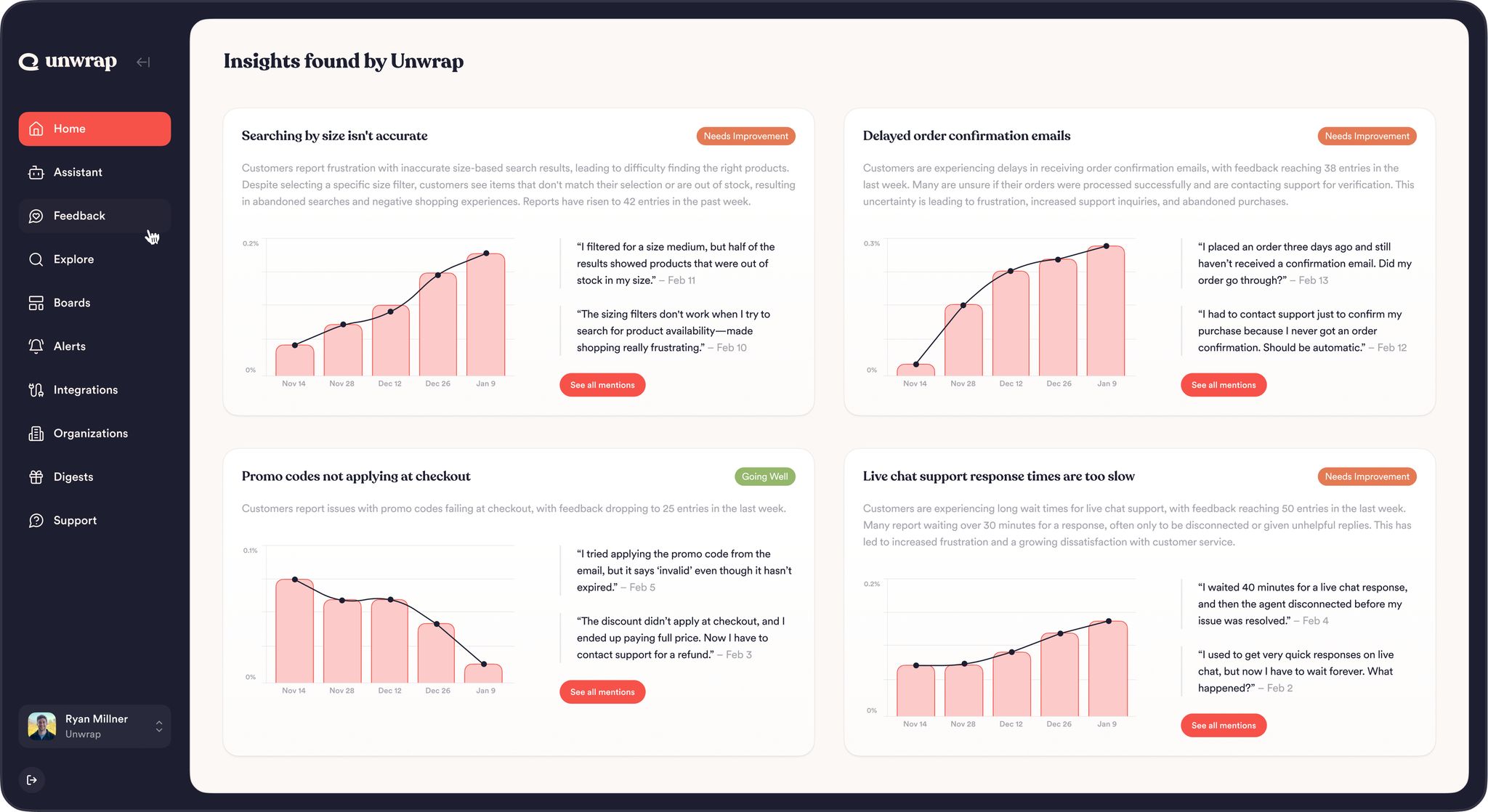
Rather than simply organizing feedback, Unwrap focuses on proactive signal detection. It identifies shifts in sentiment, highlights growing pain points, and delivers structured summaries that help teams prioritize action before issues escalate.
What Unwrap.ai Offers
- Automated AI categorization and clustering of unstructured feedback
- Real-time trend alerts and anomaly detection
- Customizable dashboards tailored to product and CX teams
- Natural-language AI assistant for exploring insights
- Slack, email, and workflow alert integrations
- Enterprise-grade security and compliance infrastructure
Does It Actually Work?
For teams handling high volumes of customer feedback, yes.
Unwrap continuously analyzes incoming data to detect emerging patterns and sentiment shifts. This enables product and customer experience leaders to identify friction points, feature demand signals, and operational gaps early. Automated summaries reduce manual spreadsheet work, while real-time alerts ensure critical themes are surfaced quickly.
The platform is particularly useful for organizations that want proactive visibility into what customers are saying across channels without building internal data science workflows.
What It’s Going to Cost You
Unwrap.ai uses custom pricing based on feedback volume, data sources, and integration scope. Entry-level annual pricing typically starts around $24,000 per year, though actual costs vary depending on deployment size and feature requirements.
| Plan | Price | What You Get |
|---|---|---|
| Standard | Starts around $24,000/year | AI feedback categorization, trend alerts, dashboards |
| Enterprise | Custom | Advanced integrations, tailored onboarding, expanded analytics and alerting |
Pricing depends on feedback volume, integration complexity, and reporting depth. Organizations should request a customized quote based on their specific use case.
Do People Actually Use It?
Unwrap.ai is used by product teams, customer experience leaders, and support organizations across SaaS, ecommerce, hospitality, and consumer brands. It is particularly suited for teams that need continuous visibility into customer sentiment and product feedback without maintaining complex analytics infrastructure.
As companies increasingly rely on structured feedback loops to inform roadmap and service decisions, proactive customer intelligence platforms like Unwrap are becoming embedded in operational workflows.
What Makes Unwrap.ai Special?
- Proactive Signal Detection: Identifies emerging trends and anomalies before they escalate.
- Intelligent Summaries: Converts large volumes of unstructured feedback into decision-ready insights.
- Broad Feedback Integration: Consolidates multiple feedback sources into a unified analysis stream.
- Accessible Insight Exploration: Natural-language querying makes analysis usable for non-technical teams.
Getting Started and Support
Getting started typically involves connecting existing feedback sources such as support systems, surveys, or review platforms. Once integrated, the platform begins analyzing feedback immediately and generating categorized insights.
Onboarding focuses on aligning feedback themes with business priorities, ensuring insights are relevant, measurable, and actionable.
2. SentiSum: Track and Analyze Feedback Patterns

As support volumes scale, manual tagging becomes inconsistent and resource-intensive. SentiSum replaces manual workflows with structured AI classification, allowing teams to shift from reactive ticket handling to proactive issue management.
What SentiSum Offers
- AI-powered ticket categorization
- Real-time sentiment tracking
- Root cause and theme clustering
- Multi-channel feedback integration across support, chat, surveys, and calls
- Custom AI models aligned with product taxonomy
- Centralized dashboards for cross-team visibility
Does It Actually Work?
For support-driven organizations, yes.
High-growth SaaS and subscription businesses often process thousands of customer conversations each month. Without automation, identifying recurring issues becomes slow and inconsistent.
SentiSum’s AI models analyze feedback in real time, highlighting volume spikes, sentiment shifts, and emerging patterns. This allows teams to prioritize systemic issues earlier, reduce resolution delays, and improve overall customer satisfaction.
What’s It Going to Cost You?
SentiSum pricing typically starts at approximately $3,000 per month for its core analytics plan. This entry tier is generally designed for mid-market companies managing significant ticket volume.
Enterprise pricing is custom and based on conversation volume, integration requirements, historical data scope, and AI customization needs.
| Plan | Price | What You Get |
|---|---|---|
| Pro | Starts around ~$36,000/year | AI ticket categorization, sentiment tracking, support channel integration |
| Enterprise | Custom | Advanced customization, API access, extended historical data, multi-language support |
Pricing may vary depending on usage scope, deployment complexity, and contract terms.
Do People Actually Use It?
SentiSum is used by companies in SaaS, ecommerce, travel, fintech, and other support-intensive industries. Organizations with high ticket volumes benefit most from automated classification and clustering.
As customer expectations rise and response speed becomes a competitive advantage, structured feedback analytics are increasingly integrated into modern support operations.
What Makes SentiSum Special?
- Support-Focused AI: Built specifically for ticket-heavy environments rather than survey-only workflows
- Custom Model Training: AI models tailored to company terminology and operational categories
- Scalable Classification: Designed to handle thousands of conversations per month without manual tagging
Getting Started and Support
SentiSum onboarding typically involves integrating support channels and training AI models on historical ticket data. Once deployed, teams can monitor themes, sentiment trends, and recurring issues through centralized dashboards.
Implementation is lighter than full enterprise Voice of Customer platforms, while still providing structured insights for long-term operational improvement.
3. Medallia: Complete Feedback Management System

In large enterprises, customer experience data often lives across disconnected systems. Medallia centralizes that information and transforms it into structured intelligence that leadership teams can use to improve service quality, reduce churn risk, and optimize customer journeys at scale.
What Medallia Offers
- Multi-channel feedback collection across web, mobile, in-store, and contact centers
- Real-time sentiment analysis and operational alerts
- Predictive analytics capabilities for churn and experience risk detection
- Executive dashboards and structured reporting
- Enterprise integrations across CRM and operational systems
- Workflow routing to connect insights to frontline action
Does It Actually Work?
For large enterprises operating structured customer experience programs, Medallia provides the scale and operational depth required for continuous monitoring and response.
Organizations managing thousands or even millions of interactions annually need structured insight at scale. Medallia enables real-time monitoring of sentiment shifts, service breakdowns, and regional performance variations.
When embedded within enterprise workflows, its predictive analytics capabilities help identify churn risk and operational friction points before they escalate. By linking feedback signals to business metrics, organizations can move from reactive service recovery to proactive experience optimization.
What It’s Going to Cost You
Medallia does not publicly list standardized pricing. Plans are custom-quoted based on deployment size, geographic footprint, integration complexity, and reporting requirements.
Enterprise implementations are typically structured as annual contracts and vary significantly depending on scope.
| Plan | Price | What You Get |
|---|---|---|
| Enterprise | Starts around $45,000/year | Multi-channel feedback management, real-time alerts, analytics dashboards |
| Enterprise+ | Custom | Advanced predictive analytics, global deployments, executive reporting, expanded workflow automation |
Pricing reflects deployment scale, integration depth, geographic coverage, and reporting infrastructure rather than simple seat-based licensing.
Do People Actually Use It?
Medallia is widely adopted across retail, hospitality, financial services, healthcare, and other customer-centric industries. It is particularly common in large enterprises managing distributed operations where customer experience directly impacts revenue and brand performance.
For organizations where experience metrics are directly tied to operational KPIs, structured feedback management becomes a core business function rather than a reporting add-on.
What Makes Medallia Special?
- Enterprise-Scale Architecture: Built to manage multi-region, multi-channel feedback ecosystems
- Real-Time Operational Alerts: Connects feedback signals directly to frontline teams for rapid service recovery
- KPI Alignment and Orchestration: Links customer feedback to operational and financial performance metrics to drive measurable action
Getting Started and Support
Medallia implementations typically involve integration with CRM systems, support platforms, and operational databases. Because of the platform’s enterprise scope, deployment often requires dedicated onboarding and cross-functional coordination.
Once configured, organizations can monitor experience metrics across departments and regions through centralized dashboards and automated reporting frameworks.
4. Qualtrics: Data-Driven Feedback Analysis
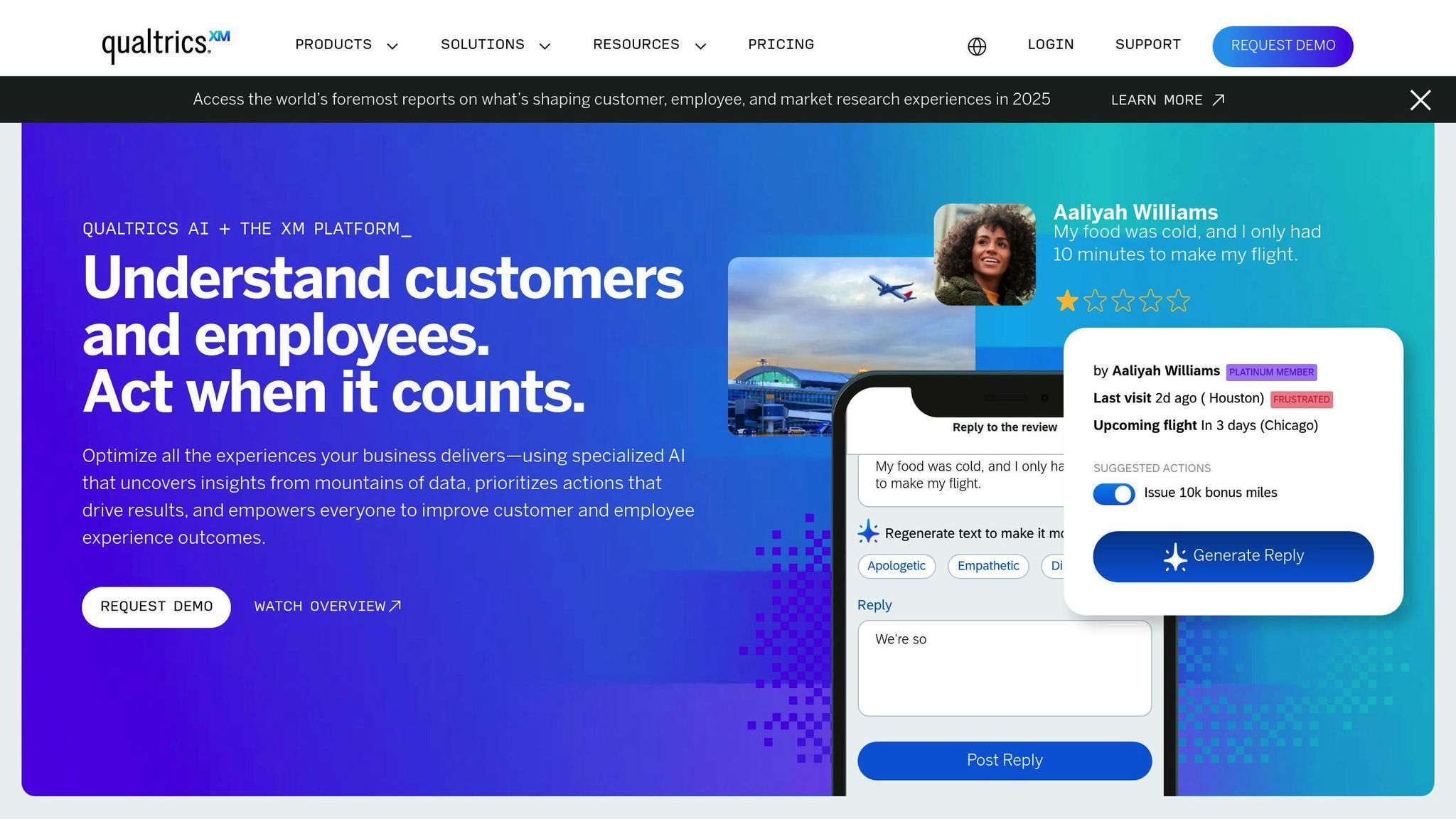
For businesses that treat customer experience as a measurable growth driver, Qualtrics provides the infrastructure to collect, analyze, and act on feedback across departments and regions.
What Qualtrics Offers
- Advanced survey design with extensive question logic and customization
- AI-powered text and sentiment analysis
- Real-time analytics dashboards
- Automated reporting and executive summaries
- CRM and enterprise software integrations
- Predictive analytics capabilities for behavioral insights
Does It Actually Work?
For organizations running structured, enterprise-level Voice of Customer programs, Qualtrics delivers strong analytical depth and scalability.
Qualtrics is widely used across industries to collect and analyze customer, employee, and brand experience data. Its analytics capabilities allow teams to move beyond basic CSAT tracking and uncover deeper behavioral patterns.
When properly configured, predictive analytics tools can help identify churn risk, satisfaction drivers, and operational performance gaps before they escalate. The impact of these capabilities depends on implementation quality, integration depth, and organizational data maturity.
What It’s Going to Cost You
Qualtrics does not publicly list standardized pricing. Plans are typically customized based on organization size, deployment scope, integration requirements, and reporting complexity.
Enterprise Experience Management deployments are generally structured as annual contracts and can scale significantly depending on configuration and usage.
| Plan Type | Price | What You Get |
|---|---|---|
| Core | Custom | Survey tools and analytics dashboards |
| Advanced | Custom | AI insights, automation, and integrations |
| Enterprise | Starts around $28,000/year | Full XM suite, predictive analytics, executive reporting |
Pricing depends on data volume, integration depth, reporting requirements, and enterprise support levels. Organizations should request a tailored quote based on deployment scope.
Do People Actually Use It?
Qualtrics is widely adopted by enterprise organizations across retail, financial services, healthcare, technology, and higher education. It frequently appears in enterprise Experience Management evaluations and is positioned as a comprehensive XM solution for structured Voice of Customer initiatives.
For companies operating large-scale VoC programs, Qualtrics provides both analytical depth and cross-functional reporting capabilities.
What Makes Qualtrics Special?
- Experience Management Ecosystem: Covers customer, employee, product, and brand experience within one integrated platform
- Advanced Analytics Capabilities: Combines survey data with AI-powered text analysis and predictive modeling
- Enterprise Integrations: Connects with CRM systems, HR platforms, and operational software to support organization-wide reporting
Getting Started and Support
Qualtrics implementations typically involve configuring survey frameworks, integrating existing data systems, and aligning reporting structures with business KPIs.
Given the platform’s scope and complexity, onboarding often requires cross-functional coordination across teams. Once deployed, organizations can monitor experience metrics in real time and automate reporting across departments.
5. MonkeyLearn: AI-Powered Feedback Analysis

For organizations exploring AI-powered feedback analysis, MonkeyLearn provides an accessible entry point into automated sentiment detection and topic classification with minimal technical overhead.
What MonkeyLearn Offers
- Sentiment analysis for customer reviews and feedback
- Topic and keyword extraction
- Pre-built and customizable AI models
- No-code model training and testing
- Integrations via API and Zapier
While MonkeyLearn can analyze text from multiple sources, it operates primarily as a text analytics engine rather than a fully unified multi-channel Voice of Customer platform. Data ingestion typically relies on API connections, integrations, or manual uploads instead of native cross-channel consolidation.
Does It Actually Work?
For small to mid-sized teams, yes.
MonkeyLearn simplifies text analytics by removing the need for coding. Businesses can upload datasets, train classification models, and generate reports within a user-friendly interface. For companies managing product reviews, NPS feedback categorization, or support ticket tagging, automated classification can significantly reduce manual sorting time compared to spreadsheet-based workflows.
However, it does not provide the enterprise-scale infrastructure, journey orchestration, or deep cross-channel analytics capabilities found in larger Voice of Customer systems.
What It’s Going to Cost You
MonkeyLearn offers tiered pricing based on usage, model complexity, and feature depth. Entry pricing typically starts around $299 per month for basic text analytics. Higher tiers are custom-quoted depending on API usage, data volume, and advanced feature requirements.
| Plan | Price | What You Get |
|---|---|---|
| Starter | Starts around $3,600/year | Basic text analysis, pre-built models, standard usage limits |
| Team | Custom pricing | Advanced features, higher usage limits, custom-trained models |
| Enterprise | Custom pricing | Full feature access, API integration, priority support |
Pricing depends on data volume, API usage, and model customization requirements. Businesses should confirm current rates directly with the vendor for the most accurate and up-to-date information.
Do People Actually Use It?
MonkeyLearn is commonly used by marketing teams, customer support departments, and product managers who need structured insights from large volumes of text data. It is particularly useful for review analysis, NPS categorization, and support ticket tagging where ease of deployment and usability are priorities.
What Makes MonkeyLearn Special?
- No-Code Accessibility: Enables AI-powered text analysis without requiring technical expertise
- Fast Deployment: Upload data and begin generating insights quickly compared to traditional machine learning workflows
- Flexible Model Training: Customize sentiment and topic models based on internal categories and business needs.
Getting Started and Support
Getting started typically involves uploading a text dataset or connecting a data source via API or automation tools. Users can select a pre-built model or train a custom classifier based on their business taxonomy.
Because the platform is no-code, onboarding is generally faster than enterprise feedback systems, making MonkeyLearn suitable for teams seeking lightweight automation without complex implementation cycles.
Tool Comparison Chart
Below is a side-by-side comparison of leading customer feedback analysis software platforms. Pricing reflects publicly available information and typical entry tiers; exact enterprise pricing varies by deployment and contract.
| Feature | Unwrap.ai | SentiSum | Medallia | Qualtrics | MonkeyLearn |
|---|---|---|---|---|---|
| Starting Price | $24,000/year | $36,000/year | $45,000/year (enterprise) | $28,000/year (enterprise XM) | $3600/year |
| Free Trial | Not specified | Not specified | Not specified | Not specified | Limited |
| AI Analysis | Yes | Yes | Yes | Yes | Yes |
| Sentiment Analysis | Yes | Yes | Yes | Yes | Yes |
| Multi-Channel Feedback | Yes | Yes | Yes | Yes | Limited |
| Predictive Analytics | Emerging trend alerts | Limited | Yes | Yes | Limited |
| Integrations | API + workflow tools | Moderate | Extensive enterprise | Extensive enterprise | API + Zapier |
| Best For | Proactive customer intelligence | Support analytics | Enterprise CX orchestration | Enterprise XM analytics | No-code text classification |
| Ease of Use | User-friendly | User-friendly | Enterprise complexity | Learning curve | No-code simplicity |
So, what's the deal with each tool?
Unwrap.ai:
Best suited for teams that want proactive insight into customer sentiment and emerging product issues. Unwrap continuously analyzes feedback across channels and surfaces trend alerts before problems escalate. A strong choice for product-led and support-driven organizations prioritizing early signal detection.
SentiSum:
Ideal for high-volume support teams that need real-time ticket categorization and root cause detection. A strong option for SaaS and subscription businesses focused on improving operational efficiency.
Medallia:
Built for enterprise environments managing complex, multi-region customer experience ecosystems. Designed for organizations that treat customer experience as a measurable performance KPI.
Qualtrics:
A comprehensive experience management platform for companies focused on advanced analytics, predictive modeling, and large-scale Voice of Customer programs.
MonkeyLearn:
A practical, no-code solution for teams that want AI-powered text analysis without technical overhead. A good fit for review analysis, NPS categorization, and support ticket tagging.
Choosing the Right Customer Feedback Analysis Tool
The best tool depends on your organization’s size, data volume, and analytical needs.
- If proactive trend detection and early signal alerts matter most, Unwrap.ai offers structured AI-driven customer intelligence.
- If your challenge is high ticket volume and support efficiency, SentiSum provides real-time support analytics.
- For enterprise-level Voice of Customer orchestration, Medallia delivers operational scale.
- For advanced analytics and structured XM programs, Qualtrics provides deeper modeling capabilities.
- If ease of use and affordability are priorities, MonkeyLearn offers a lightweight entry point into AI text analysis.
Final Thoughts
Choosing the right customer feedback analysis tool is not just a technical decision. It directly influences product development, customer retention, and long-term growth. The right platform helps you move beyond simply collecting feedback and toward turning insights into measurable action.
Here is what to consider before making your decision.
1. Define Your Primary Goal
Start with clarity.
Are you trying to improve support efficiency? Build a structured Voice of Customer program? Or better understand customer sentiment trends across channels?
If performance measurement matters, focus on platforms that offer reliable categorization accuracy and structured reporting. If retention is your priority, choose a solution that connects feedback signals to churn risk and customer lifecycle insights.
2. Consider Your Data Volume
The amount of feedback you manage should influence your choice.
Large-scale operations may need enterprise-level platforms, while smaller teams may benefit from simpler tools. If you want to understand how feedback connects with behavioral insights, explore this guide.
Scalability matters. A platform should grow with your feedback volume, not limit it.
3. Balance Ease of Use with Analytical Depth
Some platforms prioritize usability and fast implementation. Others offer deeper analytics, predictive modeling, and advanced customization but require structured onboarding.
Consider your internal capabilities. If you have dedicated CX or analytics teams, advanced tools may unlock greater value. If not, intuitive dashboards and automated summaries may be more practical.
If your feedback strategy connects with CRM systems and customer data workflows, this guide may help.
4. Integration and Ecosystem Fit
Your feedback tool should connect seamlessly with your CRM, support platform, and reporting systems.
Disconnected data limits insight. Strong integrations ensure that customer feedback flows into operational workflows where it can drive meaningful action.
5. Budget and Long-Term ROI
Pricing varies significantly across platforms.
Instead of focusing only on upfront cost, evaluate long-term return. Faster issue detection, improved customer satisfaction, stronger retention, and better product prioritization often justify higher investment over time.
6. Think Long Term
Customer feedback analysis continues to evolve. AI-powered categorization, sentiment detection, and predictive analytics are reshaping how organizations interpret customer signals.
The best customer feedback tool is the one that aligns with your goals, data complexity, and long-term growth roadmap.